The Rise of Invisible Innovation: Technologies Working Behind the Scenes
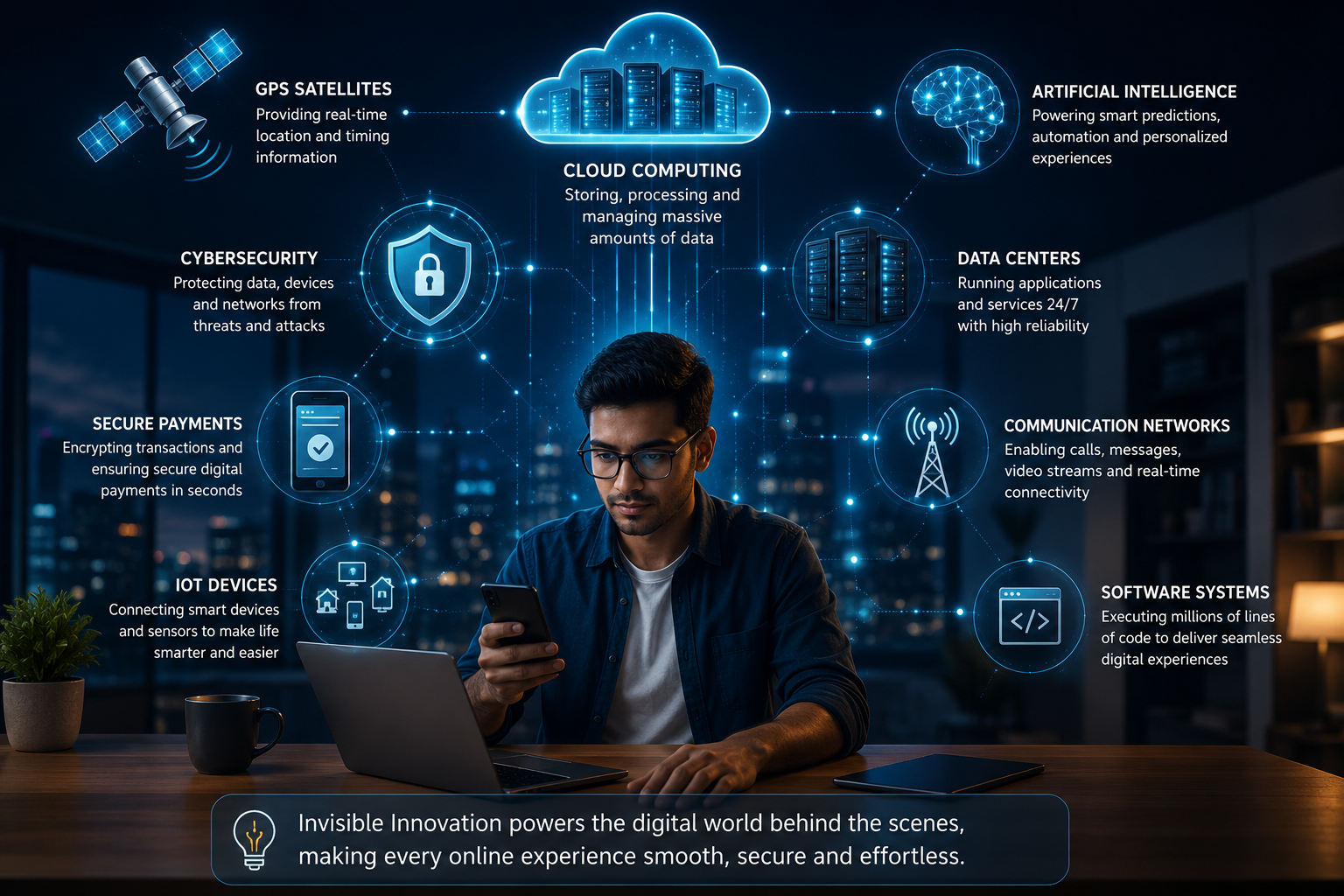
Invisible Innovation is quietly transforming modern life, even though most people rarely notice it. From cloud computing to artificial intelligence, these hidden technologies power countless everyday experiences behind the scenes. Technology is often associated with the devices we can see and touch. Smartphones, laptops, smartwatches, and voice assistants have become symbols of the digital age because they are visible parts of our everyday lives. Whenever a new gadget is launched, it captures headlines, generates excitement, and becomes the face of technological progress.
Yet the most influential innovations of the modern world rarely receive that kind of attention. They do not sit on our desks, fit inside our pockets, or appear in advertisements. Instead, they work quietly behind the scenes, performing millions of complex operations every second without asking for recognition. They are invisible, but they have become essential to almost every aspect of daily life.
Every time you unlock your phone with facial recognition, dozens of intelligent systems verify your identity in milliseconds. When you open a navigation app, satellites, cloud servers, live traffic analysis, and artificial intelligence work together to calculate the fastest route before you even begin driving. A simple tap to make a digital payment activates secure banking networks, fraud detection systems, encrypted communication, and real-time transaction processing all within a few seconds.
Most people never think about these invisible systems because they are designed to disappear into the background. Their success is measured not by how noticeable they are but by how effortlessly they perform their jobs. The smoother the experience feels, the less attention people pay to the technology making it possible.
This quiet transformation represents one of the defining characteristics of modern innovation. Instead of building technologies that constantly demand attention, engineers are increasingly creating systems that remove complexity, automate routine tasks, and make digital experiences feel almost effortless. The future of technology may therefore be defined not by devices we admire but by intelligent systems we rarely notice.
In this article, we will explore the hidden technologies powering modern life, understand why invisible innovation matters more than ever, and discover how these silent systems are shaping the future without most people even realizing it.
Why the Most Powerful Technology Is Often Invisible
Invisible Innovation is changing the way digital services operate by removing complexity from everyday experiences while making technology more reliable, secure, and effortless. When people imagine technological breakthroughs, they usually picture futuristic robots, flying cars, or advanced artificial intelligence. While these innovations attract attention, they represent only a small part of the digital world. The technologies that have the greatest impact are often those that remain hidden from view.
Consider something as ordinary as sending a message to a friend. The process feels almost instant, yet behind that simple action, thousands of operations take place. Your message is encrypted for security, transmitted through multiple internet networks, processed by cloud servers, synchronized across devices, checked for delivery, and stored safely for future access. All of this happens within moments, without requiring any action from the user.
The same principle applies to streaming a movie, booking a flight, ordering groceries, or searching for information online. What appears to be a simple tap on a screen actually depends on a vast ecosystem of data centers, communication networks, software platforms, cybersecurity systems, and intelligent algorithms working together continuously.
This is the true meaning of invisible innovation. It focuses less on creating flashy products and more on building reliable systems that make everyday experiences smoother, faster, and more secure. People may never know these technologies exist, yet they rely on them every single day.
As technology continues evolving, the most successful innovations will likely become even less noticeable. Instead of asking people to adapt to complicated systems, future technology will quietly adapt to human needs, reducing effort while increasing convenience. In many ways, the greatest compliment for an engineer is not that users admire the technology, but that they never have to think about it at all.
The Hidden Technologies You Use Every Single Day
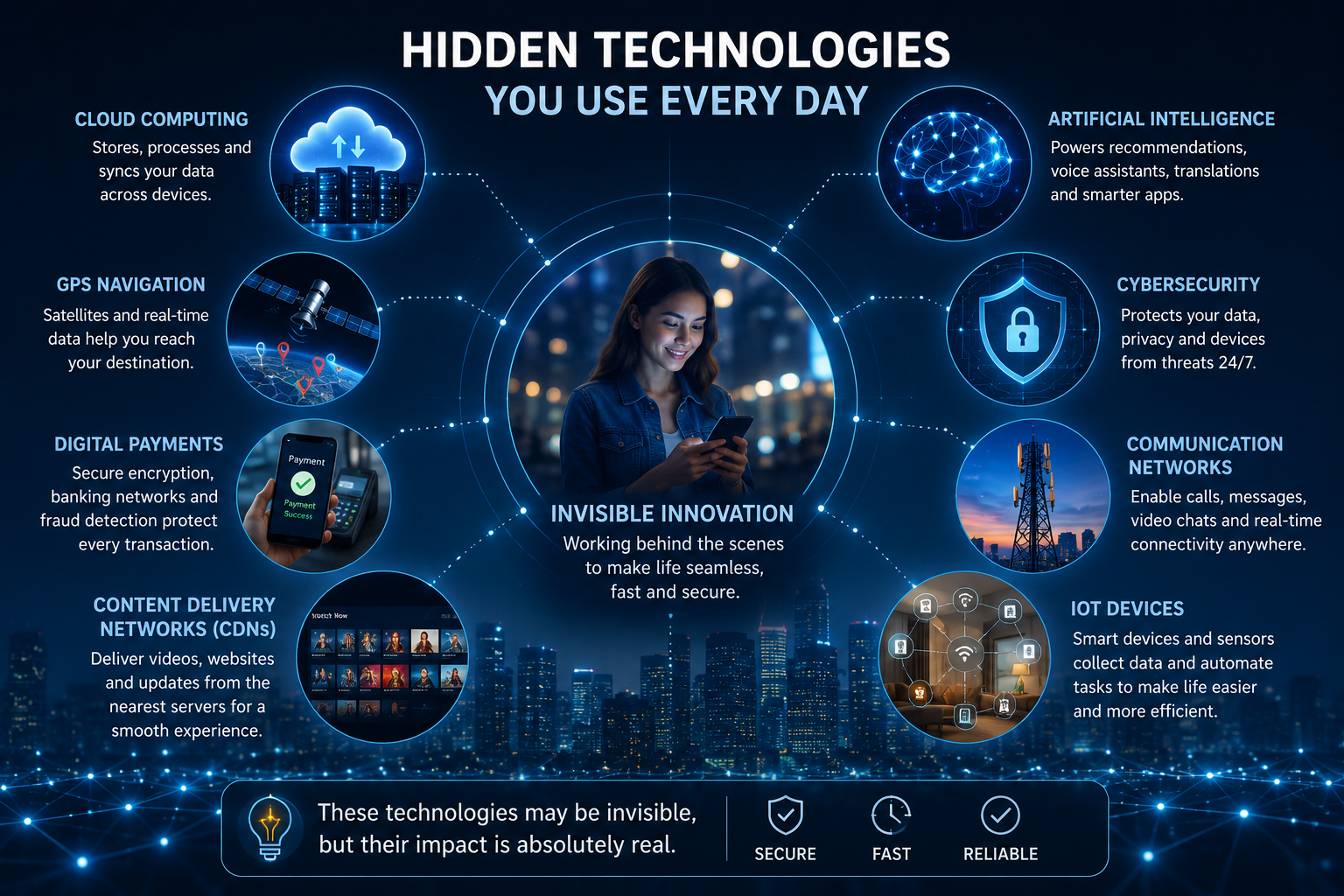
Invisible Innovation becomes most valuable when people use technology without even realizing how many intelligent systems are working in the background. Most people believe they interact with technology only when they unlock a smartphone, open a laptop, or speak to a digital assistant. In reality, the moment you wake up in the morning, dozens of invisible technologies begin working on your behalf. They organize information, protect your data, optimize services, and automate countless processes before you even realize they exist.
These systems rarely appear on screens because they were never designed to be noticed. Their purpose is to make life simpler, faster, and more reliable while remaining almost completely invisible to the people who depend on them.
One of the best examples is cloud computing. Many people think their photos, documents, emails, and messages live inside their phones. In reality, much of that information is securely stored across massive data centers located around the world. Whenever you open a document on another device, restore a backup after buying a new phone, or collaborate with someone in real time, cloud infrastructure is quietly synchronizing everything in the background. The experience feels effortless because millions of servers are constantly communicating with one another without requiring any action from the user.
Navigation provides another remarkable example of invisible innovation. When someone opens a map application and searches for the fastest route, the answer is not generated by the phone alone. GPS satellites determine the user's location, cloud platforms analyze enormous amounts of live traffic data, artificial intelligence predicts congestion, and routing algorithms calculate the most efficient journey within seconds. Drivers simply see a blue line on a map, but behind that simple visual lies one of the world's most sophisticated technological ecosystems.
Every time a football match, election result, or breaking news reaches millions of people simultaneously, global Content Delivery Networks silently distribute data across thousands of servers. Without these invisible systems, even the world's largest websites could slow down or become unavailable during moments of high demand.
Digital payments operate in a similarly invisible manner. Tapping a card, scanning a QR code, or completing an online purchase feels almost instantaneous. Behind that single action, however, encrypted communication, banking networks, fraud detection systems, identity verification, and payment gateways work together to approve or reject the transaction in just a few seconds. Consumers notice only the confirmation message, while thousands of security checks remain hidden behind the scenes.
Recommendation systems are another invisible technology that quietly influences everyday decisions. Whether watching a movie, listening to music, shopping online, or reading news articles, intelligent algorithms continuously analyze patterns to understand personal preferences. Instead of showing identical content to everyone, these systems organize information according to individual interests, making digital experiences more relevant and personalized. Most users simply assume platforms "know" what they like without realizing the complex machine learning models operating in the background.
Background synchronization is perhaps one of the least appreciated innovations of the digital era. A photograph captured on a smartphone may automatically appear on a tablet, laptop, or cloud storage service within moments. Calendars remain updated across multiple devices, notes stay synchronized regardless of where they were created, and important files remain accessible from almost anywhere. This constant coordination eliminates countless manual tasks, allowing people to move between devices without interruption.
Artificial intelligence has also become an invisible companion in modern life. Email applications automatically filter spam before it reaches inboxes. Search engines predict queries while people are still typing. Language translation occurs almost instantly during international conversations. Smartphones improve photographs automatically by adjusting brightness, reducing noise, and enhancing image quality without asking for permission. These intelligent improvements happen so naturally that many users forget artificial intelligence is involved at all.
Perhaps the most fascinating aspect of these technologies is not their complexity but their invisibility. The average person never thinks about distributed servers, encryption protocols, predictive algorithms, or intelligent synchronization while sending a message or making a payment. Another powerful example is air traffic control. Every commercial flight depends on invisible technologies that continuously monitor aircraft positions, weather conditions, flight paths, fuel efficiency, and runway availability. Passengers simply see an on-time departure, but thousands of automated calculations and real-time decisions help keep millions of people safe in the skies every day. Successful innovation quietly removes friction instead of drawing attention to itself.
As digital infrastructure continues evolving, even more services will disappear into the background. The technologies people notice today may eventually become as invisible as electricity, Wi-Fi, or running water essential systems that quietly support modern life without demanding recognition.
How Invisible Innovation Is Transforming Entire Industries
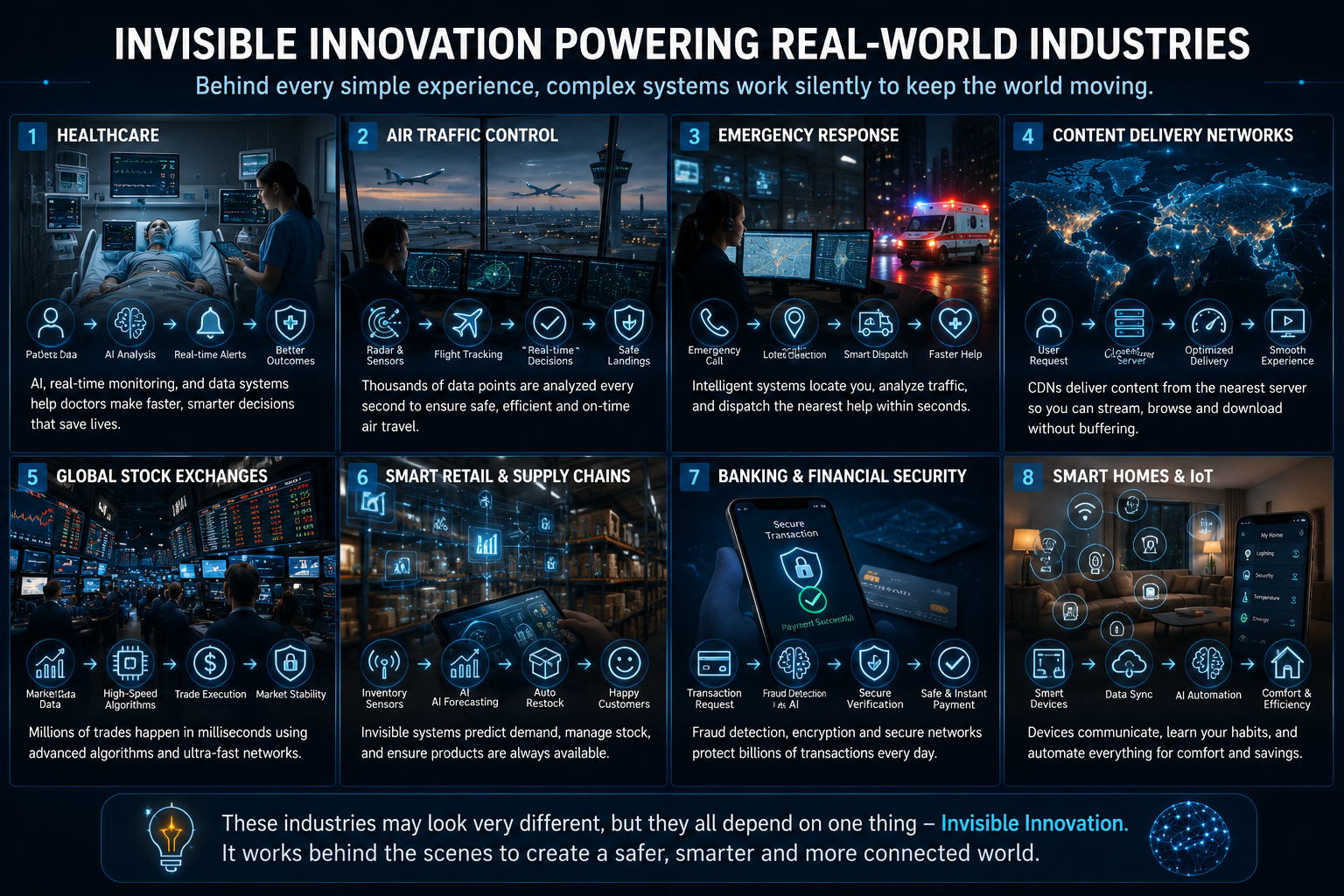
Invisible innovation is not limited to smart phones or consumer applications. It has quietly become the foundation of entire industries, changing the way businesses operate, governments deliver services, and critical infrastructure functions. In many cases, the technologies creating the greatest value are those that customers never see.
Healthcare provides one of the clearest examples. Modern hospitals increasingly rely on intelligent systems that monitor patients continuously, organize medical records, schedule appointments, and assist doctors in identifying potential health risks. Instead of spending valuable time searching through paperwork or manually updating records, healthcare professionals can access critical information almost instantly. Patients experience faster, more accurate care without realizing how many invisible digital systems are supporting every decision.
Emergency response systems provide another remarkable example of Invisible Innovation. When someone calls emergency services, intelligent software immediately identifies the caller's location, recommends the fastest available ambulance, analyzes live traffic conditions, and suggests the quickest route to the nearest hospital. These life-saving decisions often happen within seconds, long before medical teams reach the scene.
The logistics industry has undergone a similar transformation. When someone orders a product online, the package does not simply travel from a warehouse to the customer's doorstep. Artificial intelligence predicts demand, warehouse automation identifies the fastest storage location, inventory systems update stock levels in real time, route optimization software selects the most efficient delivery path, and GPS tracking continuously monitors the shipment's progress. Customers usually notice only the delivery notification, while an enormous network of invisible technologies coordinates thousands of decisions behind the scenes.
Financial institutions also depend heavily on hidden innovation. Every second, banks process millions of digital transactions while intelligent security systems analyze unusual spending patterns, verify identities, and detect potential fraud before customers notice suspicious activity. If an unusual purchase suddenly appears from another country, advanced algorithms can temporarily pause the transaction, notify the customer, and reduce financial risk within seconds. This silent protection has become one of the most valuable services modern banking provides.
Global stock exchanges also rely heavily on Invisible Innovation. Modern financial markets process millions of transactions every second using highly sophisticated algorithms, automated risk management systems, and ultra-fast communication networks. Investors usually see only changing prices on a screen, while invisible digital infrastructure quietly maintains one of the world's most complex financial ecosystems.
Modern supermarkets increasingly rely on invisible computer vision systems that monitor inventory, predict demand, and automatically trigger restocking before shelves become empty. Customers simply find products available without realizing that intelligent systems helped prevent shortages days earlier.
Transportation has become another industry shaped by unseen intelligence. Modern traffic management systems analyze vehicle movement, weather conditions, road construction, and accident reports in real time to improve traffic flow. Public transportation networks adjust schedules according to passenger demand, while airports coordinate thousands of flights using highly advanced scheduling systems. Travelers often assume these services operate smoothly on their own, yet they rely on continuous streams of invisible data working every moment of the day.
Energy infrastructure has also evolved beyond traditional power grids. Smart grids continuously balance electricity supply and demand, detect equipment failures, and distribute energy more efficiently across entire regions. Renewable energy sources such as solar and wind power introduce additional complexity because electricity production changes throughout the day. Intelligent energy management systems help maintain stability by making thousands of automatic adjustments every minute without consumers ever noticing.
Manufacturing has embraced invisible innovation through connected factories and predictive maintenance. Machines equipped with intelligent sensors continuously monitor temperature, vibration, and performance. Instead of waiting for equipment to fail unexpectedly, artificial intelligence identifies warning signs early, allowing maintenance teams to replace components before costly breakdowns occur. This proactive approach reduces downtime, improves safety, and increases productivity while remaining completely invisible to the final customer.
What connects all these industries is a common philosophy. Success is no longer measured by how impressive technology looks but by how effectively it removes complexity from people's lives. The best innovations rarely demand attention. They quietly solve problems before those problems become visible, allowing organizations to operate more efficiently while delivering better experiences to the people they serve.
This shift represents an important evolution in technological thinking. Innovation is moving away from creating products that people constantly interact with and toward building intelligent ecosystems that support everyday life automatically. The less visible these systems become, the more valuable they often prove to be. Invisible Innovation has become the invisible foundation of healthcare, banking, logistics, transportation, manufacturing, and countless other industries across the world.
Why Invisible Innovation Will Shape the Future
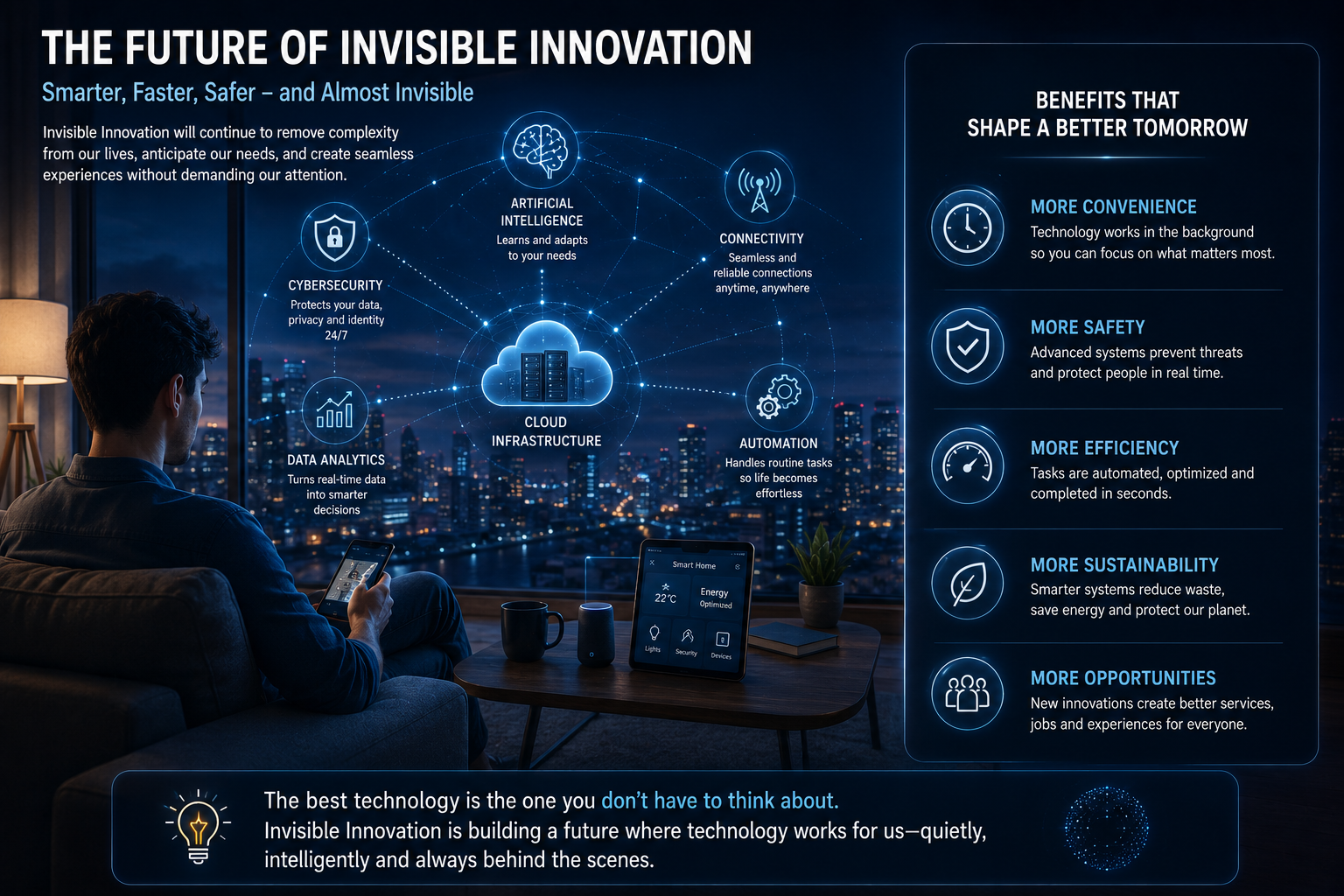
The future of Invisible Innovation will not be measured by new devices but by intelligent systems that quietly improve everyday life without demanding attention. For many years, technological progress was measured by visible breakthroughs. Faster smartphones, thinner laptops, larger displays, and more powerful processors became symbols of innovation. While these advancements certainly improved everyday life, they represented only one side of technological evolution. Increasingly, the future is being shaped not by the devices people see but by the intelligent systems they rarely notice.
Artificial intelligence is a perfect example of this transition. In its early years, AI attracted attention through chatbots, image generators, and voice assistants. Today, however, much of its real value comes from operating quietly in the background. AI filters spam emails, improves search results, detects financial fraud, predicts equipment failures, translates languages, and helps doctors analyze medical images-all without requiring users to think about the technology itself.
The same pattern is emerging across smart cities. Instead of relying solely on visible digital infrastructure, future cities will depend on interconnected systems that continuously analyze traffic patterns, energy consumption, weather conditions, emergency services, and public transportation. These systems will automatically adjust traffic signals, optimize electricity distribution, reduce water waste, and improve emergency response times. Residents may simply experience shorter travel times and more efficient public services without ever realizing that thousands of automated decisions are being made every second.
Businesses are also moving toward invisible automation. Rather than expecting employees to perform repetitive administrative tasks, intelligent software increasingly handles scheduling, document organization, inventory management, customer support, and data analysis behind the scenes. This shift allows people to spend more time solving problems, making strategic decisions, and building stronger relationships with customers instead of completing routine processes.
Imagine returning home after a long day. Before you touch a single switch, your home has already adjusted the temperature, activated soft lighting, charged your electric vehicle during off-peak hours, and optimized energy consumption based on tomorrow's weather forecast. None of these actions require commands because invisible intelligence quietly learns your daily routine.
Environmental sustainability is likely to benefit significantly from these hidden technologies. Intelligent sensors can monitor air quality, detect water leaks, optimize irrigation in agriculture, and reduce unnecessary energy consumption across entire cities. Factories may automatically adjust production to minimize waste, while smart electricity grids balance renewable energy sources more efficiently. These improvements often remain invisible to the public, yet they contribute directly to a cleaner and more sustainable future.
Perhaps the most significant characteristic of future innovation is that different technologies will no longer operate independently. Artificial intelligence, cloud computing, cybersecurity, Internet of Things (IoT) devices, edge computing, and advanced analytics will increasingly function as one connected ecosystem. Each technology contributes a different capability, but together they create digital environments that continuously learn, adapt, and improve without constant human intervention.
This evolution reflects a broader change in how innovation is measured. In the past, success often meant creating products that attracted attention. Tomorrow, success will be defined by creating systems that quietly eliminate friction from everyday life. The most advanced technology may not be the one that people admire-it may be the one they hardly notice because everything simply works.
However, this growing invisibility also introduces new responsibilities. As intelligent systems become more deeply integrated into society, issues such as privacy, transparency, cybersecurity, and ethical decision-making become increasingly important. People may not see these technologies, but they must still be able to trust them. Responsible innovation therefore requires strong governance, secure infrastructure, and clear accountability to ensure that invisible systems always serve the public interest.
Ultimately, the future of technology is becoming less about creating spectacular devices and more about designing intelligent ecosystems that quietly improve everyday experiences. Whether managing transportation, protecting financial transactions, supporting healthcare, or reducing environmental impact, invisible innovation is steadily becoming the hidden engine of modern civilization.
Looking Beyond What We Can See
When people think about technological progress, they often focus on the products they can hold in their hands. History suggests, however, that the greatest innovations are not always the most visible. Electricity transformed civilization without drawing attention to the wires behind the walls. The internet connected billions of people while remaining largely invisible beneath oceans and across global networks. Today's digital infrastructure follows the same pattern, quietly supporting modern life without demanding recognition.
Invisible innovation represents the next stage of this evolution. Rather than creating technology that constantly competes for attention, engineers are building systems that remove complexity, automate routine tasks, and improve everyday experiences while remaining almost unnoticed. This philosophy places people not technology at the center of innovation.
As artificial intelligence, cloud computing, cybersecurity, and connected infrastructure continue advancing together, invisible systems will become even more capable of supporting healthcare, education, transportation, finance, communication, and environmental sustainability. Their success will not be measured by how impressive they appear but by how naturally they improve daily life.
The future may therefore belong to technologies that most people never think about. They will not seek attention, yet they will quietly make cities more efficient, businesses more productive, healthcare more proactive, and digital experiences more secure. Behind every effortless experience will be countless invisible innovations working together with remarkable precision.
Perhaps the greatest achievement of Invisible Innovation is that success is measured by what never happens. Flights arrive safely without incident. Online videos play without buffering. Emergency responders arrive faster. Financial fraud is stopped before customers notice it. These quiet successes rarely make headlines, yet they improve billions of lives every single day.
As Invisible Innovation continues evolving, people will increasingly depend on technologies they rarely see but constantly benefit from. The most successful innovations will quietly become part of everyday life. In the end, the greatest technological revolution may not be the one we can see. It may be the one we hardly notice at all because it works so seamlessly that it simply becomes part of everyday life. Like electricity and the internet before it, Invisible Innovation is gradually becoming part of the world's essential infrastructure. The less we notice it, the more successful it has become. The technologies that shape the future may never become famous, because their greatest achievement is making extraordinary innovation feel completely ordinary.
Key Takeaways
- Invisible innovation powers much of modern life without demanding attention. From cloud computing to cybersecurity, these hidden technologies quietly support everyday activities behind the scenes.
- The most valuable technologies are often the least noticeable. Their success comes from removing complexity, improving reliability, and making digital experiences feel effortless.
- Cloud computing, artificial intelligence, GPS, digital payments, and recommendation systems work together continuously to deliver fast, secure, and personalized services.
- Entire industries rely on invisible digital infrastructure. Healthcare, banking, logistics, manufacturing, transportation, and energy management all depend on intelligent systems that operate around the clock.
- Future innovation will focus on intelligent ecosystems rather than individual devices. Connected technologies will communicate seamlessly to automate routine tasks and improve decision-making.
- Trust, cybersecurity, transparency, and privacy will become even more important as invisible technologies become more deeply integrated into everyday life.
- The future belongs to technology that quietly improves people's lives instead of constantly demanding their attention.
Invisible Innovation refers to hidden technologies that work silently behind the scenes to improve modern life. These systems include cloud computing, artificial intelligence, cyber security, GPS infrastructure, and digital payment networks.
These technologies make modern life faster, safer, and more convenient by automating complex processes behind the scenes. They reduce manual effort while improving reliability, security, and efficiency.
Common examples include: Cloud Computing, Artificial Intelligence, GPS Navigation, Digital Payment Systems, Cybersecurity, Recommendation Algorithms, Smart Energy Grids, Background Data Synchronization.
Cloud computing stores, processes, and synchronizes data across multiple devices and locations. It allows people to access files, photos, emails, and applications securely from almost anywhere without relying solely on local storage.
Artificial Intelligence silently improves many digital experiences by filtering spam emails, detecting financial fraud, recommending content, translating languages, optimizing search results, and enhancing smartphone photography without requiring user intervention.