The Silent Race Between Human Intelligence and Machine Intelligence
For centuries, intelligence has been humanity's greatest advantage. It allowed civilizations to rise from simple settlements to thriving cities, transformed curiosity into scientific discoveries, and turned imagination into works of art, literature, and technology. Every major milestone in human history began with one extraordinary ability the power to think, reason, create, and adapt.
Today, that advantage is facing an unexpected companion. Artificial intelligence is no longer limited to performing repetitive calculations or following pre-programmed instructions. It can recognize complex patterns, generate realistic content, analyze enormous volumes of information within seconds, and assist in solving problems that once demanded years of human expertise. As AI continues to evolve, the line separating human intelligence from machine intelligence grows increasingly difficult to define.
This transformation has sparked a quiet but profound race. Unlike the industrial revolutions of the past, there are no factories replacing workers overnight or dramatic moments that clearly signal change. Instead, the competition unfolds silently in classrooms where AI tutors personalize education, in hospitals where algorithms assist doctors, in offices where intelligent software automates complex tasks, and even in homes where virtual assistants learn from everyday conversations. Every day, machines become a little more capable, while humans are challenged to redefine the value of their own intelligence.
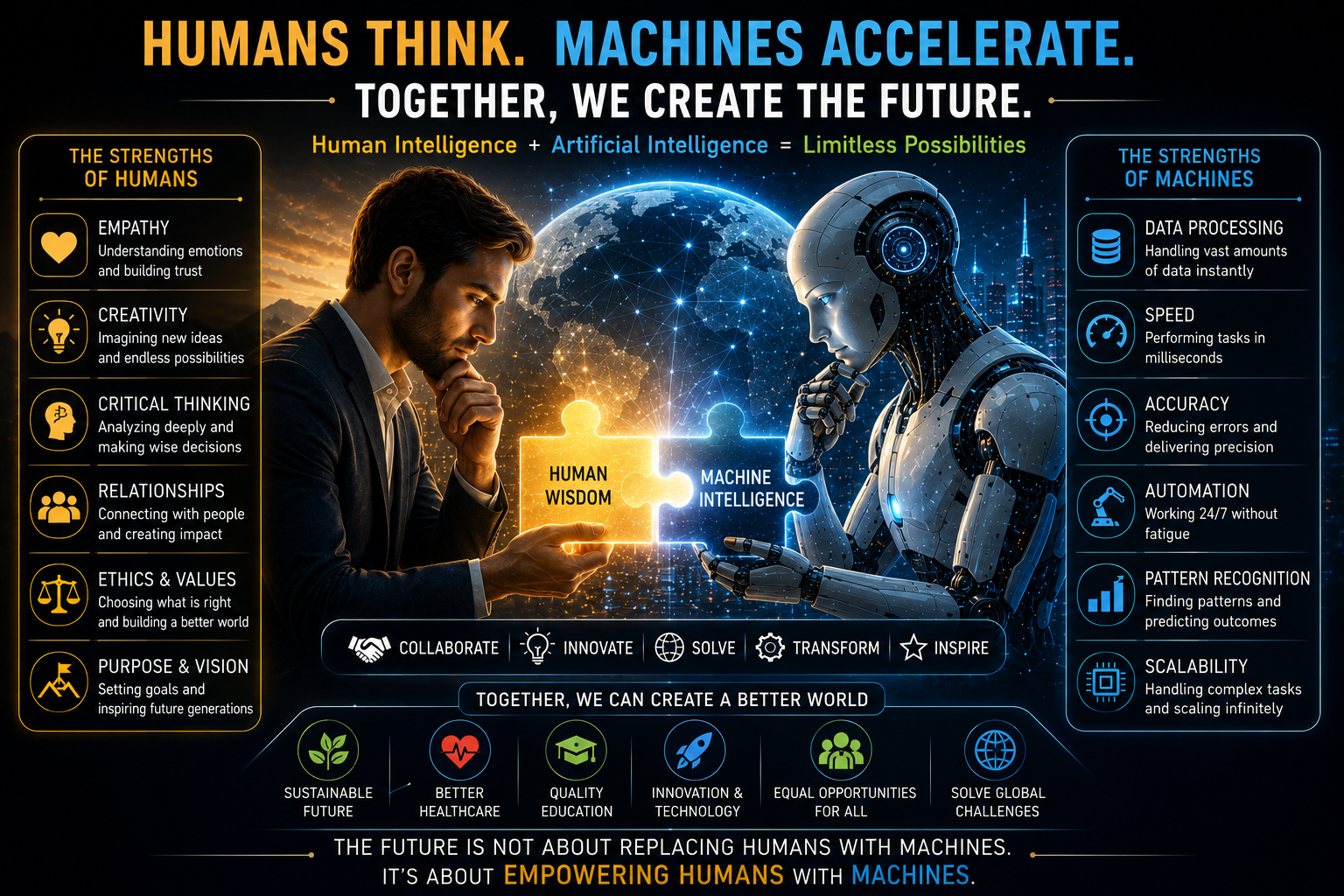
Yet describing this as a competition tells only part of the story. Human intelligence and machine intelligence are fundamentally different. One is shaped by consciousness, emotions, ethics, intuition, imagination, and lived experience. The other is built upon mathematical models, data processing, computational speed, and relentless consistency. They solve problems in different ways because they understand the world through entirely different mechanisms.
The real question, therefore, is not whether machines will become smarter than humans. It is whether humanity can learn to use machine intelligence as a partner rather than viewing it as a replacement. The future may ultimately belong neither to humans alone nor to intelligent machines alone, but to those who understand how both forms of intelligence can work together to solve challenges that neither could overcome independently.
The Rise of Machine Intelligence
Twenty years ago, artificial intelligence existed mostly in research laboratories, science fiction novels, and ambitious predictions about the future. Today, it has quietly become part of everyday life. Most people interact with AI dozens of times each day without even realizing it. From recommendation systems that suggest what to watch next to navigation apps that predict traffic, spam filters that protect inboxes, and voice assistants that answer questions instantly, machine intelligence has already woven itself into modern society.
What makes this transformation remarkable is the speed at which machines learn. Traditional computer programs could only follow instructions written by human programmers. Modern AI systems, however, improve by analyzing enormous datasets, identifying hidden patterns, and refining their performance through continuous learning. Instead of simply executing commands, they adapt, predict, and optimize.
This ability has allowed AI to enter fields once considered exclusively human. It assists scientists in discovering new medicines, helps engineers design complex systems, supports financial institutions in detecting fraud, enables autonomous vehicles to interpret their surroundings, and even contributes to creative tasks such as writing, composing music, and generating artwork. Each advancement demonstrates that machine intelligence is expanding beyond calculation into areas traditionally associated with human thinking.
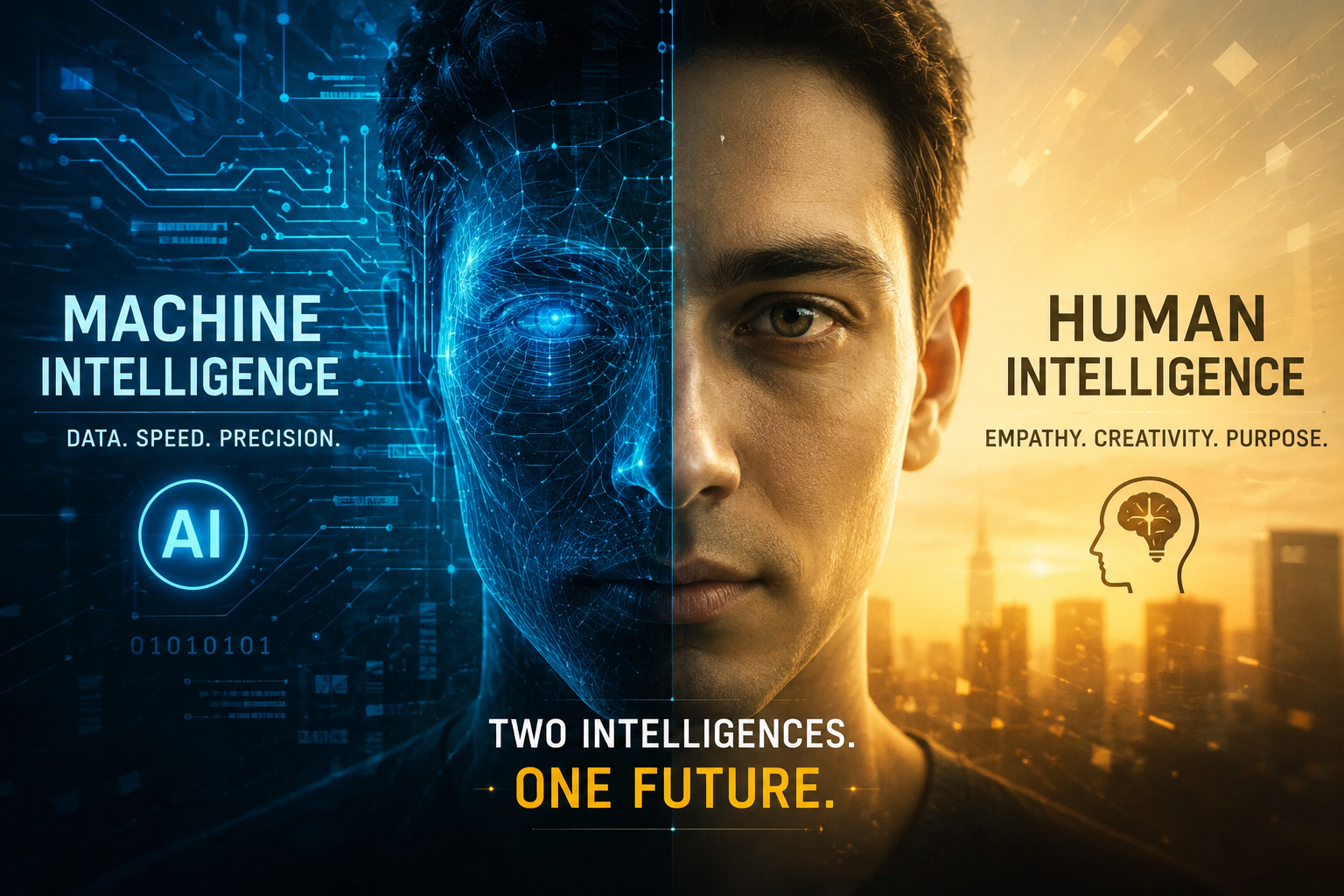
Despite these achievements, machine intelligence operates within boundaries defined by data and algorithms. It can process information faster than any human mind, but speed alone does not equal understanding. Machines recognize patterns with extraordinary accuracy, yet they do not experience curiosity, doubt, compassion, or purpose. Their intelligence is powerful, but it remains fundamentally different from the intelligence that shaped human civilization.
What Makes Human Intelligence Unique?
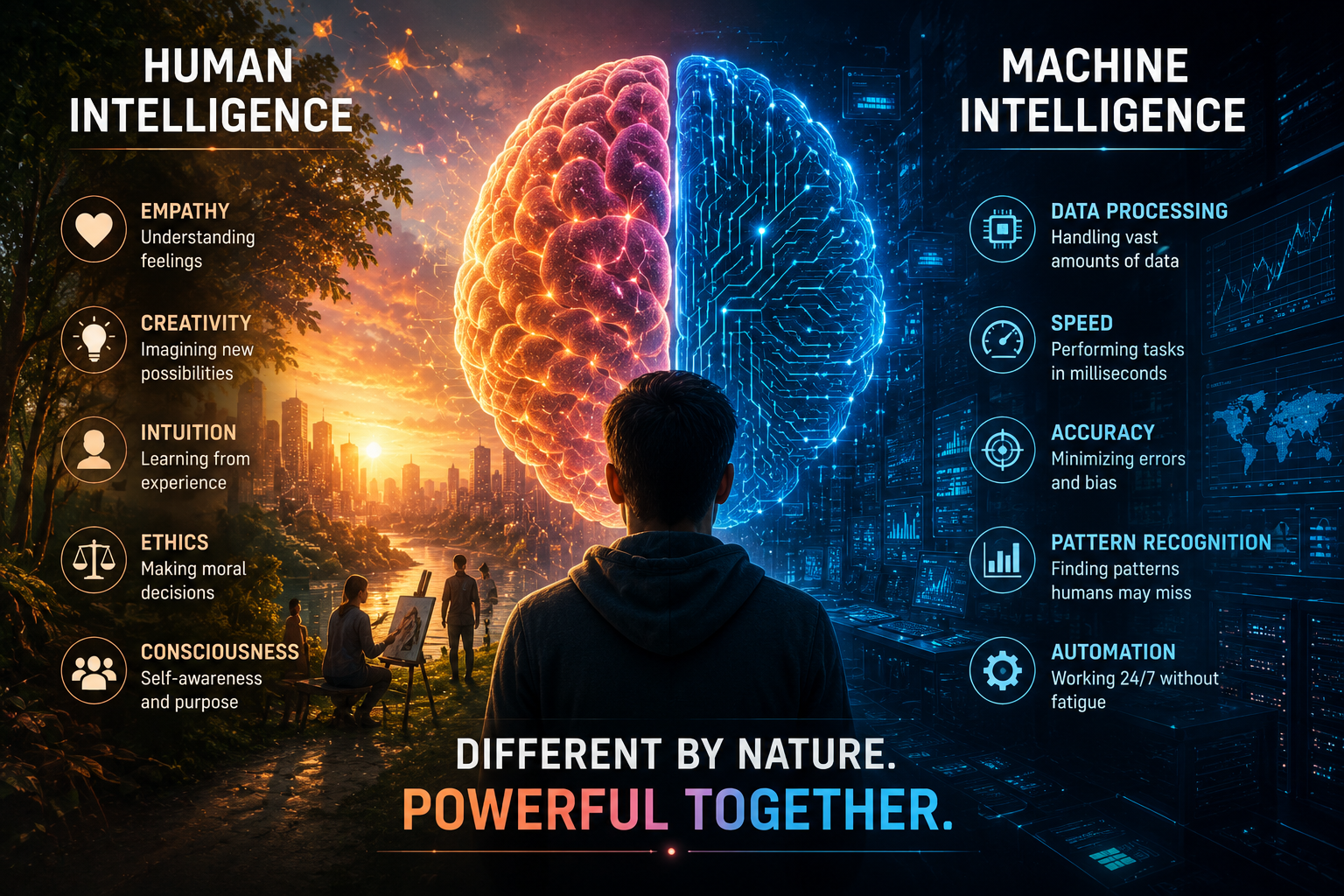
As machine intelligence continues to advance, an important question naturally arises: What still makes human intelligence different? The answer is not simply that humans think while machines calculate. The distinction runs much deeper. Human intelligence is shaped by emotions, experiences, values, relationships, and an awareness of life itself qualities that cannot be measured by processing speed or computational power.
Every human decision is influenced by far more than facts alone. People draw upon memories, cultural backgrounds, personal beliefs, intuition, and emotional understanding when making choices. A doctor comforting a frightened patient, a teacher recognizing that a struggling student needs encouragement rather than criticism, or a parent making sacrifices for a child's future demonstrates intelligence that extends beyond logic. These decisions require empathy, compassion, and moral judgment abilities that remain uniquely human.
Creativity is another defining characteristic of human intelligence. While artificial intelligence can generate impressive images, music, stories, or designs, it does so by learning patterns from existing data. Human creativity often begins where patterns end. It is capable of imagining entirely new possibilities, questioning accepted beliefs, and creating ideas inspired by dreams, emotions, curiosity, or unexpected experiences. Many of history's greatest inventions and artistic achievements were born not from existing knowledge but from the courage to think differently.
Human intelligence also possesses remarkable adaptability in unfamiliar situations. People can make decisions even when information is incomplete, uncertain, or contradictory. They often rely on instinct, life experience, and common sense when facing problems that have no clear solution. Machines, on the other hand, perform best when operating within the boundaries of the data they have been trained to understand. When confronted with situations far outside those boundaries, they may struggle in ways that humans naturally overcome.
Perhaps the greatest strength of human intelligence lies in its ability to assign meaning. A machine may recognize millions of words, but it does not truly understand love, grief, hope, courage, or purpose. It can analyze poetry but never experience the emotions behind it. It can compose music but never feel the inspiration that gave birth to a melody. Human intelligence is not merely about finding answers-it is about understanding why those answers matter.
As artificial intelligence becomes increasingly capable, these uniquely human qualities may become even more valuable. The future will not reward people simply for remembering facts or performing repetitive tasks better than machines. Instead, it will reward those who can combine knowledge with empathy, creativity, ethical thinking, leadership, and wisdom qualities that define intelligence in its fullest sense.
Can Artificial Intelligence Truly Think Like Humans?
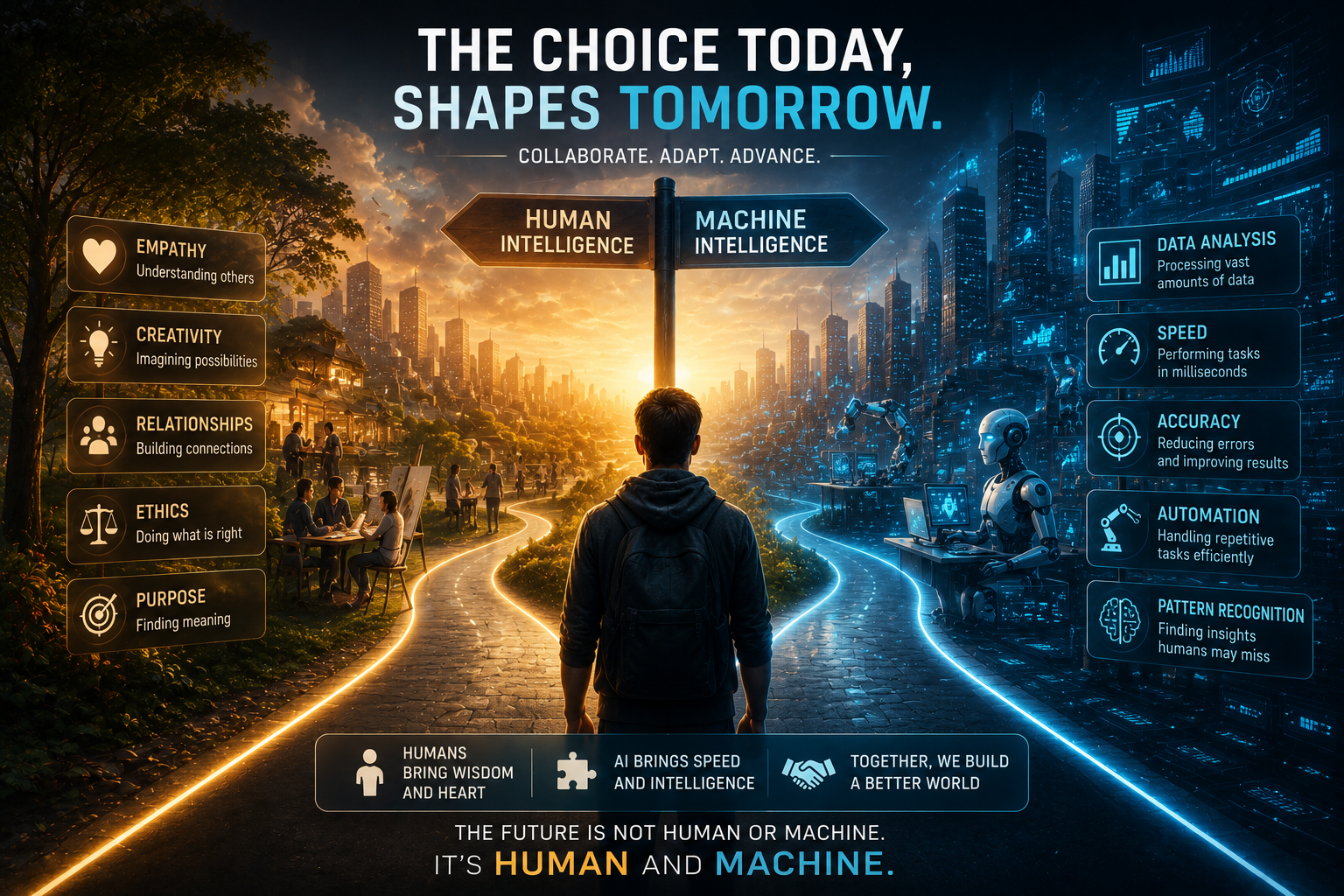
One of the most fascinating questions of the modern era is whether artificial intelligence can ever truly think like a human being. As AI systems become more advanced, they are increasingly capable of writing essays, solving complex problems, generating realistic conversations, and even producing original artwork. To many people, these abilities appear almost indistinguishable from human intelligence. But beneath this impressive performance lies a fundamental difference.
Artificial intelligence does not think in the way humans do. It processes information by identifying patterns within enormous datasets and calculating the most probable response based on its training. When an AI system answers a question or creates an image, it is not reflecting on personal experiences, forming opinions, or understanding emotions. Instead, it is using mathematical models to predict the most appropriate outcome from the information it has learned.
Human thinking follows a completely different path. Every decision people make is influenced by memories, emotions, imagination, personal values, and life experiences accumulated over years. Two individuals can witness the same event yet interpret it differently because each brings a unique perspective shaped by their own journey. Human intelligence is deeply connected to consciousness the awareness of oneself, others, and the meaning behind experiences. This is something current AI systems do not possess.
Another crucial distinction is intentional thinking. Humans ask questions because they are curious. They explore ideas because they seek purpose or understanding. Scientists investigate mysteries not only to solve problems but also because they are driven by wonder. Artists create paintings to express emotions. Writers tell stories to inspire, challenge, or connect with others. Machines, however, have no intrinsic curiosity or personal ambition. They respond when prompted, but they do not independently dream, question, or imagine a future they wish to create.
This difference becomes especially important in situations involving ethics and moral judgment. A machine can analyze countless possible outcomes in seconds, but it cannot genuinely understand compassion, justice, responsibility, or sacrifice. When faced with difficult decisions involving human lives, relationships, or values, intelligence alone is not enough. Wisdom requires empathy, conscience, and the ability to appreciate consequences beyond data qualities that remain deeply human.
As artificial intelligence continues to evolve, it will undoubtedly become more capable and more useful. Yet becoming more capable does not necessarily mean becoming more human. The strength of AI lies in its computational power and consistency, while the strength of humanity lies in consciousness, creativity, emotional depth, and the ability to assign meaning to the world. Understanding this distinction allows us to appreciate AI for what it truly is: an extraordinary tool, but not a replacement for the human mind.
The Silent Competition Already Around Us
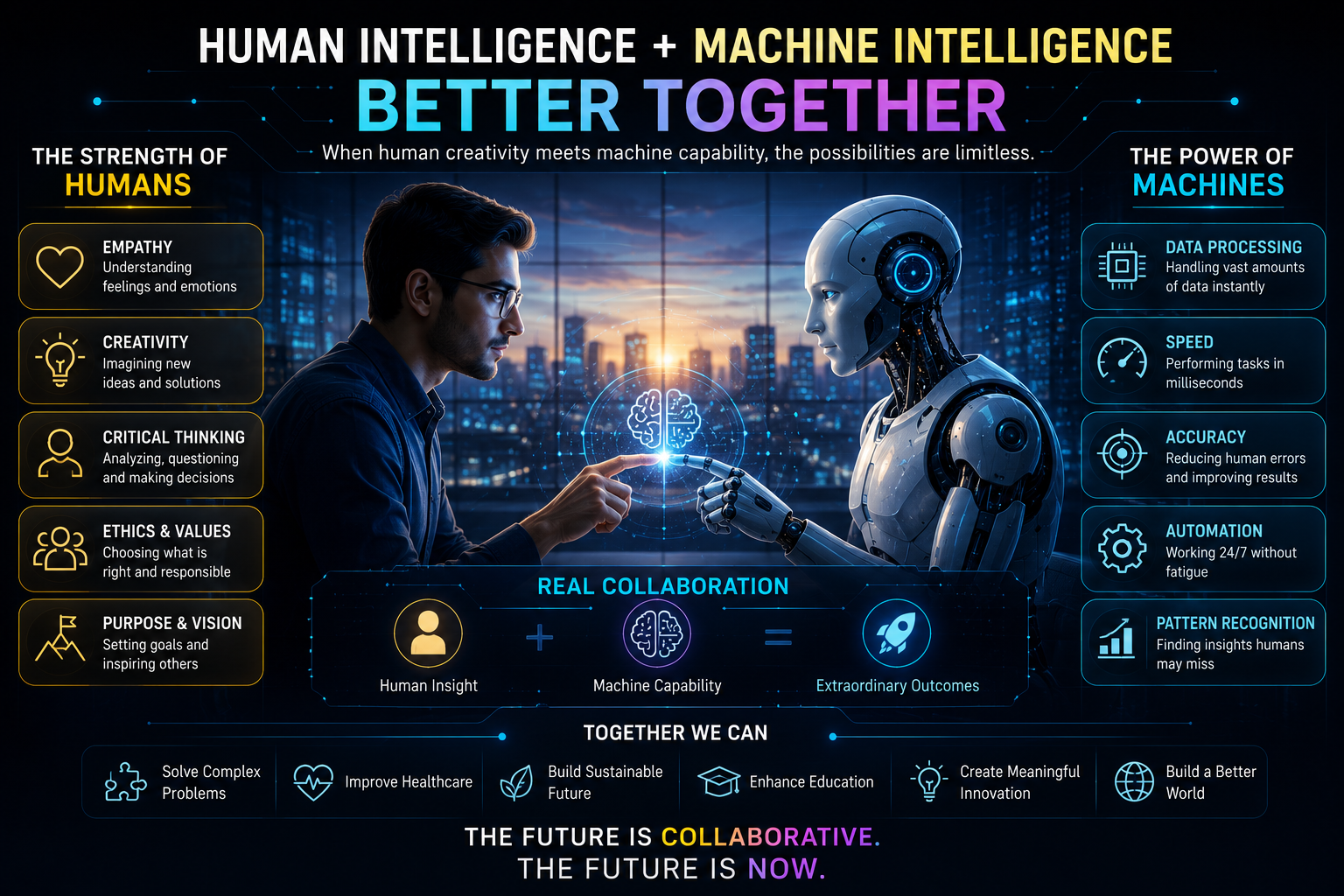
When people imagine a race between human intelligence and machine intelligence, they often picture a distant future filled with humanoid robots and fully automated cities. In reality, that competition has already begun not through dramatic events, but through thousands of small changes that quietly influence everyday life. The silent race is unfolding around us, often without us even noticing.
Consider the workplace. Tasks that once required hours of human effort can now be completed in minutes with the help of intelligent software. AI assists accountants in analyzing financial records, supports lawyers by reviewing legal documents, helps marketers understand customer behavior, and enables programmers to write and debug code more efficiently. Rather than replacing every professional, machine intelligence is steadily changing what professionals are expected to contribute. The value of simply knowing information is declining, while the ability to interpret, innovate, and make strategic decisions is becoming increasingly important.
Education is experiencing a similar transformation. Students no longer depend solely on textbooks or classrooms to access knowledge. Intelligent tutoring systems provide personalized learning experiences, answer questions instantly, and adapt lessons to individual learning styles. While this makes education more accessible, it also introduces a new challenge. If learners rely entirely on machines to think, analyze, and solve problems, they risk weakening the very cognitive abilities that education is meant to develop. The greatest benefit of AI in education comes not from replacing human thinking, but from enhancing it.
Healthcare offers another powerful example of this silent partnership. Artificial intelligence can examine medical scans, identify patterns that might escape the human eye, and assist doctors in diagnosing diseases more quickly. Yet patients rarely judge a doctor solely by diagnostic accuracy. They also value empathy, trust, reassurance, and clear communication qualities that no algorithm can genuinely provide. The most effective healthcare increasingly combines the analytical precision of machines with the compassion and judgment of experienced professionals.
Even in our personal lives, machine intelligence has become an invisible companion. It recommends what we watch, predicts what we might purchase, organizes our schedules, filters our emails, and suggests the fastest route to our destination. These conveniences save time and reduce effort, but they also encourage people to delegate more decisions to technology. Over time, this raises an important question: Are we using intelligent machines as tools, or are we gradually allowing them to shape how we think, choose, and live?
The silent race, therefore, is not simply about machines becoming smarter. It is about how human intelligence evolves in response to increasingly capable technology. Every advancement in AI challenges people to strengthen the abilities that machines cannot easily replicate critical thinking, creativity, ethical judgment, emotional intelligence, and meaningful human connection. Those who develop these uniquely human strengths will not compete against artificial intelligence; they will learn to work alongside it more effectively than ever before.
Where Humans Still Have the Advantage
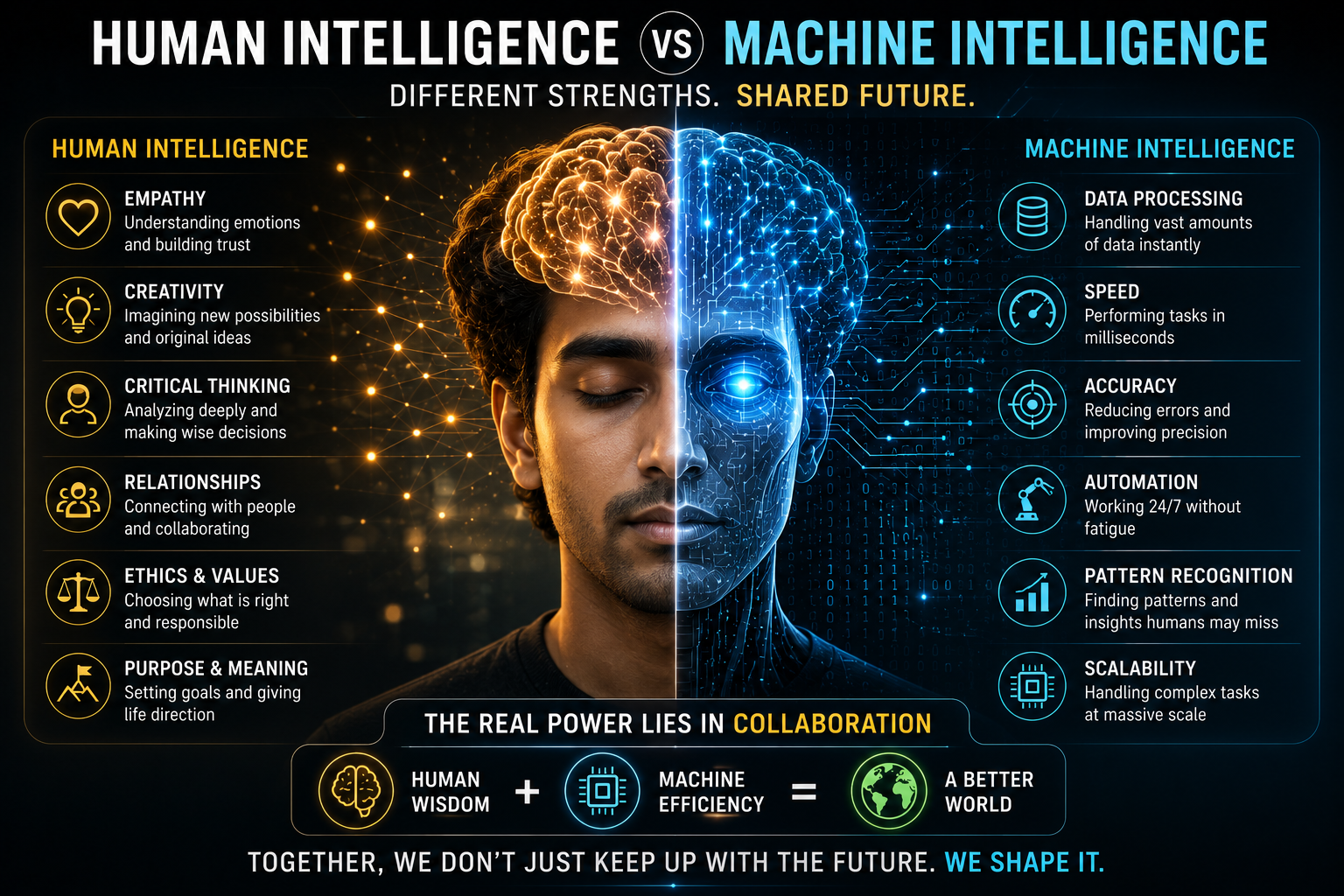
As artificial intelligence becomes faster, more accurate, and increasingly capable, many people wonder whether there will come a day when machines outperform humans in every possible field. While AI has already surpassed human performance in numerous specialized tasks, there remain areas where human intelligence continues to hold an extraordinary advantage qualities that are rooted not in data, but in consciousness, experience, and the complexity of human life.
One of the greatest strengths of human intelligence is emotional understanding. People do not simply exchange information; they build trust, offer encouragement, comfort those who are suffering, and form relationships that shape entire communities. A counselor helping someone through grief, a leader inspiring a team during difficult times, or a friend recognizing unspoken pain demonstrates a level of understanding that goes far beyond logical analysis. Machines can identify emotional patterns, but they cannot genuinely experience empathy or form authentic human connections.
Human intelligence also excels in situations where uncertainty is unavoidable. Life rarely presents perfect information or predictable outcomes. Business leaders often make decisions despite incomplete data. Emergency responders act within seconds during unpredictable crises. Scientists pursue discoveries without knowing where years of research may lead. In these moments, intuition, judgment, adaptability, and courage become just as valuable as knowledge itself. Humans possess the remarkable ability to navigate ambiguity in ways that algorithms still struggle to replicate.
Another enduring advantage lies in ethical reasoning. Technological progress constantly creates questions that have no universally correct answer. Should autonomous vehicles prioritize one life over another during unavoidable accidents? How should artificial intelligence be used in warfare? Where should society draw the line between convenience and privacy? These dilemmas cannot be solved through computation alone because they involve values, morality, responsibility, and human consequences. The answers require wisdom rather than calculation.
Creativity remains another powerful domain of human intelligence. While AI can generate music, paintings, articles, and product designs with astonishing speed, it does so by identifying and recombining patterns within existing data. Human creativity often emerges from lived experiences, personal struggles, curiosity, imagination, and the desire to express something entirely new. Many groundbreaking innovations were born not from following patterns but from challenging them. The willingness to question accepted ideas and imagine possibilities that have never existed before continues to define human progress.
Perhaps the greatest human advantage is the ability to find meaning. People seek purpose in their work, relationships, beliefs, and aspirations. They reflect on their experiences, learn from failure, celebrate achievements, and strive to leave a positive impact on future generations. Machines can optimize processes, but they cannot ask why life matters or what kind of future humanity should build. These deeply philosophical questions remain at the heart of human intelligence.
As machine intelligence continues to evolve, success will belong to those who strengthen these uniquely human qualities rather than competing with machines on their own terms. The future workforce will value individuals who combine technical knowledge with emotional intelligence, ethical leadership, creativity, adaptability, and critical thinking. These are not weaknesses to be protected they are strengths that may become humanity's greatest competitive advantage in the age of artificial intelligence.
Where Machines Perform Better
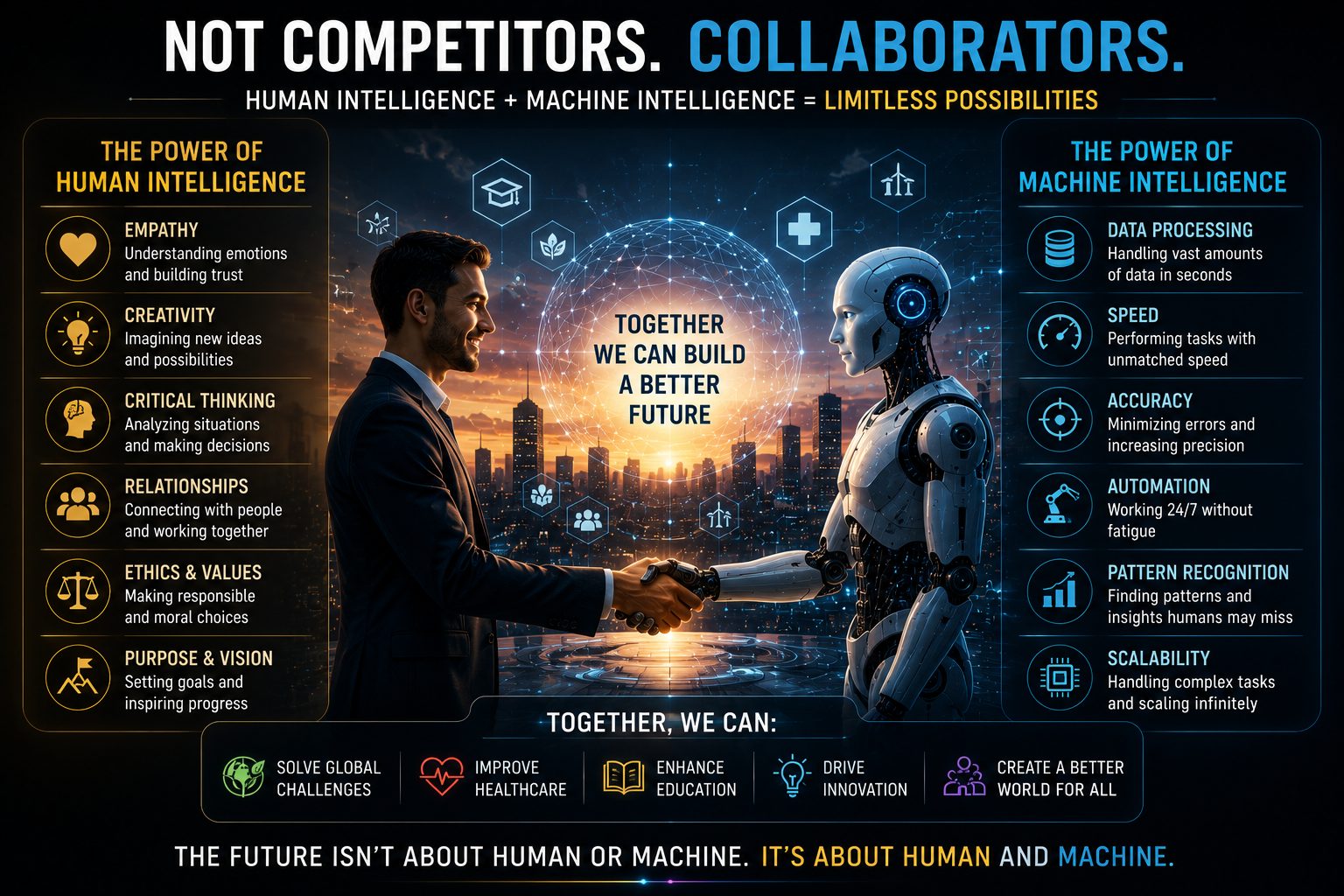
While human intelligence possesses qualities that machines cannot replicate, it would be a mistake to underestimate the extraordinary capabilities of artificial intelligence. In many areas, machine intelligence has already surpassed human performance-not because it is wiser or more creative, but because it is designed to process information with unmatched speed, consistency, and precision. Understanding these strengths helps us recognize why AI has become such a powerful force across nearly every industry.
One of the greatest advantages of machine intelligence is its ability to analyze massive amounts of data within seconds. A human researcher may spend months reviewing thousands of scientific papers or medical records, while an AI system can examine millions of data points almost instantly. This ability allows organizations to uncover hidden patterns, identify trends, and make data-driven decisions that would be nearly impossible through human effort alone.
Machines also excel at performing repetitive tasks without fatigue or loss of concentration. Humans naturally become tired, distracted, or affected by stress after long periods of work. Artificial intelligence, however, maintains the same level of accuracy whether it processes one document or one million. This consistency makes it invaluable in fields such as manufacturing, quality control, financial auditing, cybersecurity, and logistics, where even a small mistake can have significant consequences.
Another remarkable strength of machine intelligence is pattern recognition. Modern AI systems can detect subtle relationships within enormous datasets that may remain invisible to human observers. In healthcare, algorithms assist doctors by identifying early signs of diseases in medical images. In finance, they detect fraudulent transactions within milliseconds. In environmental science, AI analyzes satellite imagery to monitor climate changes and natural disasters. These capabilities enable faster and more informed decision-making across critical sectors.
Artificial intelligence is also transforming productivity by automating routine work. Businesses increasingly rely on AI to organize schedules, summarize documents, generate reports, answer customer inquiries, and streamline administrative processes. By handling repetitive responsibilities, machines allow professionals to dedicate more time to strategic planning, innovation, and meaningful human interactions. In this sense, AI often enhances human productivity rather than simply replacing human labor.
Perhaps the most significant advantage of machine intelligence is its ability to learn continuously from vast amounts of information. As new data becomes available, many AI systems refine their performance and improve their predictions over time. This constant adaptation enables them to remain effective in rapidly changing environments where traditional software would quickly become outdated.
Despite these remarkable abilities, machine intelligence still depends on goals established by humans. It can optimize processes, predict outcomes, and recommend actions with extraordinary efficiency, but it does not determine what society should value or which problems deserve priority. Machines answer questions exceptionally well, yet humans remain responsible for deciding which questions are truly worth asking. Recognizing this balance is essential because the greatest achievements of the future will likely emerge not from choosing between human intelligence and machine intelligence, but from allowing each to contribute what it does best.
The Future: Competition or Collaboration?
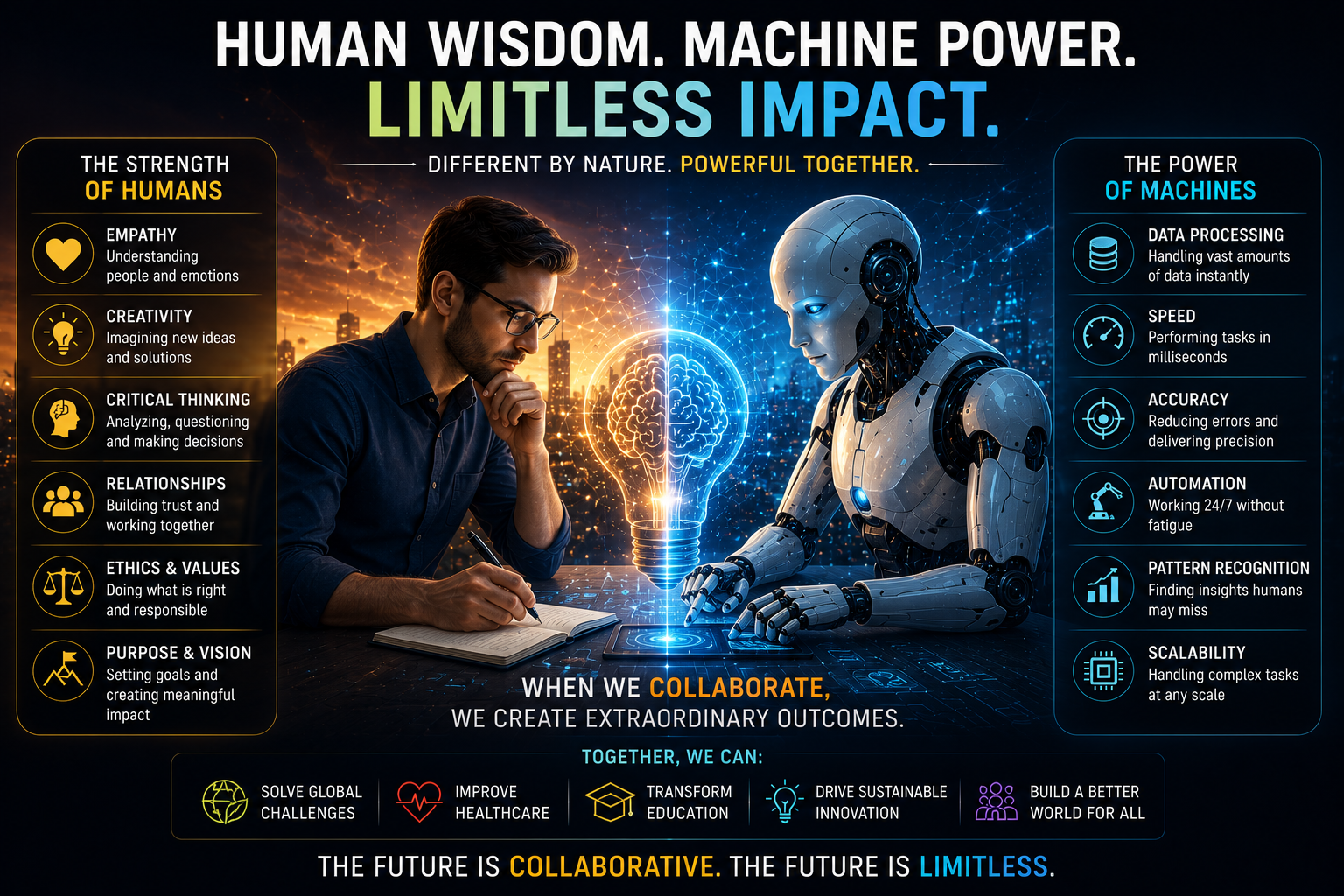
As discussions about artificial intelligence continue to grow, people often frame the future as a battle between humans and machines. Headlines ask whether AI will replace workers, surpass human intelligence, or eventually control industries once driven entirely by people. While these questions attract attention, they may overlook a far more realistic possibility. The future is unlikely to be defined by competition alone. Instead, it may be shaped by one of the most powerful partnerships in human history.
Throughout history, technology has consistently expanded human capabilities rather than eliminating them. The invention of the printing press did not replace human knowledge it spread it. Computers did not eliminate human intelligence they enabled people to solve problems that were once impossible. The internet did not replace communication it connected billions of people across the world. Artificial intelligence represents the next stage of this evolution, offering humanity tools that can amplify thinking, creativity, and productivity on an unprecedented scale.
The most successful professionals are already demonstrating what this collaboration looks like. Doctors use AI to analyze complex medical images while relying on their experience and empathy to make final decisions. Architects explore countless design possibilities with intelligent software before applying their own creativity and practical judgment. Scientists use machine learning to process enormous datasets, allowing them to focus more deeply on interpretation, discovery, and innovation. In each case, AI performs the work it does best, while humans contribute the qualities machines cannot replicate.
This partnership also changes the skills that will matter most in the coming decades. Memorizing information will become less valuable when knowledge is instantly accessible. Instead, critical thinking, creativity, communication, ethical decision-making, adaptability, and emotional intelligence will become increasingly important. People who learn how to ask better questions, evaluate AI-generated information, and combine technological tools with human insight will possess a significant advantage in nearly every profession.
At the same time, collaboration requires responsibility. Artificial intelligence should never become a substitute for independent thinking. If people blindly accept every recommendation produced by intelligent systems, they risk losing the curiosity, skepticism, and reasoning that drive genuine innovation. Technology should strengthen human intelligence, not weaken it. Maintaining that balance will require education systems, workplaces, governments, and individuals to encourage thoughtful use of AI rather than passive dependence upon it.
Ultimately, the future is not a race to determine whether humans or machines are superior. They were created for different purposes and possess fundamentally different strengths. Machine intelligence brings extraordinary speed, accuracy, and computational power. Human intelligence contributes wisdom, ethics, imagination, empathy, and purpose. When these strengths are combined thoughtfully, they create possibilities that neither humans nor machines could achieve alone.
Rather than asking whether artificial intelligence will replace humanity, a better question is this: How can humanity become even more intelligent because of artificial intelligence? The answer to that question may define the next chapter of civilization.
How Society Should Prepare for the Age of Intelligent Machines
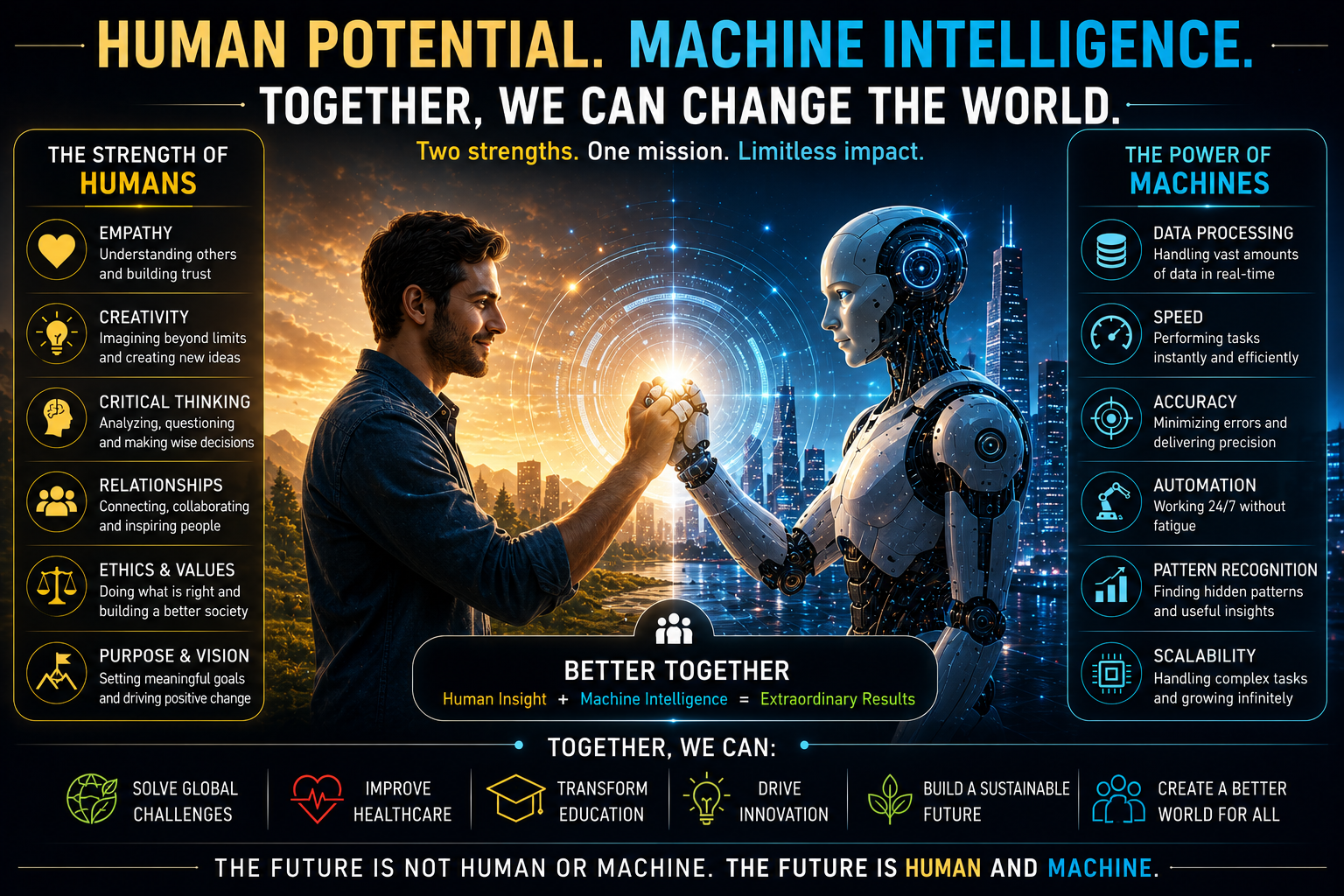
The rapid advancement of artificial intelligence is not simply a technological transformation it is a societal one. Every major technological revolution has reshaped the way people live, work, and interact with the world. The difference today is the speed at which these changes are unfolding. As machine intelligence becomes increasingly integrated into daily life, preparing society is no longer a choice; it is a necessity.
Education will play one of the most important roles in this transition. For generations, learning focused heavily on memorizing facts and repeating established methods. In an age where intelligent systems can retrieve information within seconds, education must evolve beyond knowledge alone. Schools and universities will need to place greater emphasis on critical thinking, creativity, communication, problem-solving, collaboration, and ethical reasoning. These are the abilities that enable people to work effectively with intelligent machines rather than compete against them.
Lifelong learning will become equally important. The traditional model of studying for a few years and relying on the same skills throughout an entire career is rapidly becoming outdated. As technology continues to evolve, professionals in every industry will need to adapt continuously by learning new tools, understanding emerging technologies, and developing skills that complement artificial intelligence. Those who embrace continuous learning will remain resilient in a constantly changing world.
Businesses must also rethink the relationship between employees and technology. Rather than viewing AI solely as a cost-saving replacement for human workers, organizations should focus on creating environments where technology enhances human potential. Employees should be encouraged to use AI for repetitive and data-intensive tasks while dedicating more time to innovation, strategic thinking, relationship-building, and creative problem-solving. Companies that successfully combine technological efficiency with human expertise are likely to become the leaders of the future.
Governments and policymakers carry an equally significant responsibility. As artificial intelligence becomes more influential, clear regulations will be essential to ensure transparency, accountability, privacy, fairness, and public trust. Decisions involving healthcare, finance, education, law enforcement, and public services must remain guided by ethical principles that protect human rights while encouraging responsible innovation. Building trust in AI will depend not only on technological progress but also on effective governance.
Individuals, however, remain at the center of this transformation. Every person has the opportunity to decide how technology shapes their life. Artificial intelligence should become a tool for expanding knowledge, increasing productivity, and encouraging creativity-not a substitute for independent thinking. Asking thoughtful questions, verifying information, exercising good judgment, and maintaining meaningful human relationships will become even more valuable as intelligent systems become more capable.
The future will not belong to those who fear artificial intelligence, nor to those who depend on it blindly. It will belong to people who understand both its extraordinary potential and its limitations. By strengthening uniquely human qualities while embracing technological progress responsibly, society can ensure that machine intelligence becomes one of humanity's greatest allies rather than one of its greatest challenges.
Key Takeaways
- Human intelligence and machine intelligence are fundamentally different. Humans think through consciousness, emotions, ethics, creativity, and lived experiences, while machines process information through data, algorithms, and computational models.
- Artificial intelligence excels in speed, accuracy, and pattern recognition. It can analyze enormous amounts of information, automate repetitive tasks, and support better decision-making across industries.
- Human intelligence remains irreplaceable in areas that require empathy, creativity, moral judgment, intuition, and purpose.
- The future is unlikely to be a battle between humans and machines; the greatest opportunities will come from combining the strengths of both.
- Education and lifelong learning must evolve to prioritize critical thinking, adaptability, communication, and ethical reasoning over memorization.
- Responsible use of AI is essential—technology should strengthen human potential, not encourage passive dependency.
Human intelligence is based on consciousness, emotions, creativity, intuition, ethics, and personal experiences. Machine intelligence, on the other hand, relies on algorithms, data processing, and computational models to analyze information efficiently.
No. While AI can outperform humans in repetitive and data-intensive tasks, it cannot replicate human qualities such as empathy, moral reasoning, imagination, self-awareness, and personal purpose.
AI is more efficient in specific tasks like data analysis and complex calculations. However, human intelligence remains superior in creativity, emotional understanding, ethical judgment, and navigating unfamiliar real-world problems.
AI will automate routine tasks, but it is also expected to create new opportunities requiring human creativity, leadership, and problem-solving, leading to increased collaboration between humans and machines.
The best preparation involves developing complementary skills such as critical thinking, creativity, emotional intelligence, adaptability, ethical decision-making, and continuous lifelong learning.