Digital Trust: The Invisible Foundation of the Connected World
Digital Trust has become one of the most valuable yet least visible assets in today's connected world. Every online transaction, digital conversation, and interaction with modern technology depends on trust. Whether people are shopping online, storing personal information in the cloud, using digital banking, or relying on artificial intelligence, they expect their data to remain secure, private, and transparent. Yet digital trust is built quietly and can disappear in a single moment.
For most of human history, trust was established through direct experiences. People trusted family members, local businesses, teachers, and community leaders because relationships were built through face-to-face interactions over time. In today's digital world, however, those personal interactions have largely been replaced by websites, mobile applications, algorithms, and intelligent systems. Every click, login, and online decision requires people to place their confidence in technologies they cannot see and organizations they may never meet.
This transformation has made trust one of the defining forces of the digital age. A secure website encourages people to share sensitive information. Transparent privacy policies create confidence. Reliable digital services earn long-term loyalty. On the other hand, a single security breach, data leak, or misleading practice can destroy years of credibility within hours. Technology itself is not enough-people must believe that the technology works in their best interests.
Artificial intelligence has added another layer to this challenge. AI systems increasingly recommend what people should buy, determine what content they see, assist with financial decisions, and even influence healthcare and education. While these innovations offer remarkable convenience, they also raise important questions about fairness, accountability, privacy, and transparency. As technology becomes more intelligent, trust becomes even more essential.
The future of the connected world will not be determined only by faster devices or more powerful software. It will be shaped by the confidence people have in the digital systems that increasingly influence their daily lives. Understanding Digital Trust is therefore no longer just a concern for cybersecurity experts or technology companies it is becoming an essential life skill for everyone who participates in the modern digital world.
What Is Digital Trust?
Digital trust is the confidence that people place in digital technologies, online services, and organizations to protect their information, respect their privacy, and operate responsibly. It represents the belief that technology will perform as expected without exposing users to unnecessary risks, manipulation, or misuse of personal data.
Unlike traditional trust, which is built primarily through personal relationships, Digital Trust is earned through consistent digital experiences. Every secure payment gateway, encrypted message, software update, transparent privacy policy, and reliable customer interaction contributes to strengthening that trust. Users rarely notice these protections when everything works correctly, but they quickly recognize their absence when security failures or privacy violations occur.
Consider something as routine as online banking. Millions of people transfer money, pay bills, and manage investments without ever meeting a bank employee. They continue using these services because they trust that their financial information is protected by strong security systems and that transactions will be processed accurately. The same principle applies to online shopping, cloud storage, digital healthcare platforms, and social media accounts. Every successful digital interaction quietly reinforces trust.
However, digital trust extends beyond technology alone. It also reflects the values of the organizations behind that technology. Companies that communicate honestly, explain how they use customer data, respond quickly to security concerns, and remain transparent during difficult situations are far more likely to earn lasting confidence. In contrast, businesses that hide important information or misuse personal data often lose public trust regardless of how advanced their technology may be.
This is why digital trust has become one of the most valuable assets in the modern economy. People no longer choose products and services based only on features or price. Increasingly, they choose organizations they believe will protect their privacy, secure their information, and act responsibly. In an age where almost every aspect of life has a digital component, trust has become the invisible foundation supporting every meaningful online relationship.
Why Digital Trust Has Become More Important Than Ever
Trust has always been an essential part of human progress, but the digital age has transformed it into something even more valuable. Today, people rely on technology for activities that once required face-to-face interactions, physical documents, or personal verification. From managing finances and receiving healthcare to learning new skills and maintaining relationships, digital platforms have become deeply woven into everyday life. As dependence on technology grows, so does the importance of Digital Trust.
Only a decade ago, many people still preferred visiting banks, shopping in physical stores, or meeting professionals in person. Today, a smartphone can perform many of those tasks within minutes. While this convenience has made life faster and more efficient, it has also introduced a new question into almost every digital interaction: "Can this platform be trusted?"
That single question now influences countless decisions people make every day. Before downloading an application, users read reviews and check permissions. Before making an online payment, they look for secure payment gateways. Before sharing personal information, they want assurance that their data will remain private. Even when using artificial intelligence, people increasingly ask whether its recommendations are reliable, fair, and transparent.
Digital Life Depends on Invisible Trust
One of the most remarkable aspects of modern technology is that people constantly place their trust in systems they cannot see. Every time someone logs into an email account, stores family photographs in cloud storage, orders food online, books airline tickets, or consults an AI-powered assistant, they are relying on complex digital infrastructure operating behind the scenes.
Most users never think about encryption, secure servers, authentication protocols, or cybersecurity frameworks. They simply expect these systems to function correctly. When everything works smoothly, trust grows naturally. When a service fails, customer information is exposed, or accounts are compromised, that trust can disappear almost instantly.
This invisible confidence is what allows billions of digital interactions to happen every single day.
The Rise of Artificial Intelligence Has Raised the Stakes
Artificial intelligence has significantly expanded the role of trust in technology. AI is no longer limited to research laboratories or large technology companies. It now recommends products, filters emails, assists doctors in analyzing medical data, detects financial fraud, translates languages, generates creative content, and supports customer service across countless industries.
These capabilities offer tremendous benefits, but they also create new responsibilities. People want to understand why an AI system reached a particular decision, whether their personal information is protected, and how bias or errors are being prevented. Without transparency and accountability, even highly advanced AI systems struggle to earn public confidence.
As artificial intelligence becomes more deeply integrated into society, Digital Trust is evolving from a technical requirement into a social responsibility.
Trust Has Become a Competitive Advantage
Technology is no longer judged only by innovation or performance. Increasingly, people evaluate digital products based on how trustworthy they appear.
When users believe a company protects their privacy, communicates honestly, responds quickly to security concerns, and handles personal data responsibly, they are more likely to remain loyal over the long term. On the other hand, organizations that experience repeated security breaches, misuse customer information, or fail to communicate transparently often lose credibility regardless of how advanced their technology may be.
In many industries today, trust has become just as valuable as innovation itself.
The Connected Future Will Depend on Trust
The world is becoming more connected every year. Smart homes, wearable devices, autonomous vehicles, cloud computing, digital identities, and AI-powered services are rapidly changing how people live and work. These technologies promise greater convenience and efficiency, but they also require individuals to share increasing amounts of personal information.
This creates a simple reality: the more connected society becomes, the more important Digital Trust becomes.
Without trust, people hesitate to adopt new technologies. Businesses struggle to retain customers. Innovation slows because confidence disappears. When trust is present, however, technology can improve lives, strengthen economies, and create opportunities that were once unimaginable.
Digital trust is therefore not merely about protecting data or preventing cyberattacks. It is the invisible foundation that enables the connected world to function with confidence, responsibility, and long-term sustainability.
The Three Pillars of Digital Trust
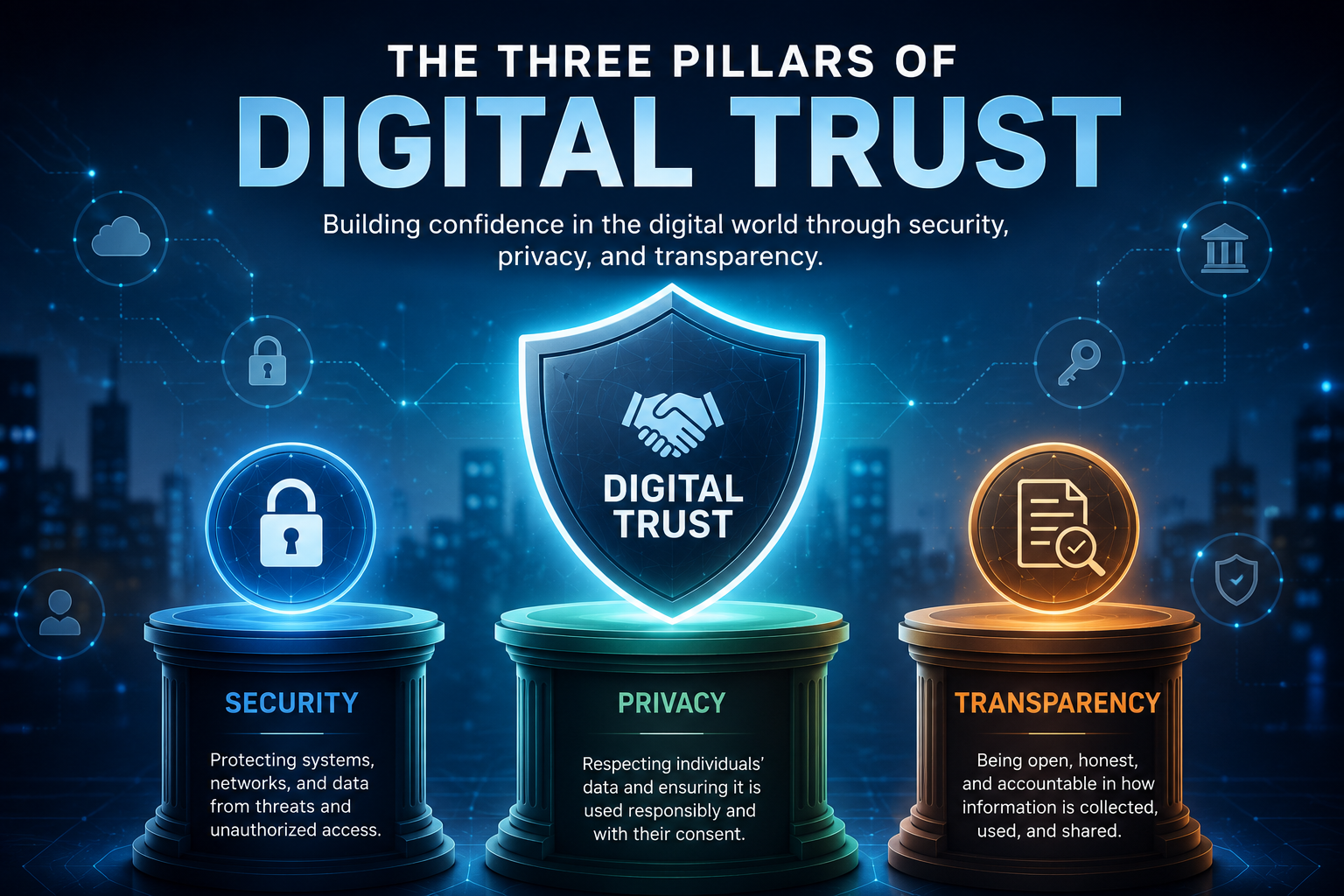
Technology evolves rapidly, but the principles that inspire confidence remain remarkably consistent. Regardless of whether people are using online banking, cloud storage, artificial intelligence, digital healthcare, or social media, Digital Trust is built upon three essential pillars: Security, Privacy, and Transparency. These pillars work together to create an environment where individuals feel safe, respected, and confident while interacting with digital technologies.
If even one of these pillars is weakened, trust begins to decline. Strong security without transparency creates uncertainty. Transparency without privacy exposes personal information. Privacy without security leaves valuable data vulnerable. Long-term digital trust can only exist when all three pillars support one another.
Security: Protecting What Matters Most
Security is the first foundation of Digital Trust. It refers to the technologies, systems, and practices designed to protect digital information, networks, and users from unauthorized access, cyberattacks, and malicious activity.
Every day, people share sensitive information online bank account details, passwords, medical records, business documents, and personal photographs. Most users may never see the complex security measures operating behind the scenes, yet they depend on them every time they interact with a digital platform.
Modern security includes far more than simply creating strong passwords. It involves encrypted communication, secure payment gateways, multi-factor authentication, continuous monitoring, software updates, and advanced threat detection systems. These protective layers quietly work together to reduce risks before users even become aware of potential threats.
A familiar example is online banking. Customers confidently transfer money because they trust that multiple security mechanisms are protecting every transaction. If those protections were removed, confidence would disappear almost immediately. The same principle applies to e-commerce websites, cloud services, educational platforms, and digital workplaces.
Strong security does more than prevent cybercrime it gives people the confidence to embrace technology without constant fear.
Privacy: Respecting Personal Information
If security protects information, privacy determines how that information should be collected, used, shared, and stored. It is the second pillar of Digital Trust because people want assurance that their personal data will be handled responsibly rather than exploited.
Every digital interaction creates information. Search history, purchase behavior, location data, browsing habits, health records, and communication patterns all contribute to an individual's digital footprint. Many users willingly share this information when they receive genuine value in return, but they also expect organizations to respect clear boundaries.
Responsible organizations explain what information they collect, why they need it, how long it will be stored, and whether it will be shared with third parties. They provide meaningful choices instead of hiding important details behind confusing language or complicated settings.
Privacy is not about preventing technology from using data altogether. Instead, it is about ensuring that individuals remain informed and retain reasonable control over how their personal information is handled.
As people become more aware of digital privacy, they increasingly choose services that demonstrate respect rather than simply offering convenience.
Transparency: Building Confidence Through Honesty
Transparency is the pillar that transforms secure technology into trustworthy technology. It means communicating openly about policies, decisions, risks, and responsibilities instead of leaving users uncertain about how digital systems operate.
People naturally trust organizations that explain their actions honestly. When companies clearly describe how artificial intelligence makes recommendations, notify users about policy changes, disclose security incidents promptly, and accept responsibility when mistakes occur, they strengthen long-term credibility.
Transparency becomes especially important as artificial intelligence influences more decisions. People often want to know why a recommendation was made, how certain conclusions were reached, and whether human oversight exists. Clear explanations reduce uncertainty and help users make informed decisions.
The opposite is equally true. Hidden practices, misleading information, confusing privacy policies, or delayed communication quickly erode trust even when no serious security breach has occurred. Uncertainty often damages confidence as much as actual technical failures.
Organizations that embrace openness demonstrate that they value long-term relationships more than short-term advantages.
Why These Three Pillars Must Work Together
Security, privacy, and transparency are often discussed separately, but in reality they are deeply interconnected. Imagine a digital healthcare platform with world-class cybersecurity but unclear policies about how patient information is shared. Patients may still hesitate to use it because privacy concerns remain unresolved.
Now consider a company with excellent privacy policies but weak cybersecurity. Although users understand how their data is intended to be used, they still face the risk of hackers accessing sensitive information.
Similarly, even secure and private systems can lose credibility if organizations refuse to explain their practices or communicate honestly during unexpected incidents.
Digital Trust is therefore not created by technology alone. It emerges when security protects people, privacy respects individuals, and transparency strengthens confidence. Together, these three pillars create digital experiences that encourage lasting trust rather than temporary convenience.
How Artificial Intelligence Is Reshaping Digital Trust
Artificial intelligence is transforming the digital world faster than almost any other technology in history. From personalized recommendations and virtual assistants to medical diagnostics and financial analysis, AI has become deeply integrated into everyday life. As these intelligent systems become more capable, they also influence decisions that directly affect people. This growing influence has made Digital Trust more important than ever before.
People no longer interact only with websites or mobile applications. Increasingly, they interact with algorithms that recommend what to watch, what to buy, which route to take, which job applicants deserve interviews, and even how certain diseases should be diagnosed. While these systems can improve efficiency and accuracy, they also introduce a fundamental question: Can people trust decisions made by artificial intelligence?
The answer depends not only on how intelligent an AI system is but also on how responsibly it has been designed, trained, and managed.
AI Can Strengthen Digital Trust
When developed responsibly, artificial intelligence has the potential to increase trust rather than reduce it. AI can detect financial fraud within seconds, identify unusual network activity before a cyberattack spreads, filter harmful content from online platforms, and help healthcare professionals recognize diseases at earlier stages. These capabilities improve safety while reducing human error.
Banks, for example, increasingly rely on AI to monitor millions of financial transactions in real time. Instead of waiting until fraud has already occurred, intelligent systems can identify suspicious behavior immediately and alert both customers and security teams. Similar technologies protect online retailers, cloud services, and communication platforms every day.
In these situations, artificial intelligence quietly strengthens Digital Trust by making digital services safer, faster, and more reliable.
Trust Declines When AI Becomes a Mystery
Despite its benefits, artificial intelligence can also create uncertainty when users do not understand how decisions are made.
Imagine applying for a loan, only to receive an instant rejection without any explanation. Or consider a healthcare system that recommends a treatment but cannot clearly describe the reasoning behind its recommendation. Even if the decision is technically correct, the absence of transparency makes people question whether the outcome is fair.
This challenge has led to growing interest in Explainable AI (XAI)-an approach that focuses on making AI systems easier to understand. Rather than presenting users with unexplained results, explainable AI helps reveal the factors that influenced a decision. When people understand why something happened, they are far more likely to trust the technology behind it.
Transparency remains one of the strongest foundations of digital trust, especially in systems that influence important life decisions.
The Challenge of Misinformation and Deepfakes
Artificial intelligence has also made it easier to create realistic fake content. Deepfake videos, AI-generated voices, manipulated images, and convincing misinformation can spread rapidly across the internet, making it increasingly difficult to distinguish truth from fabrication.
This creates a new dimension of Digital Trust. People must now evaluate not only whether a platform is secure but also whether the information they consume is authentic.
Businesses, technology companies, journalists, educators, and governments all share responsibility for addressing this challenge. Strong verification systems, responsible AI development, and improved digital literacy are becoming essential for protecting public confidence in the digital world.
Trust cannot survive where people consistently doubt the authenticity of what they see and hear.
Human Oversight Remains Essential
Although artificial intelligence can process enormous amounts of information at remarkable speed, it does not possess human judgment, empathy, or moral responsibility. AI identifies patterns and generates predictions based on data, but it cannot fully understand human values, emotions, or complex social situations.
For this reason, the most trustworthy AI systems are those that support human decision-making rather than replace it entirely. Doctors still make final medical decisions. Judges remain responsible for legal outcomes. Financial advisors continue to guide major investment choices. In each of these fields, artificial intelligence serves as a powerful assistant, while human expertise provides the accountability that technology alone cannot deliver.
The future of Digital Trust will therefore depend on achieving the right balance between intelligent automation and responsible human oversight.
Trust Will Shape the Future of Artificial Intelligence
Artificial intelligence will continue to evolve at an extraordinary pace, influencing industries that have yet to be transformed. However, long-term success will not depend solely on creating more advanced algorithms. It will depend on earning and maintaining public confidence.
Organizations that build AI systems with fairness, transparency, security, and privacy at their core will strengthen lasting relationships with users. Those that ignore these principles may develop impressive technology but struggle to gain widespread acceptance.
Ultimately, the future of artificial intelligence is not just about intelligence it is about trust. As AI becomes increasingly woven into everyday life, Digital Trust will determine whether society embraces these innovations with confidence or approaches them with hesitation.

The Hidden Cost of Losing Digital Trust
Building trust takes years of consistent effort, but losing it can happen in a matter of minutes. In the digital world, a single security breach, privacy failure, or unethical decision can permanently damage the confidence that individuals place in an organization. This is why Digital Trust is often described as one of the most valuable and most fragile assets in the modern economy.
Unlike financial losses, which can often be recovered over time, the loss of trust creates long-lasting consequences. People may forgive temporary service interruptions or technical errors, but they rarely forget incidents that compromise their personal information or make them feel deceived. Once confidence is broken, rebuilding it requires far more effort than earning it in the first place.
When Individuals Lose Trust
Every digital service depends on users believing that their information is protected. When that belief disappears, people naturally become more cautious.
Imagine receiving a notification that your personal data has been exposed due to a cybersecurity breach. Even if your account is eventually secured, the experience changes how you interact with digital platforms. You may hesitate before sharing information, avoid certain online services, or constantly worry about identity theft and financial fraud.
This loss of confidence extends beyond a single company. A major security incident can make people question similar platforms as well, creating a wider atmosphere of uncertainty across the digital ecosystem.
Trust influences behavior. When trust declines, digital adoption slows.
The Business Cost of Broken Trust
For organizations, losing Digital Trust affects far more than reputation. It directly impacts customer loyalty, brand value, financial performance, and long-term growth.
Customers are more likely to leave businesses that fail to protect their personal information or communicate honestly during a crisis. Negative experiences spread quickly through news reports, online reviews, and social media, making it difficult for organizations to regain credibility. Even companies with excellent products may struggle if customers no longer believe they can be trusted.
Rebuilding that confidence often requires years of transparent communication, stronger security investments, and consistent ethical behavior. In many cases, preventing trust from being lost is significantly less expensive than trying to restore it afterward.
Society Also Pays the Price
The consequences of broken trust extend beyond individuals and businesses. Entire societies can be affected when confidence in digital systems begins to decline.
Consider the spread of online misinformation. When manipulated content, fake news, or AI-generated deepfakes become widespread, people may struggle to distinguish credible information from falsehoods. As uncertainty grows, confidence in digital communication weakens, making it harder for reliable information to reach the public.
The same challenge applies to digital public services, online education, healthcare platforms, and electronic governance. If citizens begin questioning the integrity or security of these systems, participation decreases, slowing digital progress that benefits everyone.
A connected society depends not only on advanced technology but also on shared confidence in the systems that support everyday life.
Why Transparency During a Crisis Matters
No technology is completely immune to failures or cyber threats. What often determines whether trust survives is not the incident itself but how an organization responds.
Responsible organizations acknowledge problems quickly, communicate honestly, explain what happened, describe the steps being taken to resolve the issue, and provide clear guidance to affected users. This level of transparency demonstrates accountability and respect.
In contrast, delaying communication, hiding important information, or minimizing the seriousness of an incident usually causes greater damage than the original problem. People are often willing to forgive mistakes, but they rarely forgive deception.
This is why transparency remains one of the strongest pillars of Digital Trust, especially during challenging situations.
Trust Is Easier to Protect Than to Rebuild
Every secure login, honest privacy policy, timely software update, and transparent decision contributes to strengthening digital trust. These actions may seem ordinary, but together they create the confidence that allows the digital world to function smoothly.
The opposite is equally true. Small compromises in security, privacy, or honesty can gradually weaken trust until even loyal users begin looking elsewhere.
The hidden cost of losing Digital Trust is therefore much greater than a temporary technical failure. It affects relationships, reputations, business success, public confidence, and the willingness of society to embrace future innovations. In an increasingly connected world, protecting trust has become just as important as developing new technology.
Practical Ways to Build Digital Trust in Everyday Life
In today's connected world, Digital Trust is not created solely by governments, technology companies, or cybersecurity experts. Every individual contributes to it through the choices they make each day. From creating secure passwords and protecting personal information to verifying online content before sharing it, small actions collectively shape a safer and more trustworthy digital environment. While technology continues to evolve, responsible digital behavior remains one of the strongest defenses against emerging risks.
Building digital trust does not require advanced technical knowledge or professional expertise. Instead, it begins with awareness, good judgment, and a willingness to adopt simple habits that protect both personal information and online relationships. These everyday practices not only improve individual security but also strengthen confidence across the broader digital ecosystem.
Think Before You Share Personal Information
Every online interaction adds another piece to your digital footprint. Whether you are registering for a new application, shopping online, joining a social media platform, or subscribing to a newsletter, you are often asked to provide personal information. While some of this information is genuinely necessary, much of it may not be.
Before sharing sensitive details, take a moment to evaluate why the information is being requested and whether the organization truly needs it. Check if the website uses a secure connection, review its privacy policy, and avoid providing unnecessary personal details whenever possible. Developing this habit significantly reduces the risk of identity theft, fraud, and misuse of personal data while strengthening your overall Digital Trust.
Strengthen Your Digital Security Habits
Security is one of the most practical ways to protect yourself online. Cybercriminals often target weak passwords, outdated software, and accounts without additional security measures because these vulnerabilities are easier to exploit than sophisticated systems.
Creating unique passwords for every important account, enabling multi-factor authentication, installing software updates promptly, and downloading applications only from trusted sources provide multiple layers of protection. These precautions may appear simple, yet together they create a strong defense against many common cyber threats. Responsible security practices allow people to use digital services with greater confidence rather than constant anxiety.
Verify Information Before You Believe or Share It
The internet offers instant access to an enormous amount of information, but speed does not always guarantee accuracy. Fake websites, phishing emails, manipulated images, AI-generated content, and misinformation have become increasingly convincing, making critical thinking an essential digital skill.
Instead of reacting immediately to headlines or social media posts, develop the habit of verifying information through reliable sources. Check official websites, compare multiple trusted publications, and examine website addresses before clicking unfamiliar links. Spending a few extra minutes verifying information can prevent financial loss, protect personal data, and reduce the spread of misinformation. In today's digital world, thoughtful skepticism is often a sign of wisdom rather than distrust.
Take Control of Your Privacy Settings
Many digital platforms collect more information than users realize. Social media accounts, mobile applications, cloud storage services, and online shopping websites often include privacy settings that allow individuals to decide how their information is collected, stored, and shared.
Unfortunately, many people never review these settings after creating an account. Taking the time to customize privacy preferences, limit unnecessary permissions, and regularly review connected devices helps reduce unnecessary exposure. Privacy is not about avoiding technology it is about ensuring that you remain informed and in control of your personal information. When people understand how their data is managed, confidence naturally grows.
Choose Organizations That Value Trust
Not every digital platform deserves the same level of confidence. Some organizations consistently invest in cybersecurity, communicate openly about privacy, provide regular software updates, and respond honestly when challenges arise. Others prioritize rapid growth while treating security and transparency as secondary concerns.
Before trusting a new digital service, consider its reputation, customer reviews, security practices, and privacy commitments. Companies that explain how they protect user information and communicate clearly during both success and failure are far more likely to earn lasting trust. Supporting responsible organizations also encourages higher standards across the digital economy.
Continue Learning as Technology Changes
Technology evolves far more quickly than most people expect. Artificial intelligence, cloud computing, digital payments, smart devices, and connected ecosystems continue to introduce new opportunities alongside new risks. Remaining informed about these developments helps individuals adapt confidently rather than react with uncertainty.
Digital literacy is no longer limited to understanding how to use technology. It also includes recognizing online scams, understanding privacy rights, evaluating digital information critically, and making informed decisions about emerging technologies. People who continue learning become more resilient, more confident, and better prepared for the future.
Small Habits Build Lasting Digital Trust
Many people believe that building Digital Trust requires major technological investments, but lasting trust is often created through consistent everyday behavior. Every strong password, verified website, secure payment, thoughtful privacy decision, and responsible online interaction contributes to a healthier digital environment.
As the connected world continues to expand, technology alone will never be enough to create confidence. Trust grows when innovation is matched with responsibility, awareness, and ethical behavior. By adopting these practical habits, individuals not only protect themselves but also help create a digital future where people can embrace technology with greater confidence, security, and peace of mind.
How Businesses Can Earn and Protect Digital Trust
In today's digital economy, technology alone is no longer enough to attract and retain customers. Organizations may offer innovative products, advanced artificial intelligence, or highly efficient digital services, but without trust, even the most impressive innovations struggle to succeed. Customers are increasingly choosing businesses that demonstrate responsibility, transparency, and respect for their personal information. As a result, Digital Trust has evolved from a technical concern into one of the most valuable competitive advantages an organization can possess.
Earning digital trust is not achieved through marketing campaigns or carefully written promises. It is built gradually through consistent actions that demonstrate reliability over time. Every secure transaction, honest communication, transparent policy, and responsible decision strengthens the confidence that customers place in an organization. Likewise, every security failure, privacy violation, or misleading practice weakens that confidence and makes rebuilding relationships significantly more difficult.
Make Security a Business Priority
Strong security is the foundation upon which digital trust is built. Customers expect businesses to protect sensitive information such as financial records, personal details, passwords, and confidential communications. They may never see the security systems operating behind the scenes, but they assume those protections exist every time they interact with a digital platform.
Organizations should invest continuously in cybersecurity rather than treating it as a one-time project. Regular software updates, encrypted communications, multi-factor authentication, secure payment systems, employee security training, and ongoing vulnerability assessments all contribute to creating a safer digital environment. Businesses that proactively strengthen their security infrastructure reduce risks while giving customers greater confidence in their services.
Protecting customer information is no longer simply an IT responsibility-it has become a core business responsibility.
Respect Customer Privacy
Collecting data has become easier than ever, but responsible organizations understand that having access to information does not automatically justify using it without clear purpose or consent.
Customers appreciate businesses that explain what information is collected, why it is needed, how it will be used, and whether it will be shared with third parties. Privacy policies should be written in language that ordinary people can understand instead of lengthy legal documents filled with technical terminology.
Organizations that provide customers with meaningful control over their personal information demonstrate respect rather than exploitation. This approach strengthens long-term relationships because people feel that their privacy is valued rather than treated as a commercial asset.
Communicate with Transparency
Transparency is one of the most powerful ways to earn Digital Trust. Customers are far more likely to trust organizations that communicate honestly, especially when challenges arise.
Instead of hiding mistakes or delaying important announcements, responsible businesses acknowledge problems quickly, explain the situation clearly, describe the corrective actions being taken, and keep customers informed throughout the recovery process. Honest communication demonstrates accountability and shows that maintaining customer confidence is more important than protecting a company's public image.
Transparency should also extend beyond crisis management. Businesses that openly explain pricing, product limitations, privacy practices, and the role of artificial intelligence in their services create stronger relationships because customers understand what to expect.
Use Artificial Intelligence Responsibly
Artificial intelligence is becoming an essential part of modern business, but its success depends heavily on public confidence. Customers increasingly want to know how AI systems make recommendations, process personal information, and influence important decisions.
Organizations should ensure that AI supports human judgment rather than replacing it completely in situations involving healthcare, finance, education, recruitment, or legal services. Providing clear explanations, reducing algorithmic bias, protecting user privacy, and maintaining human oversight all contribute to responsible AI adoption.
Businesses that prioritize ethical AI development strengthen Digital Trust, while those that ignore fairness and transparency risk damaging their reputation regardless of how advanced their technology may be.
Build a Culture of Trust from Within
Digital trust cannot be sustained through technology alone. It must become part of an organization's culture.
Employees at every level should understand the importance of protecting customer information, respecting privacy, following ethical practices, and communicating honestly. Leadership plays a critical role by demonstrating accountability, encouraging responsible decision-making, and investing in long-term trust rather than short-term gains.
When trust becomes part of an organization's everyday culture, customers experience that commitment consistently across every interaction.
Trust Creates Long-Term Business Success
Many businesses focus heavily on innovation, pricing, and marketing to remain competitive. While these factors certainly influence growth, they are often not enough to create lasting customer loyalty.
Organizations that consistently protect customer data, communicate transparently, respect privacy, and act responsibly earn something far more valuable than immediate sales they earn lasting confidence. Trusted businesses are more likely to retain loyal customers, strengthen their reputation, encourage positive recommendations, and adapt successfully as technology continues to evolve.
In the connected world, products and technologies may change rapidly, but trust remains remarkably consistent. Companies that make Digital Trust a central part of their strategy are not simply protecting their reputation they are investing in sustainable success for the future.
The Future of Digital Trust in a Connected World
The digital world is evolving at an extraordinary pace. Artificial intelligence is becoming more intelligent, smart devices are becoming more common, digital identities are replacing physical documents, and connected technologies are transforming how people live, work, learn, and communicate. While these innovations promise greater convenience and efficiency, they also create a growing need for one essential element-Digital Trust.
The future will not be shaped simply by the technologies that become available. It will be shaped by the confidence people have in using them. Regardless of how advanced innovation becomes, widespread adoption will always depend on whether individuals believe that their privacy is respected, their information is secure, and technology is being used responsibly.
Digital Identity Will Become More Important
In the coming years, digital identities are expected to play a much larger role in everyday life. Instead of carrying multiple physical documents, people may increasingly use secure digital identities to access government services, healthcare systems, educational institutions, banking platforms, and international travel.
This shift offers tremendous convenience, but it also places enormous responsibility on organizations managing these systems. Protecting digital identities from cyber threats, identity theft, and unauthorized access will become one of the greatest challenges of the connected world.
People will only embrace digital identity systems if they have complete confidence that their information remains protected and under their control. Without Digital Trust, even the most advanced identity systems will struggle to gain widespread acceptance.
Artificial Intelligence Will Demand Greater Accountability
Artificial intelligence will continue expanding into industries where decisions have significant real-world consequences. Healthcare, finance, education, transportation, law, and public services are already using AI to improve efficiency and support decision-making.
As AI becomes more influential, people will expect far greater transparency regarding how these systems operate. Organizations will need to explain how decisions are made, how bias is minimized, how personal information is protected, and where human oversight remains essential.
Future AI systems will not be judged solely by their intelligence or speed. They will also be evaluated by their fairness, accountability, and trustworthiness.
In many ways, the future success of artificial intelligence will depend as much on Digital Trust as it does on technological innovation.
Connected Technologies Will Increase Responsibility
The Internet of Things (IoT), smart homes, wearable devices, autonomous vehicles, and connected cities are creating environments where billions of devices continuously exchange information. These technologies can improve efficiency, reduce waste, enhance public services, and simplify daily life.
However, every connected device also represents a potential point of vulnerability if security and privacy are not properly maintained.
Manufacturers, software developers, governments, and service providers will need to collaborate to establish stronger security standards and responsible data management practices. Building a connected future requires more than intelligent devices it requires systems that people genuinely trust.
Trust Will Become a Competitive Advantage
As digital services become increasingly similar in terms of features and performance, trust will become one of the most important factors influencing customer decisions.
Consumers are already paying closer attention to how organizations protect personal information, communicate during security incidents, and use artificial intelligence responsibly. Businesses that consistently demonstrate transparency, ethical leadership, and strong cybersecurity practices will stand out in increasingly competitive markets.
In the future, customers are unlikely to remain loyal simply because a product is innovative. They will remain loyal because they trust the organization behind it.
This makes Digital Trust not only a social responsibility but also a powerful business strategy.

A Future Built on Confidence Rather Than Fear
Throughout history, every major technological revolution has introduced uncertainty alongside opportunity. The digital revolution is no different. Concerns about cybersecurity, misinformation, AI, privacy, and data protection will continue to evolve as technology advances. Yet history also shows that people embrace innovation when they feel confident that it serves their interests responsibly.
The future of technology should therefore not be driven by fear of emerging risks but by confidence created through responsible innovation. Governments, businesses, educators, technology professionals, and individual users all have a role to play in building this confidence.
When security protects information, privacy respects individuals, transparency encourages accountability, and ethical innovation guides technological progress, Digital Trust becomes the invisible foundation upon which the connected world can continue to grow.
Technology will undoubtedly continue changing the way people live. The greater challenge-and the greater opportunity-will be ensuring that trust grows alongside innovation. Only then can society fully realize the benefits of a digital future that is not only smarter but also safer, more responsible, and worthy of the confidence people place in it.
The Future Begins with Trust
Technology has transformed the way people communicate, learn, work, and solve problems. It has connected communities across continents, accelerated innovation, and created opportunities that previous generations could scarcely imagine. Yet beneath every successful digital interaction lies something far more valuable than advanced software or powerful hardware-Digital Trust.
Throughout this article, we have seen that digital trust is built on far more than cybersecurity alone. It depends on strong security that protects information, privacy that respects individual rights, transparency that encourages confidence, and ethical innovation that places people at the center of technological progress. These principles are no longer optional. They have become essential requirements for a connected society.
As artificial intelligence, digital identities, cloud computing, and smart technologies continue reshaping everyday life, trust will become one of the defining factors that determines whether these innovations are embraced or rejected. People are willing to adopt new technologies when they believe those technologies are designed to protect their interests, respect their privacy, and operate responsibly.
The responsibility for building Digital Trust belongs to everyone. Governments must establish effective regulations. Businesses must protect customer data and communicate transparently. Technology professionals must design ethical and secure systems. Individuals must develop responsible digital habits and remain informed as technology evolves. When each of these groups fulfills its role, trust becomes stronger and the digital ecosystem becomes safer for everyone.
Ultimately, the future of technology is not only about creating smarter machines or faster systems. It is about creating a digital world where people feel confident, respected, and secure every time they interact with technology. Innovation may drive progress, but trust determines whether that progress truly benefits society. In the years ahead, Digital Trust will remain the invisible foundation that supports every meaningful digital experience.
Key Takeaways
- Digital Trust is the confidence people place in technology, organizations, and digital services to protect their information and act responsibly.
- Security, privacy, and transparency are the three essential pillars that strengthen long-term digital trust.
- Artificial intelligence increases both the opportunities and the responsibilities associated with building trustworthy digital systems.
- Losing digital trust can damage individuals, businesses, and society far more than many technical failures.
- Simple everyday habits such as protecting personal information, verifying online content, and using strong security practices help strengthen digital trust.
- Organizations that prioritize ethical leadership, cybersecurity, privacy, and transparency earn lasting customer confidence.
- The future success of emerging technologies will depend not only on innovation but also on the level of trust people place in them.
Digital Trust is the confidence people have that digital technologies, online services, and organizations will protect their personal information, respect their privacy, and operate securely, ethically, and transparently.
Digital Trust enables people to confidently use online banking, e-commerce, cloud services, digital healthcare, artificial intelligence, and other connected technologies. Without trust, users become reluctant to adopt digital services, slowing innovation and digital transformation.
The three core pillars are: Security – Protecting systems and data from cyber threats. Privacy – Respecting and safeguarding personal information. Transparency – Communicating openly about policies, decisions, and data practices. Together, these pillars create confidence in digital interactions.
Artificial intelligence can strengthen Digital Trust by improving security, detecting fraud, and increasing efficiency. However, AI must also be transparent, fair, accountable, and supported by human oversight to maintain public confidence.
People can strengthen Digital Trust by protecting personal information, using strong passwords and multi-factor authentication, verifying online information before sharing it, reviewing privacy settings, and choosing organizations that demonstrate responsible security and transparency.