When Technology Starts Making Decisions: Are Humans Losing the Final Say?
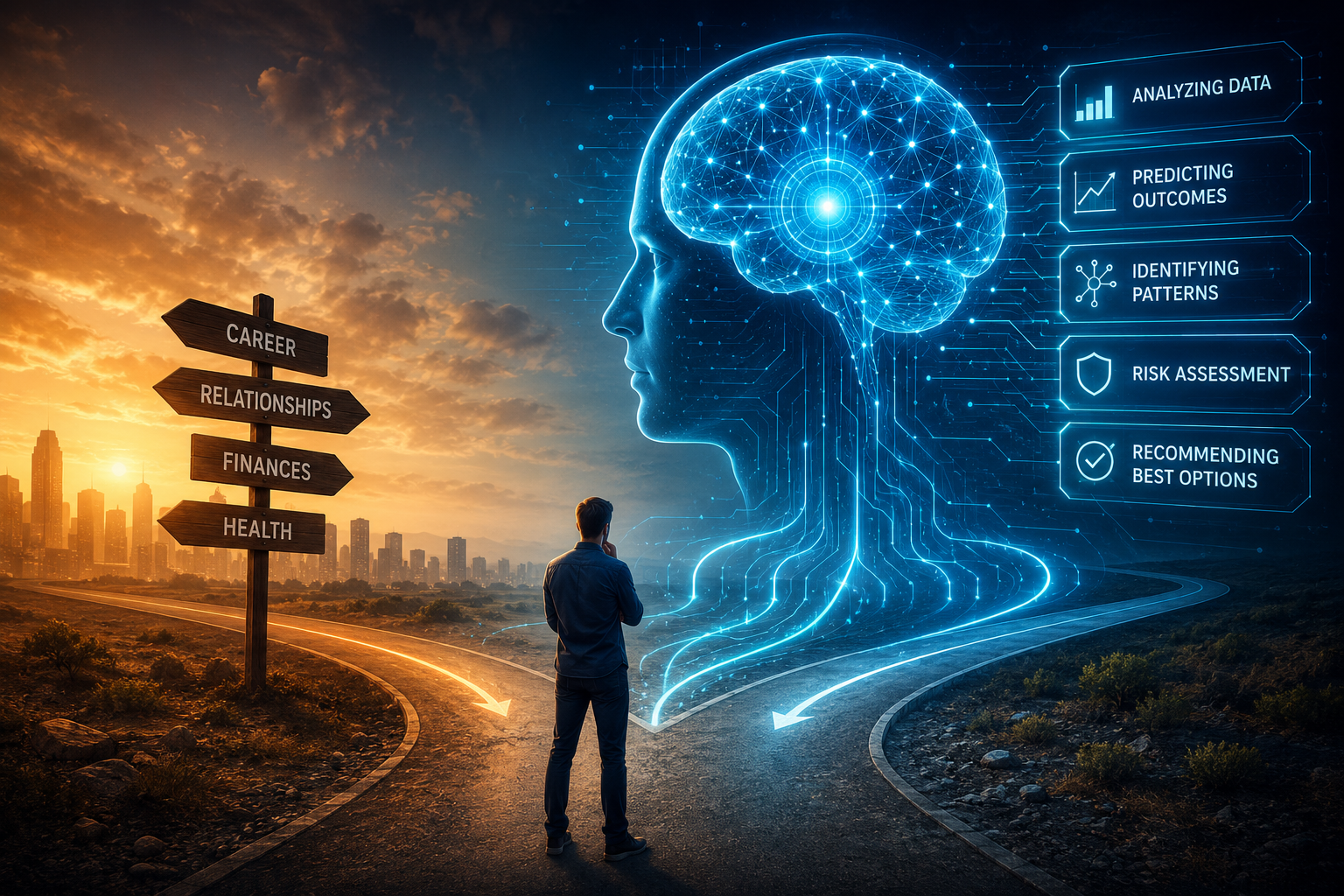
Technology has always been created with one primary purpose to make human life easier. From the invention of the wheel to the development of modern computers, every major innovation has helped people solve problems faster, work more efficiently, and achieve tasks that once seemed impossible. For decades, technology remained a powerful tool that supported human intelligence without replacing it. People gathered information, evaluated options, and ultimately made the final decision themselves.
That relationship is gradually changing. Modern intelligent systems are no longer limited to following instructions. They analyze massive amounts of data, recognize patterns that humans might overlook, predict possible outcomes, and recommend actions within seconds. Whether it is a navigation app choosing the quickest route, an online retailer suggesting products, a streaming platform deciding what appears on the homepage, or a recruitment system filtering job applications, technology is becoming increasingly involved in decisions that directly influence everyday life.
Most of these changes happen quietly. People rarely notice them because each recommendation appears helpful on its own. Accepting the fastest driving route, trusting a fraud detection system, or following a personalized content recommendation feels convenient rather than revolutionary. However, when millions of similar decisions occur every day across healthcare, education, finance, transportation, entertainment, and public services, technology gradually shifts from being a passive assistant to becoming an active participant in human decision-making.
The growing influence of artificial intelligence has accelerated this transformation even further. Instead of simply processing information, intelligent systems now evaluate possibilities, estimate probabilities, and prioritize one option over another. Businesses rely on predictive analytics to forecast customer behavior, hospitals use AI-assisted diagnostics to support medical decisions, banks assess financial risks through automated models, and logistics companies optimize complex supply chains without requiring constant human intervention. These capabilities demonstrate how decision-making is steadily becoming a shared responsibility between people and intelligent systems.
This evolution offers undeniable advantages. Automated systems can process information at extraordinary speed, reduce repetitive work, and improve consistency in situations involving enormous datasets. At the same time, it introduces important questions about accountability, transparency, fairness, and human autonomy. If technology continues making more recommendations that people routinely accept, where should society draw the line between helpful assistance and independent decision-making? More importantly, who remains responsible when those decisions significantly affect people's lives?
Understanding this silent transition is no longer a discussion reserved for technology experts. Every individual who uses a smartphone, shops online, applies for a job, visits a hospital, drives with digital navigation, or interacts with online platforms is already part of this technological shift. Exploring how Technology Starts Making Decisions is essential for understanding not only the future of innovation but also the future of human responsibility, trust, and freedom in an increasingly intelligent world.
How Technology Starts Making Decisions in Everyday Life
Many people imagine intelligent decision-making as a futuristic concept involving highly advanced robots or fully autonomous machines. In reality, the transition has already become part of ordinary life through digital services that billions of people use every day. The process did not begin with artificial intelligence replacing human judgment overnight. Instead, it evolved gradually as software became capable of analyzing information, identifying patterns, and recommending actions based on previous data.
Early computer systems functioned primarily as calculators and record keepers. They stored information, performed repetitive tasks, and followed predefined instructions with remarkable accuracy. Although these systems improved productivity, they still depended entirely on human direction. Every meaningful decision required someone to interpret the information, evaluate the available choices, and determine the appropriate course of action.
The rapid growth of data fundamentally changed this relationship. As businesses, governments, and digital platforms collected enormous volumes of information, manually analyzing every detail became increasingly impractical. Intelligent algorithms emerged as valuable tools capable of recognizing trends, detecting unusual behavior, and predicting future outcomes within seconds. Their ability to process millions of data points simultaneously gave organizations insights that would have been nearly impossible to obtain through traditional human analysis alone.
Today, intelligent systems influence decisions in ways that many people no longer consciously recognize. Search engines determine which information appears first, recommendation algorithms decide which videos or articles receive greater visibility, online marketplaces prioritize certain products over others, and financial software evaluates transaction risks before payments are approved. In many cases, humans still retain the authority to make the final choice, but the range of options they consider has already been shaped by technology.
This subtle influence represents one of the most significant technological transformations of the modern era. Technology rarely forces individuals to accept a recommendation. Instead, it organizes information, ranks possibilities, and highlights what appears to be the most suitable option. Over time, repeated exposure to reliable recommendations naturally increases trust, making people more likely to depend on intelligent systems without carefully evaluating every alternative themselves.
As this reliance continues to grow, the conversation shifts beyond technological capability and enters the realm of ethics, responsibility, and human control. Understanding where assistance ends and independent influence begins will determine how society balances innovation with the enduring importance of human judgment.
Why Intelligent Systems Are Trusted More Than Ever
The rapid rise of intelligent technologies is not driven solely by innovation. It is driven by trust. Every time a navigation app successfully avoids traffic, a banking system detects fraudulent activity, or a recommendation engine suggests something genuinely useful, people's confidence in technology grows a little stronger. Over thousands of daily interactions, that confidence gradually transforms intelligent systems from optional tools into trusted decision-making partners.
One of the primary reasons for this trust is speed. Human beings naturally require time to gather information, compare alternatives, and evaluate possible outcomes. Intelligent systems can perform similar analytical tasks within seconds while processing millions of pieces of information simultaneously. In industries where time directly affects safety, efficiency, or financial performance, this capability creates enormous practical value. Businesses, hospitals, airlines, and public services increasingly depend on automated analysis because it enables faster responses without sacrificing operational consistency.
Accuracy also plays a significant role. Unlike people, software does not become physically tired after working for long hours or emotionally distracted by personal circumstances. When trained correctly and supported by high-quality data, intelligent systems can perform repetitive analytical tasks with remarkable consistency. This is particularly valuable in environments where even small human errors can lead to substantial financial losses or serious safety concerns.
Another important factor is the growing complexity of modern society. Every day, organizations generate enormous volumes of information that far exceed what any individual or team could realistically analyze. Financial markets process millions of transactions, hospitals continuously collect patient records, logistics companies monitor global supply chains, and digital platforms manage billions of user interactions. Without intelligent analytical systems, extracting meaningful insights from this scale of information would become almost impossible.
At the same time, many people believe that automated systems are naturally objective because machines do not possess emotions, personal opinions, or individual preferences. This perception often creates greater confidence in algorithmic recommendations than in purely human judgment. However, objectivity is more complicated than it appears. Intelligent systems learn from historical data that reflects real human decisions, behaviors, and societal conditions. If that underlying data contains biases, incomplete information, or historical inequalities, technology may unintentionally reproduce those same patterns instead of eliminating them.
Trust therefore should never depend exclusively on technological capability. It must also include transparency, accountability, regular evaluation, and meaningful human oversight. Technology can significantly improve decision-making, but understanding how those decisions are generated remains equally important. Blind confidence in automation can become just as dangerous as rejecting technological progress altogether.
Technology Already Makes More Decisions Than Most People Realize
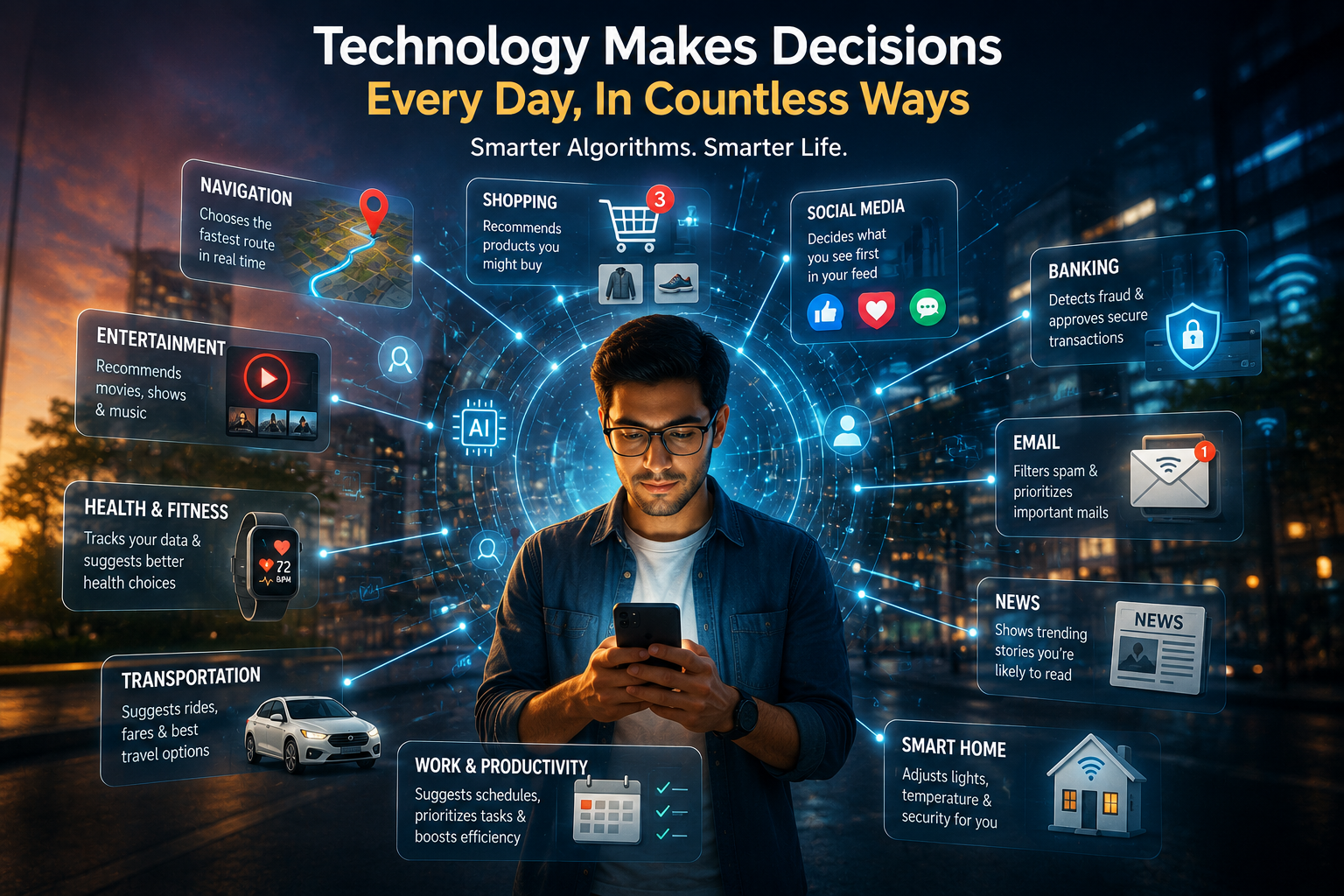
For many individuals, the phrase Technology Starts Making Decisions sounds like a prediction about the future. In reality, it describes the present. Intelligent systems are already influencing countless decisions every day, often without attracting attention because their involvement has become deeply integrated into ordinary routines.
A typical morning demonstrates this reality remarkably well. A smartphone prioritizes notifications before the user even unlocks the screen. A weather application recommends whether carrying an umbrella is necessary. A navigation system evaluates traffic conditions and automatically suggests the fastest route to work. Streaming services determine which news headlines, videos, or music playlists appear first, while email platforms separate important messages from promotional content without requiring manual sorting.
The workplace has experienced an equally significant transformation. Many organizations now use automated software to screen job applications before recruiters review them. Customer support platforms prioritize service requests according to urgency, while project management systems recommend task schedules based on deadlines and resource availability. Financial institutions rely on intelligent risk assessment models to evaluate loan applications, detect suspicious transactions, and identify unusual spending patterns within seconds.
Healthcare represents another field where intelligent decision support has expanded rapidly. Artificial intelligence can assist medical professionals by identifying potential abnormalities in diagnostic images, prioritizing urgent cases, monitoring patient data, and predicting possible health risks. Importantly, these technologies are designed to support medical expertise rather than replace qualified healthcare professionals. Their greatest strength lies in helping specialists make faster and more informed decisions using comprehensive data analysis.
Education is following a similar path. Digital learning platforms increasingly personalize lessons according to individual progress, recommend additional study materials, and identify subjects where students may require extra attention. Instead of delivering identical educational experiences to every learner, intelligent systems continuously adapt content based on performance and learning patterns, allowing teachers to provide more targeted guidance.
Each of these examples appears relatively small when viewed independently. Collectively, however, they illustrate a profound transformation. Technology is no longer limited to executing instructions after humans make decisions. It increasingly participates in determining which information people see, which options receive attention, and which recommendations appear most valuable. This quiet evolution is gradually redefining the relationship between human judgment and intelligent assistance.
The Difference Between Assistance and Authority
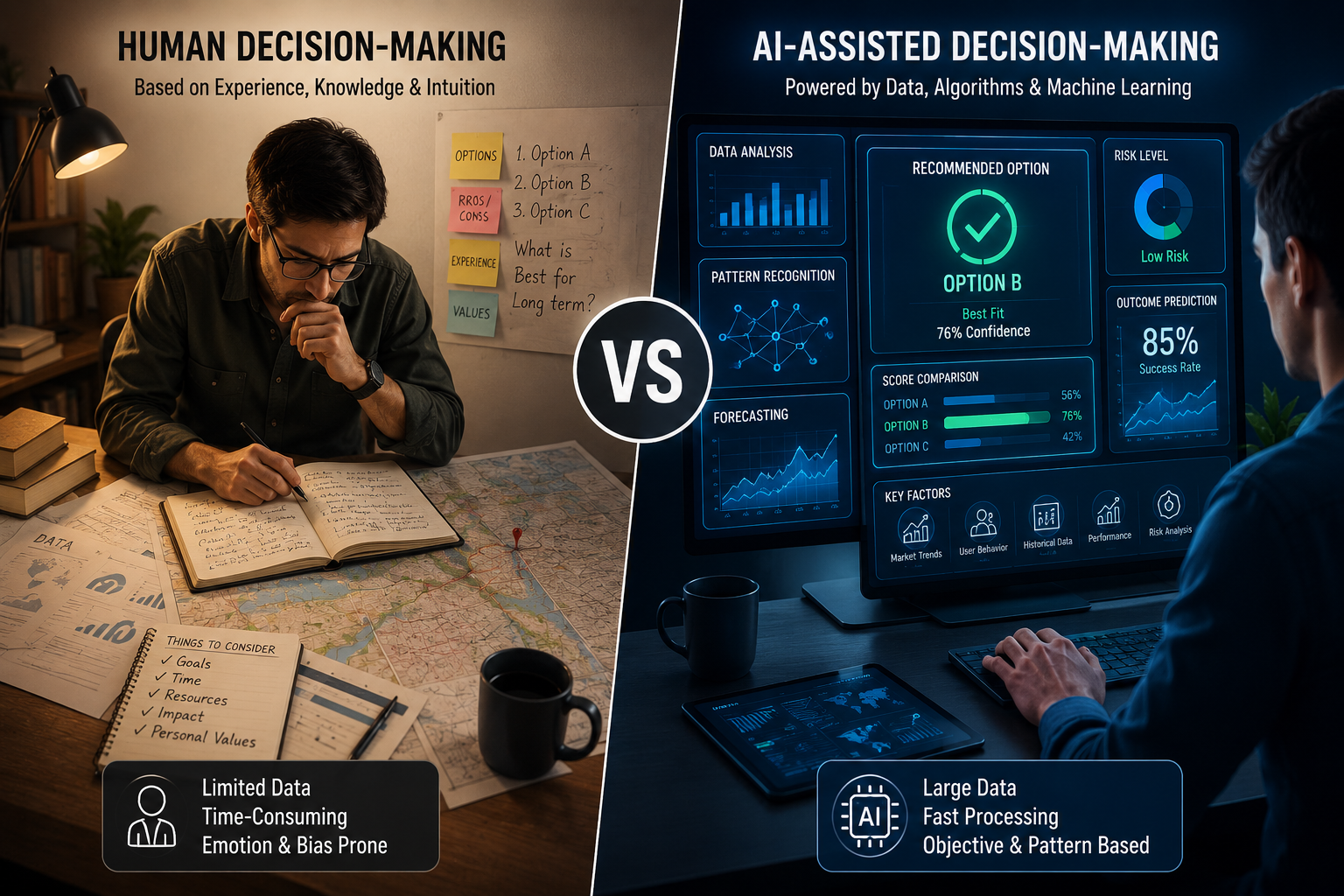
Supporting a decision and making a decision are not the same thing. Understanding this distinction is essential because the future of responsible technology depends on maintaining a healthy balance between human judgment and intelligent automation.
When technology functions as an assistant, it provides information, identifies patterns, and recommends possible actions while leaving the final responsibility with human decision-makers. A navigation application suggesting multiple routes, a financial dashboard presenting investment data, or an AI writing assistant recommending edits all represent examples of technology enhancing human capability without removing personal control.
Authority begins to shift when recommendations become automatic actions that receive little or no meaningful human review. If hiring software rejects applicants without oversight, automated financial systems deny services without transparent explanations, or predictive algorithms determine important opportunities based solely on historical data, technology moves beyond assistance and begins exercising practical authority over outcomes that directly affect people's lives.
The challenge is not whether intelligent systems should participate in decision-making. In many situations, their analytical capabilities provide substantial benefits that improve efficiency, accuracy, and consistency. The greater challenge is ensuring that human values, ethical reasoning, and accountability remain central whenever decisions influence individual rights, opportunities, or long-term societal consequences.
As intelligent technologies continue advancing, the question facing society is becoming increasingly clear. Rather than asking whether machines are capable of making decisions, people must decide which decisions should always remain guided by informed human judgment.
The Benefits We Cannot Ignore
Discussions about intelligent decision-making often focus on potential risks, but doing so without acknowledging its genuine advantages presents an incomplete picture. The increasing role of technology in decision-making is not simply the result of technological enthusiasm. It reflects real improvements that have helped individuals, businesses, and public institutions solve problems more efficiently than ever before. Understanding these benefits is essential before evaluating where limits should exist.
One of the most significant advantages is speed without sacrificing analytical depth. Human experts can certainly make excellent decisions, but they are naturally limited by time and the amount of information they can process. Intelligent systems can evaluate millions of data points within moments, compare hundreds of possible scenarios, and highlight the most relevant findings almost instantly. This capability enables organizations to respond faster during emergencies, detect unusual patterns earlier, and improve operational efficiency across countless industries.
Consistency represents another important strength. Human decision-making is influenced by fatigue, stress, emotional pressure, distractions, and cognitive limitations. Even experienced professionals may reach different conclusions when presented with similar situations under different circumstances. Properly designed intelligent systems apply the same evaluation process repeatedly, helping organizations maintain more predictable and standardized outcomes for routine analytical tasks.
Technology also expands access to expertise. Small businesses, independent professionals, and individuals now benefit from analytical tools that were once available only to large organizations with dedicated research teams. Financial planning software, language translation systems, educational platforms, healthcare support tools, and productivity applications provide advanced recommendations that help people make better-informed decisions without requiring years of specialized training.
Personalization has become another transformative advantage. Instead of offering identical experiences to everyone, intelligent systems increasingly adapt recommendations according to individual preferences, behavior, and goals. Educational platforms adjust learning materials based on student performance, fitness applications recommend personalized workout plans, and digital accessibility tools assist people with disabilities in navigating information more effectively. When implemented responsibly, personalization allows technology to serve diverse human needs more effectively than traditional one-size-fits-all approaches.
Perhaps the greatest benefit is that technology allows people to devote more attention to complex decisions that require creativity, empathy, ethical reasoning, and long-term thinking. By automating repetitive analytical work, intelligent systems create opportunities for professionals to focus on responsibilities where uniquely human qualities remain irreplaceable. In this sense, technology has the potential to strengthen human capability rather than diminish it provided that automation continues serving people instead of quietly replacing meaningful human judgment.
The Risks of Letting Technology Decide Too Much
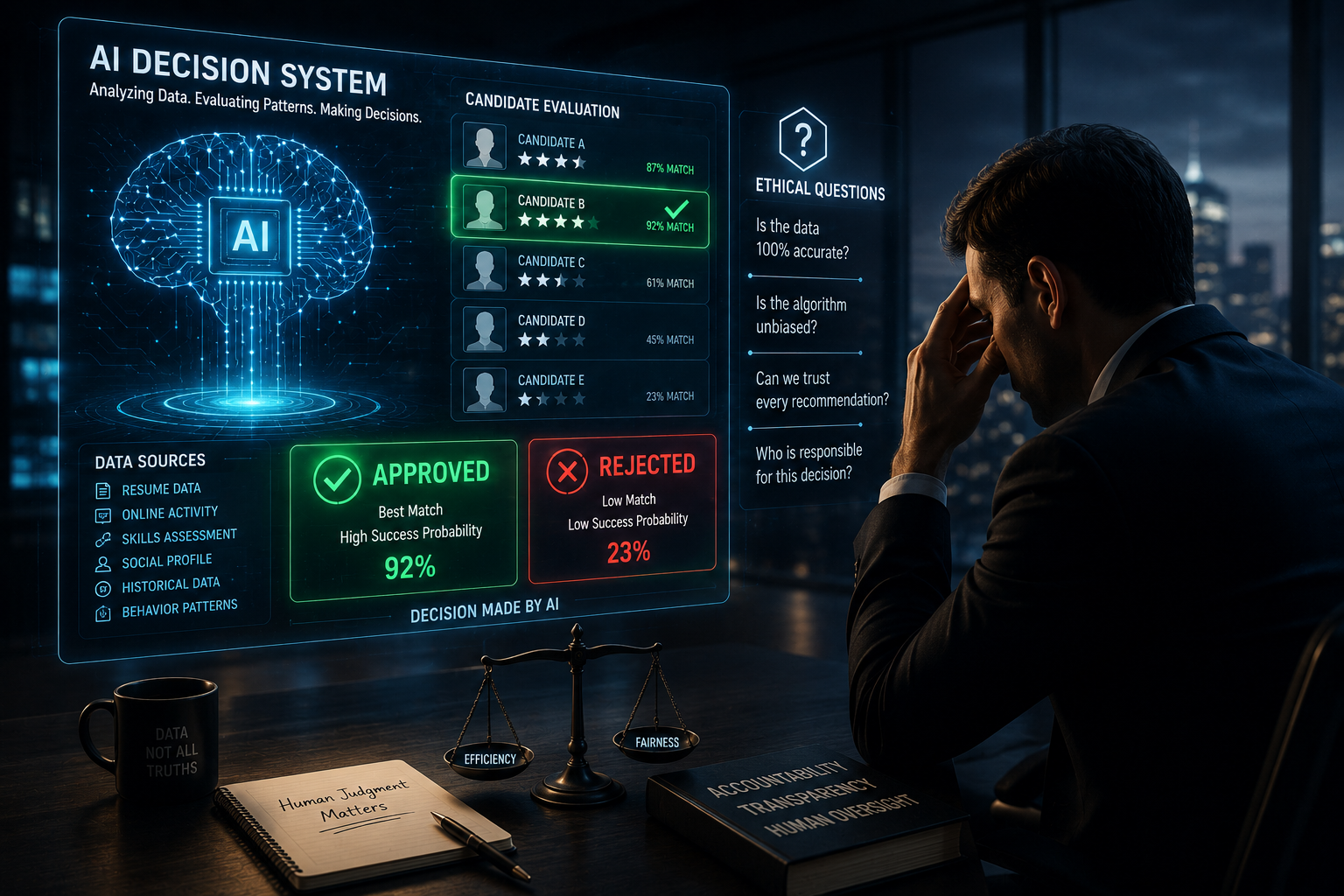
The same capabilities that make intelligent systems valuable can also create significant challenges when society begins depending on them without sufficient oversight. As technology becomes increasingly involved in important decisions, the conversation shifts from technical performance to ethical responsibility. The central concern is not whether intelligent systems can make decisions efficiently, but whether every decision should be delegated to them in the first place.
One major risk is the gradual erosion of human critical thinking. When people consistently rely on automated recommendations, they may stop questioning how those recommendations were generated or whether better alternatives exist. Convenience naturally encourages acceptance, and repeated acceptance gradually weakens the habit of independent evaluation. Over time, individuals may become comfortable following technological guidance even in situations where careful human judgment remains essential.
Another concern involves accountability. When an automated decision causes harm, determining responsibility becomes considerably more complicated. If a financial algorithm unfairly rejects a loan application, a medical support system overlooks a critical diagnosis, or an autonomous vehicle contributes to an accident, responsibility may be shared among software developers, data providers, organizations using the technology, and human supervisors. Without clear accountability, public trust becomes increasingly difficult to maintain.
Transparency presents an equally important challenge. Many advanced artificial intelligence systems operate through highly complex models that even their creators cannot fully explain in simple terms. This lack of explainability becomes problematic when technology influences decisions affecting employment, education, healthcare, financial opportunities, or legal outcomes. People deserve to understand why important decisions are made, especially when those decisions have lasting consequences for their lives.
Historical bias within data also deserves careful attention. Intelligent systems learn from existing information rather than developing independent moral reasoning. If historical records contain unfair treatment, incomplete representation, or social inequalities, technology may unintentionally reinforce those same patterns instead of correcting them. While algorithms do not possess personal prejudice, they can inherit the limitations of the data used to train them, making continuous monitoring and responsible data management essential.
Perhaps the greatest long-term concern is not technological failure but excessive dependence. A society that gradually stops exercising independent judgment risks losing valuable human skills such as critical thinking, ethical reasoning, creative problem-solving, and contextual understanding. These qualities cannot be fully replicated through data analysis alone because they depend on human experience, empathy, cultural awareness, and moral responsibility.
Why Human Judgment Still Matters
Despite remarkable advances in artificial intelligence, technology remains fundamentally different from human intelligence. Machines excel at identifying patterns, performing calculations, and processing information at extraordinary speed. Human beings contribute something equally valuable that cannot be measured simply through data wisdom, empathy, ethical reasoning, imagination, and the ability to understand situations that extend beyond measurable facts.
Consider a physician speaking with a seriously ill patient. Medical software may accurately predict treatment outcomes based on thousands of similar cases, yet it cannot fully understand the patient's personal fears, family circumstances, emotional priorities, or cultural values. Likewise, a teacher deciding how to encourage a struggling student must consider motivation, confidence, personality, and emotional well-being alongside academic performance. These decisions require compassion and contextual understanding that extend beyond statistical analysis.
Leadership provides another powerful example. Successful leaders rarely make decisions based solely on numerical evidence. They evaluate relationships, organizational culture, long-term vision, public trust, and ethical responsibility. During periods of uncertainty, leadership often requires balancing conflicting priorities where no algorithm can objectively define the "correct" answer because the decision depends on human values rather than mathematical optimization.
The future therefore should not be viewed as a competition between people and intelligent systems. A more constructive perspective recognizes that each possesses different strengths. Technology can analyze information more quickly than humans, while people provide judgment, accountability, creativity, and ethical direction. The most resilient decision-making systems will combine these complementary capabilities instead of allowing one to replace the other entirely.
Maintaining meaningful human oversight is not a sign of technological weakness. It is a recognition that the most important decisions often involve values that extend beyond efficiency, probability, or computational accuracy. As intelligent systems become increasingly capable, preserving the human ability to question, interpret, and take responsibility will remain one of society's greatest responsibilities.
Preparing for a Future Where Humans and Technology Decide Together
The conversation surrounding intelligent decision-making is often framed as a choice between complete human control and complete technological automation. In reality, the future is far more likely to involve collaboration than replacement. As intelligent systems become increasingly capable, the most successful societies and organizations will be those that learn how to combine computational intelligence with responsible human judgment rather than viewing them as competing forces.
This collaborative approach is already emerging across multiple industries. In healthcare, artificial intelligence assists doctors by identifying possible abnormalities and organizing complex medical information, while physicians continue making final treatment decisions based on clinical expertise and patient needs. In aviation, sophisticated systems continuously monitor aircraft performance and environmental conditions, yet trained pilots remain responsible for critical decisions during unexpected situations. Financial institutions increasingly rely on automated analysis to detect risks, but experienced professionals still evaluate complex cases that require contextual understanding and ethical consideration.
The same principle can extend to education, business leadership, public administration, scientific research, and countless other fields. Intelligent systems excel at processing information, recognizing patterns, and predicting likely outcomes. Human beings contribute qualities that technology cannot fully replicate, including empathy, moral reasoning, creativity, cultural awareness, and the ability to understand circumstances that cannot be reduced to data alone. When these strengths complement one another, decision-making becomes both more efficient and more responsible.
Achieving this balance requires thoughtful design rather than blind optimism. Organizations adopting intelligent technologies must ensure that automated recommendations remain transparent, understandable, and subject to meaningful human review whenever decisions affect people's rights, safety, employment, education, healthcare, or financial opportunities. Technology should expand human capability instead of quietly removing opportunities for people to question, challenge, and improve important decisions.
Public awareness will play an equally important role. Digital literacy is no longer limited to learning how to operate devices or use software effectively. Modern digital literacy also includes understanding how recommendation systems influence choices, recognizing the limitations of automated predictions, and maintaining the confidence to question technological outputs when necessary. The more informed people become about intelligent systems, the less likely they are to confuse technological convenience with unquestionable authority.
Rather than fearing innovation or embracing automation without limits, society has an opportunity to shape a future where technology remains accountable to human values. Progress will not be measured simply by building smarter machines but by ensuring that greater intelligence is matched by greater responsibility, transparency, and ethical oversight.
Key Takeaways
- Technology has evolved from performing repetitive calculations to actively participating in decisions that influence nearly every aspect of modern life. This transformation has occurred gradually through recommendation systems, predictive analytics, machine learning, and artificial intelligence that increasingly guide how information is organized and presented. Although many of these systems improve efficiency, speed, and consistency, they also introduce important questions about accountability, fairness, and human autonomy.
- The benefits of intelligent decision-making are substantial. Organizations can process enormous amounts of information more quickly, reduce repetitive work, personalize services, and support professionals in solving complex problems. These capabilities create opportunities for better healthcare, safer transportation, more efficient businesses, and improved public services when implemented responsibly.
- At the same time, excessive dependence on automated decisions may weaken independent thinking, reduce transparency, complicate accountability, and unintentionally reinforce historical biases contained within training data. These risks highlight why human oversight should remain central whenever technology influences decisions with significant personal or societal consequences.
- The future is unlikely to belong exclusively to either humans or machines. Instead, it will be shaped by partnerships in which technology provides analytical power while people continue contributing ethical judgment, creativity, empathy, and responsibility. Maintaining this balance will determine whether intelligent systems strengthen human decision-making or gradually replace the qualities that make thoughtful leadership and meaningful choice possible.
- Ultimately, the most important question is not whether Technology Starts Making Decisions. That transition is already underway. The more meaningful question is whether humanity will continue making the values-based decisions that guide how technology itself should be used.
It refers to the growing role of intelligent technologies in analyzing information, predicting outcomes, and recommending or automating decisions that were once made entirely by humans. Examples include AI-powered healthcare systems, financial risk assessments, navigation apps, recruitment software, and personalized recommendation algorithms.
No. In most real-world applications, artificial intelligence supports human decision-making rather than replacing it entirely. Human oversight remains essential in areas involving ethics, legal responsibility, healthcare, education, and public safety.
People often trust intelligent systems because they process large amounts of data quickly, provide consistent recommendations, reduce repetitive work, and frequently improve efficiency. However, trust should always be balanced with transparency and human evaluation.
Technology can improve consistency, but it is not automatically free from bias. Intelligent systems learn from historical data, and if that data contains inaccuracies or unfair patterns, automated decisions may reflect similar limitations unless carefully monitored and improved.
The most effective approach is using technology as a decision-support tool while ensuring that humans remain responsible for ethical reasoning, accountability, creativity, and final decisions that significantly affect people's lives.