Why People Feel Lonely Even When They Are Surrounded by Others
- Why people feel lonely even when surrounded by others is not always easy to understand. A person can have family members at home, colleagues at work, friends in different cities and hundreds of contacts on a phone, yet still experience loneliness. From the outside, that can be difficult to understand. If someone is constantly surrounded by people, attending gatherings and exchanging messages throughout the day, why might they still feel disconnected?
- The answer is that loneliness is not simply about the number of people in a person's life. The World Health Organization describes loneliness as a distressing feeling that can arise when the social connections a person has do not match the connections they want or need. Social isolation is different: it refers more objectively to having too few relationships, roles or interactions with others.
- That distinction helps explain why two people can live very different social lives and still experience connection in completely different ways. One person may spend an evening alone and feel peaceful, while another may sit in a crowded room and quietly wish there were someone they could speak to honestly.
- This article looks at how that kind of distance can develop in ordinary life. It explores family routines, changing friendships, major life transitions, digital communication and the small ways people can gradually become less connected without anyone deliberately choosing it. The purpose is not to label or diagnose anyone, but to understand an experience that can be surprisingly difficult to explain.
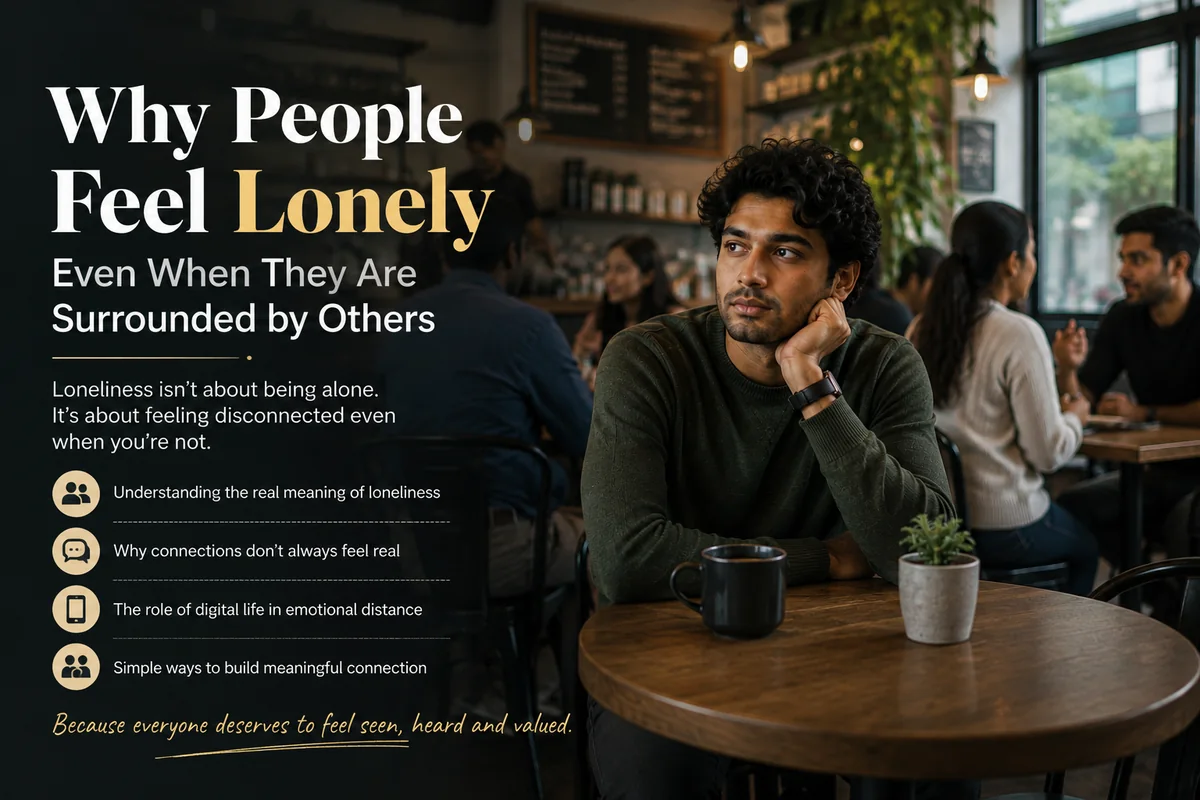
A person can have family members at home, colleagues at work, friends in different cities and hundreds of contacts on a phone, yet still experience loneliness. From the outside, that can be difficult to understand. If someone is constantly surrounded by people, attending gatherings and exchanging messages throughout the day, why might they still feel disconnected?
The answer is that loneliness is not simply about the number of people in a person's life. The World Health Organization describes loneliness as a distressing feeling that can arise when the social connections a person has do not match the connections they want or need. Social isolation is different: it refers more objectively to having too few relationships, roles or interactions with others.
That distinction helps explain why two people can live very different social lives and still experience connection in completely different ways. One person may spend an evening alone and feel peaceful, while another may sit in a crowded room and quietly wish there were someone they could speak to honestly.
This article looks at how that kind of distance can develop in ordinary life. It explores family routines, changing friendships, major life transitions, digital communication and the small ways people can gradually become less connected without anyone deliberately choosing it. The purpose is not to label or diagnose anyone, but to understand an experience that can be surprisingly difficult to explain.
When Being Around People Is Not the Same as Feeling Connected
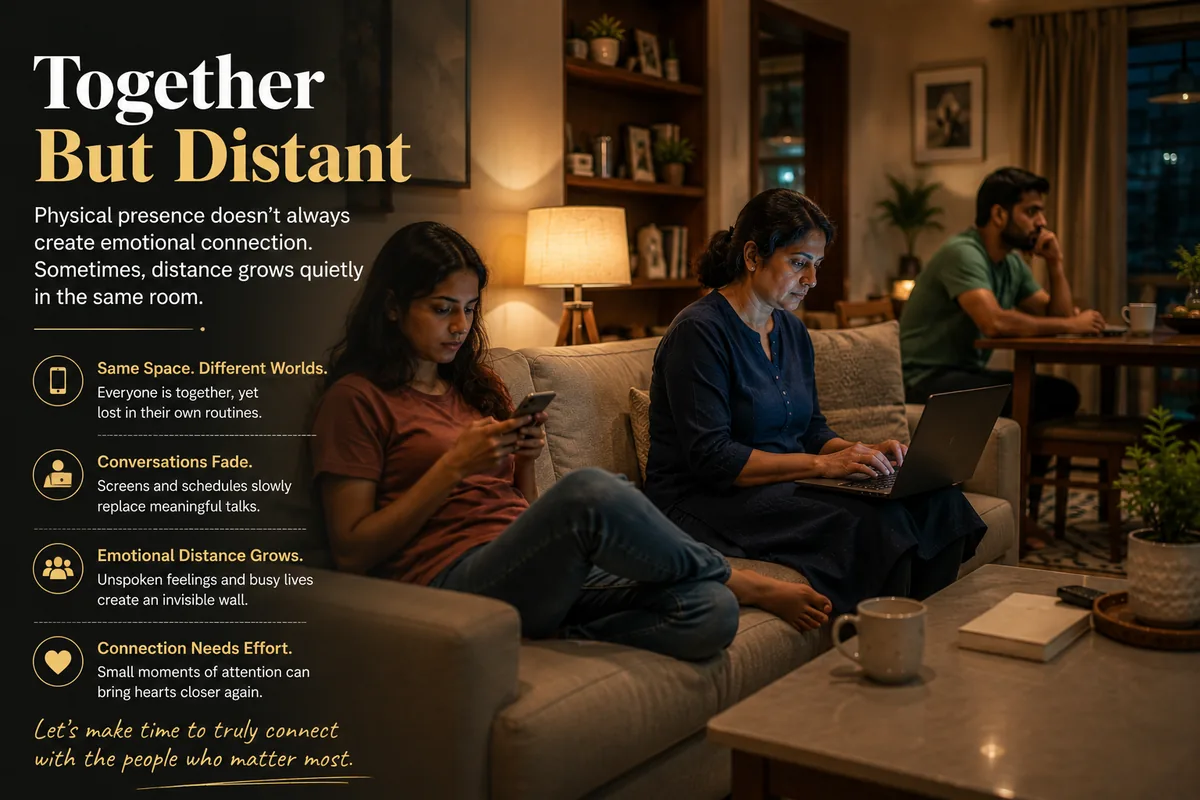
Imagine someone returning home after a long day. The house is not empty. A family member is watching television, someone else is checking a phone, messages are arriving on several devices and the ordinary sounds of home are all around them. From the outside, it would be easy to assume that this person has plenty of company.
Yet they may still feel as though nobody really knows how their day went.
That quiet difference sits at the centre of many experiences of loneliness. Physical presence and emotional connection are not the same thing. A person can sit in a room with ten people without having one conversation that makes them feel genuinely heard. Another person can spend an evening alone, read a book, take a walk or call someone they trust and feel perfectly comfortable.
The more useful question, then, is not simply how many people are around us. It is whether the relationships in our lives give us a genuine sense of connection, support and belonging.
The WHO's current framework for social connection looks beyond the number of relationships. It considers their structure, the support exchanged through them and their quality, including whether interactions feel positive and satisfying or strained and difficult.
This is one reason loneliness can be difficult for other people to notice. There may be no obvious outward sign. Someone may continue going to work, attending family functions, answering messages, laughing with friends and completing everyday responsibilities. Nothing necessarily looks wrong from the outside.
Sometimes the change is much quieter. Conversations become shorter. Invitations are declined more often. Personal thoughts remain unshared. A person who once talked freely may start feeling that explaining themselves takes too much effort.
None of these things automatically means that someone is experiencing serious loneliness. People naturally go through periods when they want privacy, rest or time away from others. But when a persistent feeling of disconnection begins to shape everyday life, it deserves understanding rather than dismissal.
The difficulty is that the outside picture and the inside experience may look completely different.
Someone can appear socially active while privately feeling that there is no one with whom they can really be themselves.
Why People Feel Lonely: It Is Not the Same as Being Alone
The words alone and lonely are often used as though they mean the same thing. They do not.
Being alone describes a situation. Loneliness describes an internal experience.
Someone may choose to spend a quiet Sunday morning alone because they enjoy the peace. They may cook breakfast, listen to music, read, take a walk or simply sit without speaking to anyone. There is nothing unusual about enjoying solitude while also having healthy relationships.
Loneliness can be very different. A person may want conversation but feel that there is nobody they can comfortably call. They may attend a family gathering but feel unable to talk about what is actually troubling them. They may have friends but believe those friendships have become mostly superficial. They may communicate constantly online while still feeling that nobody really understands what is happening in their life.
The WHO makes this distinction important by separating loneliness from social isolation. Social isolation is an objective lack of sufficient social connections, while loneliness is the person's subjective experience of a gap between the connection they have and the connection they want or need.
That difference also helps explain why people feel lonely even when they have regular contact with others.
If loneliness simply meant “not having enough people,” the obvious solution would be to meet more people. Sometimes that can help. But it does not automatically address what a person is missing.
Someone who spends every working day around colleagues may not need more acquaintances. They may need one relationship in which they can speak honestly without feeling judged. Someone who receives dozens of messages every day may not need more notifications. They may need one conversation that goes beyond routine updates.
A large social circle can provide company, but company and closeness are not interchangeable.
This is also why telling someone who feels lonely to “just go out more” can sometimes miss the point. The issue may not be the absence of people. It may be the absence of a relationship in which the person feels understood.
Why Emotional Connection Can Disappear Inside Busy Lives
Modern life leaves very little empty space. Work occupies one part of the day, commuting another and household responsibilities another. Family members may follow different schedules, children may have school and activities, and adults may carry responsibilities that nobody else in the household fully sees.
The strange result is that people can spend a great deal of time together while having very little unhurried time with one another.
A conversation that once lasted twenty minutes may now happen in fragments: one sentence while preparing dinner, another while leaving for work, a quick message during lunch and a short exchange before bed. Nothing dramatic has necessarily happened to the relationship. There has simply been less room for conversation to develop naturally.
Over time, that can change how people experience one another.
A partner may know what groceries need to be bought but not what the other person has been worrying about. Parents may know whether their child attended school but not what has been occupying the child's mind. Adult children may speak to their parents regularly about practical matters without asking how either of them is actually doing.
This is one reason loneliness does not always begin after a major argument, breakup or obvious conflict.
Sometimes it develops through smaller things: missed conversations, postponed calls, tired evenings and repeated promises that there will be time to talk later.
The relationship may still be there. The affection may still be there. The people may still be physically close. But the feeling of being genuinely known can gradually become weaker.
And when that happens, a person may quietly begin to wonder why they feel alone when, technically, they are not.
The Difference Between Being Seen and Being Understood
There is another layer to this experience that is easy to miss.
Being noticed is not always the same as being understood.
A person may be asked, “How are you?” several times in a week and still feel that nobody really wants to hear the answer. They may receive congratulations when something goes well, sympathy when something goes wrong and advice whenever they mention a problem. Yet what they may actually want is a little space to explain what is happening without immediately being corrected or given a solution.
People do not always need someone to solve their problems. Sometimes they need someone who can stay in the conversation long enough to understand what they are trying to say.
This becomes particularly important when people are known mainly for the roles they play. The dependable sibling may always be expected to manage things. The successful colleague may be assumed to be doing fine. The quiet parent may rarely be asked what they want. The person who jokes constantly may be treated as though difficult days are not part of their life.
When a person's role becomes stronger than the individual behind it, genuine conversation can become harder.
The person is still surrounded by others. They are still included in conversations and daily activities. But they may begin to feel that people know what they do without really knowing how they feel.
That is a very different kind of distance.
How Major Life Changes Can Create Quiet Distance
Loneliness can become more noticeable when life changes in ways we did not fully expect. Moving to another city, starting a new job, leaving college, getting married, becoming a parent, retiring, losing a familiar routine or watching children leave home can all change a person's social world. The change may be positive, necessary or even something the person wanted, yet it can still leave behind a sense of distance from the relationships and routines that once felt natural.
Before a major transition, social contact often happens without much planning. A workplace provides familiar faces every day. School or college creates regular opportunities to meet friends. Children bring parents into contact with other families. A neighbourhood can create casual conversations that gradually become friendships. When circumstances change, these natural points of contact can disappear surprisingly quickly.
A person may still have the same phone number, old friends and family members. What may have disappeared is the everyday rhythm of connection.
There is a big difference between having someone you can contact and having someone who naturally becomes part of your day.
Consider someone who moves from a smaller town to a large city for work. Their new apartment may be comfortable, their workplace may be busy and their phone may contain dozens of contacts. Yet after returning home each evening, they may realise that none of those new relationships has become part of their everyday life in the way the people they left behind once were.
The opposite can happen too. Someone may remain in the same home while the people around them enter new stages of life. Children become independent. Friends become occupied with careers and families. Colleagues change jobs. A neighbourhood changes gradually. The person has not moved, but their social world has.
This is why loneliness should not be understood only as a problem experienced by people who live alone.
Sometimes a person's surroundings change without their address changing, which helps explain why people feel lonely after major life changes.
Retirement Is One Example
Retirement provides a useful example of how a change in routine can affect social connection.
For many working adults, a workplace provides more than an income. It creates structure, familiar faces, conversations and a reason to leave home each morning. When that structure disappears, the reduction in everyday interaction can be surprising.
A retired person may have family members nearby and still miss the ordinary rhythm of meeting colleagues, discussing everyday matters and feeling involved in something outside the home.
That does not mean retirement itself causes loneliness. Many people enjoy retirement and use the opportunity to develop new interests, friendships and routines. The important point is that a major change in daily structure can remove old opportunities for connection, which means new ones may need to be created deliberately.
The same principle can apply to other transitions.
A student moving away for education may miss the familiarity of home. A new parent may find that conversations with friends become less frequent. Someone caring for an ageing family member may gradually reduce social activities because responsibilities become difficult to manage.
These situations are different, but they share something important: the old pattern of connection no longer fits the person's new life.
When Social Media Adds More Contact but Less Closeness
Modern communication has made it easier than ever to reach another person.
A message can cross the country in seconds. Family groups can keep relatives updated about everyday events. Friends can share photographs, videos and celebrations without meeting in person. Someone who has moved abroad can remain in regular contact with people back home.
That is a genuine benefit.
But constant communication does not automatically create emotional closeness.
A person can spend an hour scrolling through other people's lives and still finish the evening feeling disconnected from their own relationships. They may know where their friends went, what they ate, what they bought and what they celebrated, while having no idea what one of those friends is privately struggling with.
This creates an interesting contradiction.
We may know more about people while knowing less about how they actually feel.
Social platforms also make it possible to maintain relationships through very small interactions. A reaction, emoji, short comment or quick message can keep a connection active without requiring much emotional effort. None of these interactions is inherently bad. They become less satisfying when they gradually replace the deeper conversations a person actually wants.
At the same time, it would be too simple to say that social media causes loneliness. Online communities can provide genuine companionship, particularly for people separated by distance or those who find it easier to connect around shared interests online. The experience depends on how digital communication fits into a person's wider social life.
The more useful question is not simply:
“How much time do you spend online?”
It is:
“After spending time online, do you feel more connected to people, or more distant from them?”
That question says much more about the quality of a person's digital social life and can help explain why people feel lonely even when communication is constant.

Why Some People Stop Reaching Out
One of the less visible parts of loneliness is what can happen before someone becomes disconnected.
Sometimes people stop reaching out because they have tried before.
A person may have called a friend several times and received short replies. Someone may have suggested meeting but found that plans were repeatedly cancelled. An older relative may have called family members less often after feeling that everyone was too busy. A colleague may have attempted to join conversations but gradually decided that they were not really part of the group.
After enough experiences like these, a person may begin protecting themselves from disappointment.
They stop asking.
This can create a difficult cycle. Other people may assume the person is busy because they no longer initiate contact. The person may interpret the lack of invitations as evidence that nobody cares. Both sides continue with their own assumptions, and the distance slowly becomes normal.
There can also be a fear of appearing needy.
Adults are often expected to manage their own lives. Someone may think, “Everyone has their own problems,” or “I don't want to disturb them.” A person who looks independent from the outside may therefore receive less support because others assume they do not need it.
This is particularly relevant in families and communities where people are more accustomed to expressing care through practical help than through emotional conversations.
Someone can be extremely well cared for and still find it difficult to say, “I feel alone.”
That sentence can feel much more vulnerable than asking someone to help with an everyday problem.
Why Asking for Company Can Feel Harder Than Giving It
Many people are comfortable helping others but uncomfortable asking others for help.
They will answer a friend's call, visit a relative, help a neighbour or support a colleague. But when they themselves want company, they may hesitate. They may worry about imposing, being misunderstood or discovering that the other person does not feel the same closeness.
Over time, this can create one-sided relationships in which a person is always available to others but rarely allows others to be there for them.
That pattern can be difficult to recognise because the person may appear socially active, dependable and generous.
The quieter question is whether they feel comfortable being cared for too.
Everyday Signs That Someone May Be Feeling Disconnected
There is no single sign that proves a person is experiencing loneliness. Changes in behaviour can have many explanations, and it would be inappropriate to diagnose someone simply by observing them.
Still, certain changes may be worth noticing when they continue for some time and occur alongside other changes.
A person may gradually stop making plans they once enjoyed. They may participate in conversations but rarely share anything personal. They may repeatedly say they are “fine” while avoiding opportunities to talk. They may spend increasing amounts of time passively scrolling, watching television or staying occupied simply because quiet moments feel uncomfortable.
Another person may become unusually quiet during family gatherings. Someone who once called friends regularly may stop initiating conversations. A person who recently moved, retired or experienced a major change may discover that familiar social routines have disappeared without new ones taking their place.
None of these behaviours should be treated as proof of loneliness.
They are simply reasons to pay attention.
The most useful response is usually not an interrogation. A simple and genuine conversation can create more space than a dramatic intervention.
Instead of asking:
“Why are you so lonely?”
someone might say:
“You seem a little quieter lately. How have things actually been going?”
That leaves room for an honest answer without placing a label on the person.
Sometimes the answer will simply be, “I'm fine.”
Sometimes it may open a conversation that was waiting to happen.
What Meaningful Connection Can Actually Look Like
If loneliness is not simply about the number of people around us, then a more useful question is: what does meaningful connection actually look like, and why do people feel lonely even when they have regular social contact?
There is no single formula. Different people need different kinds of relationships, and the amount of social interaction that feels comfortable can vary considerably. One person may feel deeply connected through a close friendship. Another may find that family, neighbours, colleagues, community activities and a few trusted relationships together provide a strong sense of belonging.
What matters is not creating an impressive social life.
It is having relationships in which a person can be reasonably comfortable being themselves.
That can mean having someone who notices when your usual energy has changed. It can mean being able to discuss something without the conversation immediately turning into advice, criticism or a comparison with someone else's experience. It can mean knowing that a friend will listen even when there is no practical solution to offer.
Meaningful connection also appears in ordinary moments.
A neighbour asking how a family member is doing. A sibling remembering an important appointment. A friend calling without needing a particular reason. A parent sitting with an adult child for ten quiet minutes instead of filling the conversation with advice. A colleague noticing that someone has been unusually quiet and giving them an opportunity to speak.
These moments may look insignificant.
They can quietly communicate something important:
“You are noticed here. You matter to someone.”
Connection Does Not Always Require a Large Social Circle
There is a common assumption that people need a large group of friends to avoid loneliness. In reality, the number of relationships does not automatically determine how connected someone feels.
A person with two trustworthy relationships may feel more secure and understood than someone with fifty acquaintances. Large social groups can be enjoyable, but numbers alone cannot guarantee emotional closeness.
This becomes particularly relevant when contact lists, followers and online communities make social connection appear measurable. A large network can tell us how many people might be able to contact someone. It tells us much less about how many people that person feels comfortable calling when something genuinely matters.
Meaningful connection is therefore less about collecting contacts and more about having relationships that feel real, dependable and mutual.
Strong relationships also leave room for boundaries. Being connected does not mean being available every minute, sharing every private thought or agreeing with everything another person says. Healthy relationships can include disagreement, personal space and different interests while still maintaining respect and trust.
In other words, meaningful connection is not constant contact.
It is reliable human connection when it matters.
Practical Ways to Rebuild Everyday Connection
If someone recognises themselves in parts of this article, the answer does not have to be a dramatic change in lifestyle. Small adjustments can sometimes create opportunities for connection that busy routines have gradually removed.
The first step is to notice where connection has weakened.
Think about the people you used to speak with naturally. Perhaps it was an old friend, a sibling, a neighbour, a former colleague or a relative. You do not need to rebuild every relationship at once. One genuine conversation can be a better starting point than making a long list of social goals.
- Start With One Person, Not Everyone: When someone feels disconnected, the idea of becoming “more social” can sound exhausting. There is no need to suddenly attend events every weekend or build a large social circle. Choose one person with whom conversation already feels relatively comfortable. Send a simple message. Ask how they are doing. If the conversation develops naturally, allow it to continue instead of rushing back to routine. The goal is not to create an impressive social calendar. The goal is to create one real point of connection.
- Replace Routine Questions With Genuine Ones: Questions such as “How was your day?” can become automatic. Sometimes a more specific question creates a better conversation. Instead of asking only whether someone's day was good, ask what part of the day was difficult, what they are looking forward to, whether something has been worrying them or what has been occupying their thoughts recently. The other person may not want to answer deeply, and that is perfectly fine. The value comes from making it clear that there is room for a real answer rather than expecting the usual “fine” and moving on.
- Make Regular Contact Easier: Relationships often weaken because staying in touch requires too much planning. A short weekly call can sometimes be easier to maintain than repeatedly saying, “We should meet sometime.” Families can choose a regular meal together. Friends living in different cities can create a simple routine for calling each other. Consistency can matter more than duration. A fifteen-minute conversation that happens regularly may create more connection than a long conversation that happens only once every six months.
- Spend Some Time Together Without an Agenda: Not every meeting needs a purpose. People sometimes become so focused on activities that they forget the value of simply being together. A walk, cup of tea, shared meal or short visit can create opportunities for conversation that do not occur when every interaction is planned around a task. This can be especially useful within families. A person does not always need a formal “family discussion.” Sometimes sitting together without a specific objective makes conversation feel more natural.
- Listen Without Immediately Fixing: When someone shares a difficult experience, the first response is often advice. Advice can be useful, but it is not always what the other person needs first. Listening without interrupting, dismissing or immediately comparing their experience with someone else's can make a conversation feel safer. Sometimes a person simply wants to finish explaining what happened. A useful response can be as simple as: “I can understand why that stayed on your mind.” It acknowledges the experience without pretending to know exactly what the person feels.
- Reconnect Through Activities: Connection can be easier when people share an activity. A walking group, reading group, sports activity, volunteering opportunity, community event, hobby class or local gathering can create repeated contact without requiring people to begin with a deeply personal conversation. This can be especially useful after a major life transition. The activity itself does not have to be extraordinary. What matters is that it creates a regular opportunity to see familiar people and gradually develop familiarity.
- Notice People Who May Have Fewer Opportunities to Connect: Sometimes rebuilding connection is not only about our own social life. Look around. An older relative may rarely receive visitors. A neighbour who recently moved may not know many people nearby. A colleague working remotely may spend most days without ordinary workplace interaction. Someone who has recently retired may have lost the routine that once brought them into contact with others. A simple invitation can make a difference. It does not need to be dramatic. A cup of tea, a short walk, a shared meal or a conversation outside the usual routine can create an opening.

When Reaching Out Is Not Enough
There are situations where loneliness can become more complicated than simply needing more social contact.
A person may have tried to reconnect with others and still feel persistently disconnected. They may also experience significant changes in mood, sleep, appetite, concentration, motivation or their ability to manage everyday responsibilities.
In such circumstances, it is worth looking beyond the simple advice to “go out more” or “make new friends.”
Loneliness can coexist with other emotional or mental-health difficulties, but the experience of loneliness by itself does not tell us what is happening clinically. That distinction matters because an article cannot diagnose an individual based on a list of experiences.
If a person is struggling for a prolonged period or their wellbeing and everyday functioning are being affected, speaking with a qualified mental-health professional or healthcare provider can be an appropriate step.
Seeking help should not be treated as an admission of weakness.
Sometimes it is simply another way of taking a difficult situation seriously.
The same principle applies when we are concerned about someone else. We do not need to diagnose them, analyse their behaviour or tell them what is wrong. We can listen, encourage them to speak with someone they trust and, when appropriate, support them in finding professional help.
The Role of Family and Friends
There is something else worth remembering: connection is a shared responsibility.
It is easy to think of loneliness as an individual's problem. We may say that someone should make more friends, leave the house more often or become more social. But relationships involve more than one person.
A person can make an effort to reach out and still be met with indifference. A family can say it cares about an older relative while rarely making time for conversation. Friends can remain connected through social media while never creating space for an actual conversation.
This does not mean people are deliberately uncaring.
Modern life creates genuine pressures. Work, childcare, commuting, finances, health responsibilities and personal commitments can consume much of a person's attention.
But understanding those pressures should not make us blind to their consequences.
Sometimes the most meaningful change is simply becoming more intentional.
Call someone before they always have to call you.
Ask a question and wait for the answer.
Invite someone without assuming they are too busy.
Remember the detail they mentioned last week.
Notice when a normally talkative person becomes unusually quiet.
These actions are small, but relationships are often built through repeated small actions rather than occasional dramatic gestures.
Why This Matters Beyond the Individual
Loneliness is often discussed as though it is purely a private feeling.
It is not always that simple.
When people feel disconnected, it can affect how they participate in families, workplaces and communities. The WHO increasingly frames social connection as a broader public-health and social issue, noting that loneliness and social isolation can affect health and quality of life.
That does not mean every quiet person is lonely or that every period of solitude is harmful.
It means connection is part of how human beings experience belonging.
A society can have crowded streets, busy workplaces, large apartment buildings and constantly active digital networks while still containing people who feel that nobody truly knows them.
That is why the subject deserves attention.
Not because everyone needs to become highly social, but because belonging cannot be measured simply by how crowded a person's life appears.
A Different Way to Look at an Ordinary Conversation
Think about the last time someone listened to you without checking their phone, interrupting, rushing or immediately trying to solve the problem.
It may not have been a remarkable event.
You may not even remember the exact words.
But you probably remember how the conversation made you feel.
That is one of the simplest ways to understand the difference between contact and connection.
Contact transfers information.
Connection makes a person feel that the information—and the person sharing it—actually matters.
We do not need to turn every interaction into a deep emotional conversation. That would be unrealistic. Ordinary conversations, humour, shared activities and even comfortable silence are all part of healthy relationships.
But somewhere inside the ordinary rhythm of life, people need moments when they are not simply present in a room.
They need to feel present with someone.
Key Takeaways
- Loneliness is not the same as being alone. A person can enjoy solitude and still have meaningful relationships, while someone surrounded by people can feel emotionally disconnected.
- The number of people around us does not automatically determine how connected we feel. The quality, trust and meaning within relationships matter.
- Busy family routines can leave people physically close but emotionally distant when conversations become limited to responsibilities and practical matters.
- Major life changes such as moving to another city, retirement, marriage, parenthood or children becoming independent can quietly change a person's everyday opportunities for connection.
- Social media can help people maintain genuine relationships, but frequent digital contact does not automatically provide emotional closeness.
- A large contact list or social circle cannot guarantee that someone has a person they feel comfortable talking to about something that genuinely matters.
- People sometimes stop reaching out after repeated disappointments, cancelled plans or the feeling that they might be disturbing others.
- Small and consistent actions—such as a regular call, shared meal, walk or genuine conversation—can help relationships remain active and meaningful.
- Listening without immediately judging, comparing or trying to fix the situation can make another person feel heard.
- If persistent feelings of disconnection begin affecting wellbeing or everyday functioning, professional support may be appropriate.
- Supporting connection is not only an individual's responsibility. Families, friends, colleagues and communities can all help create opportunities for meaningful interaction.
- Sometimes a simple conversation can matter more than a large social gathering because it gives someone the feeling that they are genuinely noticed.
Frequently Asked Questions
Yes. Physical closeness and emotional connection are different things. A person may live with family members, share meals and manage everyday responsibilities together while still feeling that nobody understands what they are experiencing internally.
Being alone describes a situation in which a person has limited physical company. Loneliness describes a subjective feeling of lacking the level or quality of connection they want or need. Someone can spend time alone and feel peaceful, while another person can be surrounded by people and still feel lonely. The World Health Organization makes a similar distinction between loneliness and social isolation.
It can, depending on how it is used and what role it plays in someone's wider social life. Online communication can help people maintain genuine relationships, particularly across distance. At the same time, passive scrolling or mainly superficial interactions may not provide the same sense of closeness as meaningful conversation. Social media should therefore not be treated as automatically harmful or automatically helpful.
Start without making assumptions or giving the person a label. Ask how they have genuinely been doing, listen without immediately trying to solve the problem and offer a simple opportunity to spend time together. If they appear to be struggling significantly or persistently, encouraging appropriate professional support may also be helpful.
No. The number of relationships does not necessarily determine how connected someone feels. A person can have many acquaintances and still lack a relationship in which they feel understood and comfortable being themselves.
If feelings of disconnection persist and begin affecting daily functioning, sleep, mood, motivation, relationships or general wellbeing, speaking with a qualified healthcare or mental-health professional may be appropriate. Loneliness itself is not enough to diagnose a mental-health condition, so individual circumstances need to be considered.
Continue Exploring Moments That Matter
If you found this article on DivyalVision, you can continue exploring more human experiences, social observations and stories through our Moments That Matter collection:
- 📖 One Moment Can Redefine a Life: When Everything Changes – Explores how one unexpected moment can become a turning point, changing the direction of a person's life and leaving a lasting impact. Read the article
- 📖 Invisible Problems We See Every Day but Rarely Talk About: 9 Alarming Realities – Looks at everyday issues that often remain unnoticed because they have become so familiar in our surroundings. Read the article
- 📖 Silent Crises That Are Changing Society More Than We Realize: 8 Warning Signs – Explores social changes that develop quietly and may have a deeper impact on individuals and communities than we realise. Read the article
At DivyalVision, the Moments That Matter series explores human experiences, social changes, and often-overlooked realities around us from a closer and more thoughtful perspective.
Final Thoughts
Loneliness does not always have a visible face.
It can exist in a crowded home, a busy office, a family gathering, a classroom or a group chat. It can exist in the life of someone who appears confident, productive and socially active. That is what makes the experience so easy to misunderstand.
The answer is not to assume that every quiet person is lonely or that everyone who enjoys time alone needs to become more social. Solitude can be healthy, and different people naturally need different amounts of social interaction.
What deserves more attention is whether the relationships in our lives give us opportunities to feel heard, respected and included.
Do we have people with whom we can speak honestly? Do we make time for relationships that matter? Do we listen when someone starts talking about something difficult? Do we notice when a person who is normally engaged begins to withdraw?
These questions do not require a perfect social life.
They require awareness.
Sometimes connection begins with something remarkably ordinary: a phone call that is not rushed, a cup of tea shared without checking the clock, a walk with an old friend, a question asked with genuine interest or simply sitting beside someone and giving them your full attention.
We may not always know who around us is feeling disconnected.
But we can make it a little easier for people to feel that they belong.