Prevention of Insults to National Honour Amendment Act 2026: What the New Law Means for Vande Mataram
- The Prevention of Insults to National Honour Amendment Act 2026 has brought Vande Mataram, India's National Song, within the scope of the statutory protection provided under Section 3.The change places the National Song alongside the National Anthem in relation to the specific conduct covered by that provision.
- The key point, however, is easy to misunderstand. The amendment does not mean that simply choosing not to sing Vande Mataram automatically becomes a criminal offence. The provision is concerned with intentionally preventing the singing of the National Anthem or National Song, or causing disturbance to an assembly engaged in such singing.
- The amendment also does not change the official identities of India's two national compositions. Vande Mataram remains the National Song, while Jana Gana Mana remains the National Anthem. The significant change lies in the statutory legal protection now extending to the National Song.
- In this article, we will look at what the 1971 law originally provided, what changed in 2026, what the punishment provisions mean, why Vande Mataram received this protection, and what the change means in schools, official functions and everyday public understanding.
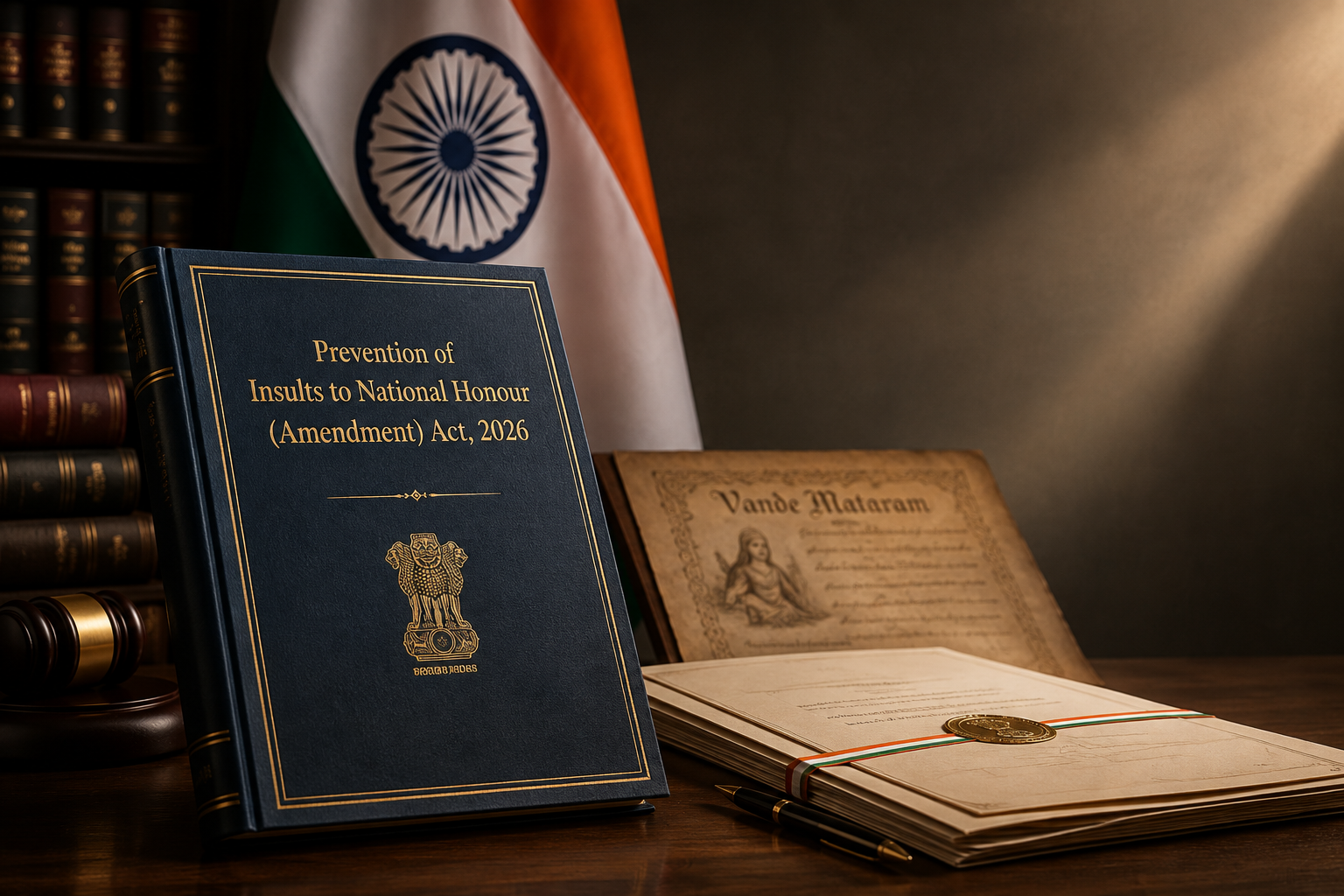
The Prevention of Insults to National Honour Amendment Act 2026 has brought Vande Mataram, India's National Song, within the scope of the statutory protection provided under Section 3.The change places the National Song alongside the National Anthem in relation to the specific conduct covered by that provision.
The key point, however, is easy to misunderstand. The amendment does not mean that simply choosing not to sing Vande Mataram automatically becomes a criminal offence. The provision is concerned with intentionally preventing the singing of the National Anthem or National Song, or causing disturbance to an assembly engaged in such singing.
The amendment also does not change the official identities of India's two national compositions. Vande Mataram remains the National Song, while Jana Gana Mana remains the National Anthem. The significant change lies in the statutory legal protection now extending to the National Song.
In this article, we will look at what the 1971 law originally provided, what changed in 2026, what the punishment provisions mean, why Vande Mataram received this protection, and what the change means in schools, official functions and everyday public understanding.
What Did the 1971 Law Originally Provide?
To understand what changed in 2026, it helps to first look at the law that was already in place. The Prevention of Insults to National Honour Act, 1971 was created to provide legal protection to important national symbols and to deal with certain acts of disrespect towards them.
The original law dealt with the Indian National Flag, the Constitution of India and the National Anthem. Its provisions were not all framed in the same way. Section 2 dealt with specified acts involving the National Flag and the Constitution, while Section 3 dealt specifically with conduct that interfered with the singing of the National Anthem.
Under the original Section 3, a person who intentionally prevented the singing of the National Anthem or caused disturbance to an assembly engaged in singing it could face imprisonment for up to three years, a fine, or both.
The law also contained a provision for repeat offences. Where a person had already been convicted under the relevant provisions and was convicted again, the law provided for a minimum one-year imprisonment for the second and every subsequent offence.
The important point for understanding the 2026 amendment is that Vande Mataram was not specifically included in this Section 3 framework in the same way as the National Anthem was. The 2026 amendment changes that position by extending the relevant protection to the National Song.
The Legal Position Before 2026
Before the amendment, Section 3 was focused on the National Anthem. Its wording dealt with two particular types of conduct: intentionally preventing the singing and intentionally causing disturbance to an assembly engaged in singing the National Anthem.
This distinction is important because the law was not simply a general rule requiring every individual to sing. It addressed deliberate interference with the singing or with the assembly taking part in it.
The 2026 amendment builds on this existing framework rather than replacing the 1971 Act with an entirely new law. The basic punishment structure therefore remains relevant when considering the new protection for Vande Mataram.
Before and After the Amendment
| Legal position | Before 2026 | After the 2026 amendment |
|---|---|---|
| Jana Gana Mana | Covered under Section 3 | Remains covered |
| Vande Mataram | Not specifically included in Section 3 | Included under Section 3 |
| Intentional prevention of singing | Covered for the National Anthem | Applies to the National Anthem and National Song |
| Disturbance to singing assembly | Covered for the National Anthem | Applies to the National Anthem and National Song |
| Maximum punishment | Up to 3 years, fine, or both | Same punishment framework |
| Repeat offence | Minimum 1 year under the relevant provision | Continues to apply within the amended framework |
This background makes the 2026 change easier to understand: the amendment expands an existing statutory protection rather than creating an entirely separate criminal law for Vande Mataram.
What Exactly Changed Under the 2026 Amendment?
The Prevention of Insults to National Honour Amendment Act 2026 expands Section 3 to cover both the National Anthem and the National Song. The provision that previously dealt with intentional interference with the singing of Jana Gana Mana has been extended to include Vande Mataram.
That means a person who intentionally prevents the singing of Vande Mataram or causes disturbance to an assembly engaged in singing it can now come within the same statutory provision. The amendment therefore gives the National Song a specific legal protection that it did not previously have under Section 3.
It is worth being precise about what this change does—and what it does not do. The amendment does not create a general criminal offence covering every act connected with Vande Mataram. Its scope is tied to the conduct specifically described in the amended provision.
The Change Is About Protection, Not Designation
Vande Mataram's official status has not been changed by the amendment. It remains the National Song of India, while Jana Gana Mana remains the National Anthem.
What has changed is the statutory protection attached to the two. Before 2026, Section 3 specifically protected the singing of the National Anthem against intentional prevention or disturbance. After the amendment, the same provision covers the National Song as well.
This is why describing the amendment simply as “Vande Mataram has become the National Anthem” would be incorrect. The two continue to have different official designations; the change is in the scope of the legal protection.
What Conduct Does the Amended Section Cover?
The provision focuses on two situations.
First, it addresses intentionally preventing the singing of the National Anthem or National Song. Second, it addresses causing disturbance to an assembly engaged in singing either of them.
The wording matters because it keeps the focus on deliberate interference with the singing or the assembly. A broad statement such as “anyone who does not sing Vande Mataram can be punished” goes beyond what the provision specifically says.
The practical distinction between not participating and intentionally obstructing or disturbing therefore becomes one of the most important points for anyone trying to understand the 2026 amendment.
Is Not Singing Vande Mataram a Criminal Offence?
This is probably the most important question for readers trying to understand the 2026 amendment. The answer should not be reduced to a simple “yes” or “no,” because the wording of the amended provision focuses on intentional interference with the singing, not merely on whether an individual joins in.
The law specifically addresses a person who intentionally prevents the singing of Vande Mataram or causes disturbance to an assembly engaged in singing it. That is different from simply remaining silent or not participating in the singing.
Not Singing and Stopping the Singing Are Different
Imagine an assembly where Vande Mataram is being sung. A person who does not sing is not automatically doing the same thing as someone who deliberately tries to stop the performance or disrupts the assembly.
That distinction is central to understanding the amendment. The statutory provision identifies the conduct that can attract criminal consequences, so it would be misleading to summarise the change by saying that “not singing Vande Mataram is now a crime.”
The circumstances of an actual incident would still matter, and questions of criminal liability ultimately depend on the facts and the applicable legal process.
What the Amendment Actually Targets
The focus is on deliberate obstruction or disturbance. If someone intentionally attempts to prevent Vande Mataram from being sung, or deliberately disrupts an assembly while it is being sung, the conduct can fall within the amended Section 3 framework.
This is also why public discussions about the amendment need to distinguish between participation, non-participation and intentional disruption. Treating all three as legally identical would give readers a broader impression than the provision itself supports.
For everyday understanding, the simplest takeaway is this: the amendment protects the singing of Vande Mataram against the specific intentional conduct described in Section 3; it should not be presented as a blanket criminal requirement that every individual must sing.
What Is the Punishment Under the 2026 Amendment?
The amendment extends the existing Section 3 framework to Vande Mataram, but it does not introduce a separate punishment specifically for the National Song. The punishment already provided under the law continues to apply to the conduct now covered by the amended provision.
A person who intentionally prevents the singing of the National Anthem or National Song, or causes disturbance to an assembly engaged in such singing, can face imprisonment for a term of up to three years, a fine, or both.
The Maximum Sentence Is Three Years
The phrase “up to three years” is important. It describes the maximum term of imprisonment provided by the provision; it does not mean that every conviction automatically results in a three-year prison sentence.
The law also permits a fine, and imprisonment and fine can be imposed together where applicable. The actual consequence in an individual case would depend on the circumstances and the legal process.
What About a Repeat Offence?
The Act separately provides for more serious consequences when a person is convicted again under the relevant provisions. For a second and every subsequent offence, the law provides for a minimum one-year imprisonment.
With Vande Mataram now brought within Section 3, this repeat-offence provision becomes relevant where the conduct involving the National Song falls within the amended provision.
The important distinction is that this is not a newly created one-year minimum introduced specifically for Vande Mataram in 2026. It is part of the existing framework for repeat convictions, which now operates in the context of the expanded Section 3.
What the Punishment Provision Does Not Mean
The existence of a criminal penalty does not mean that every disagreement, refusal to participate or allegation automatically leads to imprisonment. The relevant conduct must fall within the statutory provision and be established through the applicable legal process.
For readers, the essential point is therefore simple: the amended law provides up to three years' imprisonment, a fine, or both for the specified offence, while a second or subsequent conviction can attract a minimum one-year imprisonment under the repeat-offence provision.
Why Has Vande Mataram Received This Legal Protection?
The legal change cannot be understood fully without looking at the place Vande Mataram has held in India's history. The song has been associated with the country's freedom movement for well over a century and became a powerful expression of national sentiment during the struggle for independence.
The 2026 amendment gives that National Song a specific statutory protection under the national honour law. Its historical significance, however, goes much further back than the amendment itself.
Vande Mataram and the Freedom Movement
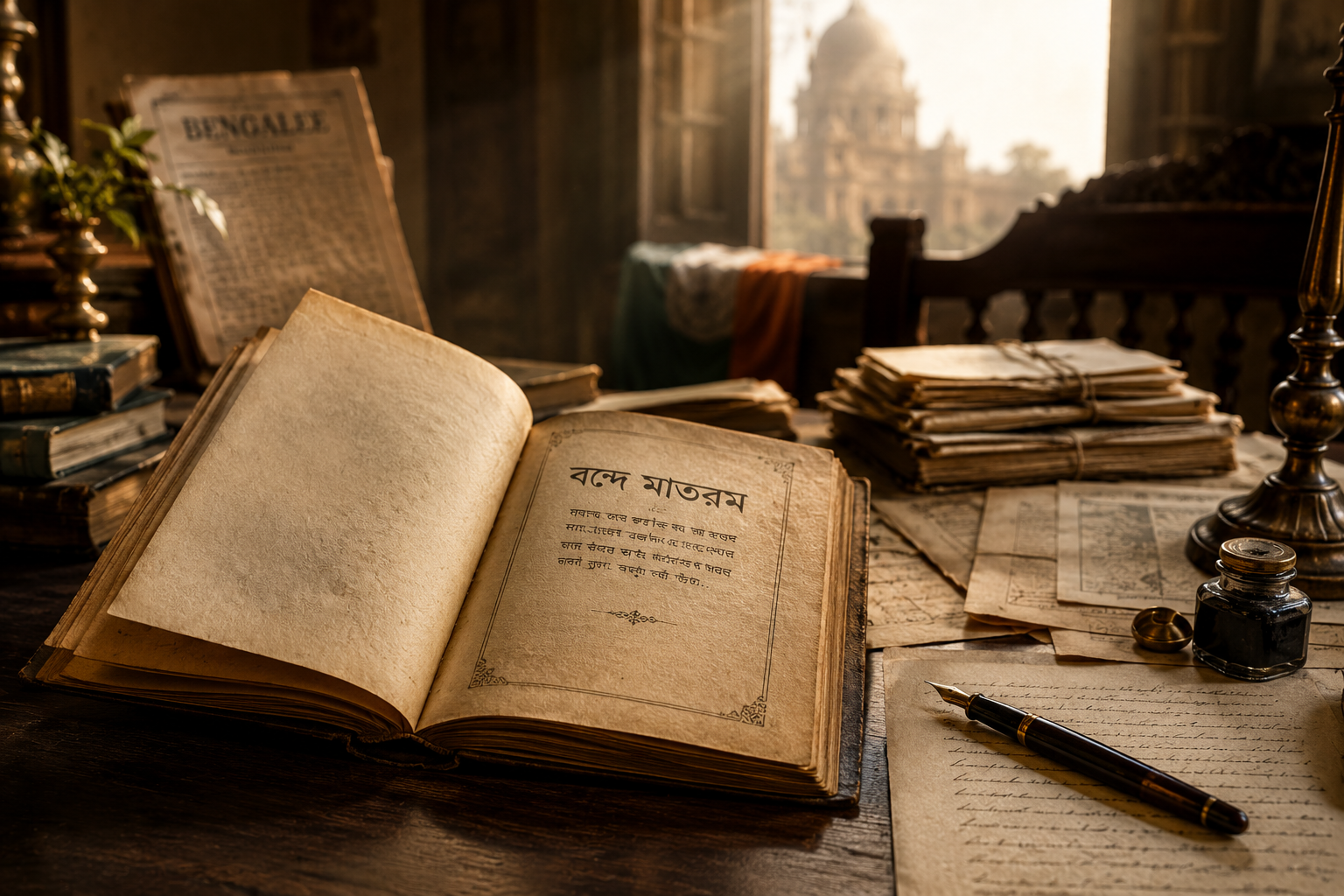
Vande Mataram was composed by Bankim Chandra Chatterjee. It was first published in Bangadarshan on 7 November 1875 and was later included in his novel Anandamath, published in 1882.
The song gradually moved beyond its literary origins and became closely associated with India's nationalist movement. Rabindranath Tagore gave it a musical setting and sang it at the 1896 session of the Indian National Congress in Calcutta. During the Swadeshi movement, Vande Mataram also became a prominent nationalist slogan, including at the gathering held on 7 August 1905.
These moments helped give the song a place in the history of India's independence movement that went beyond its original literary context.
The 1950 Constituent Assembly Reference
The history of Vande Mataram also featured prominently at an important moment just before India became a republic. On 24 January 1950, Dr. Rajendra Prasad, then President of the Constituent Assembly, referred to Vande Mataram and its place alongside Jana Gana Mana, stating that it should be honoured equally and accorded equal status.
This historical recognition is relevant to the 2026 amendment because it shows that the significance of Vande Mataram did not begin with the new law. The amendment provides a specific statutory form of protection to a National Song that already had a long-established place in India's national history.
It is equally important, however, not to confuse historical recognition with the legal change itself. The amendment does not turn Vande Mataram into the National Anthem. Its effect is much more specific: it brings the National Song within the relevant statutory protection of Section 3.
National Song vs National Anthem: What Is the Difference?
One of the easiest ways to misunderstand the 2026 amendment is to assume that giving Vande Mataram statutory protection makes it the National Anthem. It does not. The amendment changes the legal protection available under Section 3; it does not change the official designation of either national composition.
India continues to recognise Jana Gana Mana as the National Anthem and Vande Mataram as the National Song. The two therefore have distinct official identities even though the amended law now provides the same specific Section 3 protection against intentional prevention of singing or disturbance to the singing assembly.
Jana Gana Mana Remains the National Anthem
Jana Gana Mana continues to hold the position of India's National Anthem. The 1971 Act already provided specific statutory protection concerning its singing, and the 2026 amendment extends that relevant protection to Vande Mataram.
This creates an important legal similarity between the two without making them the same national composition. In other words, equal protection under this particular provision does not mean identical official status.
| Vande Mataram | Jana Gana Mana |
|---|---|
| National Song | National Anthem |
| Remains National Song | Remains National Anthem |
| Yes | Yes |
| No | No |
The amendment therefore creates parity in this specific area of statutory protection without changing the separate official designations of the two national compositions. Vande Mataram remains the National Song, while Jana Gana Mana remains the National Anthem.
The distinction matters because public discussion around the amendment can easily blur the difference between national status and legal protection. The amendment concerns the latter.
For a reader, the simplest way to remember it is: Vande Mataram has received statutory protection under the national honour law, but it has not become Jana Gana Mana, and Jana Gana Mana remains the National Anthem.
Vande Mataram in Schools and Official Functions
The 2026 amendment is likely to attract particular attention in schools and other institutions because Vande Mataram is already part of many national and cultural programmes. The legal change makes it important for teachers, students and organisers to understand exactly what the amended law covers, while also keeping the separate ceremonial protocol in mind.
The law and the protocol serve different purposes. The amended law identifies specific conduct that can attract criminal consequences, while the prescribed arrangements explain how Vande Mataram is to be presented on designated occasions.
What Is the Protocol When Both Are Performed?
Where Vande Mataram and Jana Gana Mana are both sung or played under the prescribed protocol, Vande Mataram comes first, followed by Jana Gana Mana.
The assembly is expected to stand to attention while Vande Mataram is being sung. For specified official functions, directions also provide for all six stanzas of Vande Mataram to be sung, with the complete rendition taking approximately three minutes and ten seconds.
These arrangements should not be confused with the criminal provision itself. A ceremonial instruction about how a programme should be conducted is not automatically the same thing as an offence under Section 3.

What Does This Mean for Students?
For students, the most useful takeaway is clarity. The amendment should not be presented as a rule saying that every student who does not sing Vande Mataram has automatically committed a criminal offence.
The relevant legal provision is concerned with intentional prevention of the singing or disturbance to an assembly engaged in singing. Schools can therefore explain the legal change accurately while also teaching students about the historical and national significance of Vande Mataram.
The prescribed directions also provide for community singing of Vande Mataram in schools as part of the daily routine. Institutions following those directions should ensure that students understand the programme and the applicable protocol rather than relying on simplified claims circulating online.
Why the Distinction Matters in Schools
Schools are places where legal awareness and civic education often meet. A new law can easily be misunderstood when a complex statutory provision is reduced to a short statement such as "not singing is punishable."
A better approach is to explain the three ideas separately: what the law prohibits, what the protocol requires, and why Vande Mataram has historical significance. Keeping those concepts distinct gives students a much clearer understanding of what the 2026 amendment actually does.
What Are the Practical Questions Around the 2026 Amendment?
The legal change is relatively specific, but its implementation can raise practical questions for schools, institutions and organisers. One example is the difference in duration between the two national compositions when they are included in the same programme.
A complete rendition of Vande Mataram for specified official functions is approximately three minutes and ten seconds, while Jana Gana Mana is commonly associated with a rendition of about 52 seconds. When both are included in a formal programme, that difference naturally adds to the time required for the ceremony.
This is a practical consideration, not a separate requirement created by the criminal provision.
Protocol and Criminal Law Are Not the Same Thing
This distinction is worth keeping clear. The amended law establishes the conduct that can attract criminal consequences, while the prescribed protocol deals with matters such as the order of performance, standing to attention and the occasions on which the National Song is to be presented.
So, if an official programme takes longer because both compositions are being performed according to the applicable arrangements, that is a question of ceremonial planning, not a new offence under the 2026 amendment.
The same principle applies when discussing schools and other institutions. Programme arrangements may vary depending on the nature of the event, and the applicable directions should be considered rather than assuming that every gathering follows precisely the same format.
Why This Matters for Public Understanding
Much of the confusion around new laws comes from combining several different things into one statement. In this case, the amendment, the ceremonial protocol and the historical significance of Vande Mataram are connected, but they do not perform the same legal function.
The amendment determines the statutory protection. The protocol governs the presentation of the National Song at relevant functions. The historical background explains why Vande Mataram has such a distinctive place in India's national life.
Keeping those three aspects separate makes the 2026 change much easier to understand—and avoids turning a specific legal amendment into a much broader claim than the law actually makes.
Key Takeaways: What Should You Remember About the 2026 Amendment?
The 2026 amendment is easier to understand once the legal change is separated from the wider debate around national symbols. It does not replace the existing national honour law; it expands one of its specific protections to include Vande Mataram.
Here are the points that matter most:
- Vande Mataram is now covered by Section 3 of the Prevention of Insults to National Honour Act, 1971, alongside the National Anthem.
- The amended provision deals with intentionally preventing the singing of the National Anthem or National Song, or causing disturbance to an assembly engaged in such singing.
- Simply not singing Vande Mataram should not be described as an automatic criminal offence. The conduct identified by the provision is intentional prevention or disturbance.
- The punishment can extend to three years' imprisonment, a fine, or both.
- For a second or subsequent conviction, the existing repeat-offence provision provides for a minimum one-year imprisonment.
- The amendment does not make Vande Mataram the National Anthem. Vande Mataram remains the National Song, while Jana Gana Mana remains the National Anthem.
- The historical importance of Vande Mataram predates the amendment by many decades. Its association with India's freedom movement is an important part of the context behind its national significance.
- Where both compositions are performed under the applicable protocol, Vande Mataram comes first, followed by Jana Gana Mana.
- The prescribed arrangements for official functions and schools should not be confused with the criminal provision. Protocol and criminal law are related, but they are not the same thing.
The most useful way to remember the amendment is therefore simple: it gives Vande Mataram specific statutory protection against intentional obstruction or disturbance during its singing, without changing its status as the National Song.
Frequently Asked Questions About the 2026 Amendment
No. Vande Mataram remains the National Song, while Jana Gana Mana remains the National Anthem. The 2026 amendment changes the statutory protection available under Section 3; it does not change the official designation of either national composition.
The amended provision specifically addresses intentionally preventing the singing of the National Song or causing disturbance to an assembly engaged in singing it. Therefore, the amendment should not be simplified into a statement that merely not singing Vande Mataram automatically constitutes a criminal offence.
The provision covers intentional prevention of the singing of the National Anthem or National Song, as well as intentionally causing disturbance to an assembly engaged in such singing. Whether a particular incident falls within the provision would depend on its facts and the applicable legal process.
The specified offence can carry imprisonment for up to three years, a fine, or both. The 2026 amendment extends this existing punishment framework to the National Song.
For a second and every subsequent offence, the relevant repeat-offence provision provides for a minimum one-year imprisonment. This existing provision becomes relevant to conduct involving Vande Mataram that falls within the amended Section 3.
Vande Mataram has a long-standing association with India's freedom movement and national history. Its literary origins, role in nationalist mobilisation and historical recognition have contributed to its distinctive place as India's National Song. The 2026 amendment gives that National Song specific protection under the national honour law.
Under the applicable prescribed protocol, Vande Mataram is performed first, followed by Jana Gana Mana. The assembly is expected to stand to attention during the singing of Vande Mataram at the relevant occasions.
The change is relevant to schools because Vande Mataram may form part of school programmes and community singing. The prescribed directions also provide for its inclusion in the daily routine of schools, making it important for institutions to understand both the applicable protocol and the scope of the amended legal provision.
The Prevention of Insults to National Honour (Amendment) Act, 2026 gives Vande Mataram a specific statutory protection under the national honour law by bringing it within the relevant Section 3 provision. The change is significant, but its meaning is narrower than some public discussions may suggest.
The key issue is intentional interference. The amended provision addresses conduct that intentionally prevents the singing of the National Anthem or National Song, or causes disturbance to an assembly engaged in such singing. It should therefore not be presented as a blanket rule under which simply choosing not to sing Vande Mataram automatically becomes a criminal offence.
The amendment also leaves an important distinction intact: Vande Mataram remains the National Song and Jana Gana Mana remains the National Anthem. Giving the two compositions the same specific statutory protection under Section 3 does not make their official designations identical.
For citizens, students and institutions, the best way to understand the change is to keep three things separate: what the law actually prohibits, what the prescribed protocol requires, and the historical significance of Vande Mataram. That approach provides a clearer picture than relying on simplified headlines or social-media claims.
Continue Your Legal Empowerment Journey
Building a legally aware society begins with understanding your rights, recognising everyday legal risks, and making informed decisions. These related DivyalVision articles explore practical legal awareness, digital responsibilities, agreements, important documents, and the everyday situations where legal knowledge can make a difference:
- 📖 Legal Risks in Everyday Life: 10 Hidden Dangers Most People Ignore – Explore ordinary situations where overlooked legal risks can create unnecessary complications and understand the importance of recognising potential legal issues early. Read the article
- 📖 Your Rights Begin with Awareness: Why Legal Knowledge Is Your Greatest Protection – Understand why knowing your basic legal rights can support better everyday decisions, responsible action, and greater confidence when dealing with legal situations. Read the article
- 📖 Think Before You Sign: Legal Facts Hidden Inside Everyday Documents – Understand what to examine before accepting contracts, consent forms, financial paperwork, and other important documents that can create legal responsibilities. Read the article
Final Editorial Note
The central point remains straightforward: the 2026 amendment extends specific statutory protection to Vande Mataram, while its status as the National Song remains distinct from Jana Gana Mana, the National Anthem. The law focuses on intentional prevention or disturbance of the singing, not on turning every instance of non-participation into a criminal offence.
Understanding that distinction is important for students, teachers, institutions and citizens alike. Good legal awareness is not about memorising penalties; it is about knowing what the law actually says, where it applies and what it does not say.
External Resource
For readers who want to verify the law and related national-symbol provisions directly from an official source, the Ministry of Home Affairs — National Flag, Emblem & Anthem page is the most relevant resource. It provides official material relating to the National Song, National Anthem and the Prevention of Insults to National Honour Act.
Read the official information: Ministry of Home Affairs — National Flag, Emblem & Anthem