Legal Awareness in the Digital Age: Protecting Yourself from Modern-Day Risks
- Digital Risks Can Have Real Consequences: Identity theft, online fraud, phishing, fake documents, and digital impersonation can affect money, privacy, reputation, and personal security. Understanding the legal dimension can help people respond more carefully when something goes wrong.
- Verification Should Come Before Reaction: A convincing message, profile, document, or payment request is not necessarily genuine. Legal Awareness encourages people to pause, verify the source independently, and avoid sharing sensitive information simply because a communication appears urgent or official.
- Evidence Can Matter Later: Screenshots, emails, transaction records, documents, URLs, phone numbers, and relevant dates can help explain what happened. Preserving accurate information is often more useful than relying on memory after an incident.
- The Right Response Depends on the Situation: A suspicious message that was ignored is different from financial loss, identity misuse, or a potentially fraudulent document. Serious situations may require an official reporting channel or advice from a qualified professional.
The digital world has made everyday activities faster and more convenient. We communicate through messaging apps, make payments from our phones, store personal information online, receive documents electronically, and use digital platforms for work, education, shopping, and financial services. The same convenience, however, can create opportunities for people who misuse personal information, imitate trusted individuals or organisations, create deceptive documents, or manipulate others into making decisions they would not otherwise make. This is why Legal Awareness in the digital age is not only about knowing the law after something has gone wrong; it is also about recognising situations that deserve caution before a problem becomes larger.
Consider someone who receives a message claiming to be from a familiar service provider. The message says that an account will be suspended unless the recipient immediately clicks a link and confirms personal information. The message looks convincing, and the recipient is worried about losing access to the account. Instead of checking the source independently, the person follows the instructions and only later realises that the communication may not have come from the organisation at all.
The lesson is not that every unusual message is automatically a crime or that people should become afraid of using digital services. The more useful lesson is that Legal Awareness begins with recognising when a situation deserves verification, documentation, and an appropriate response. Technical security tools remain important, but people also need to understand how digital conduct can affect their identity, money, privacy, evidence, and legal interests.
Why Digital Risks Require More Than Technical Awareness
Digital safety is often discussed in terms of passwords, antivirus software, device updates, and account security. These measures are valuable, but they do not address every risk a person may face online. Someone can have a strong password and still be deceived by a convincing message, misled by a fake customer-support account, or affected by the misuse of their identity. Digital protection therefore involves not only technology but also judgement.
The human decision made immediately after receiving suspicious information can matter just as much as the technology being used. A person may receive an urgent request for payment, a warning about an account, a request for an OTP, or a document that appears to come from an official source. The important question is not simply whether the communication looks professional; it is whether the source, request, and surrounding circumstances can be independently verified.
This is where Legal Awareness adds another layer of protection. It encourages people to think about what information they are sharing, whose identity is being represented, what evidence should be preserved, and what official or professional assistance may be appropriate if something goes wrong. It also discourages people from making unsupported assumptions about what has happened or what legal remedy is automatically available.
Digital incidents can develop quickly, but that does not mean every response should be rushed. If something appears suspicious, taking a moment to verify the information and preserve relevant records can be more useful than immediately confronting the sender or deleting everything connected with the incident. A calm response gives the person an opportunity to distinguish between an ordinary mistake, a suspicious attempt, and a potentially serious matter.
Identity Theft: When Your Personal Information Is Misused
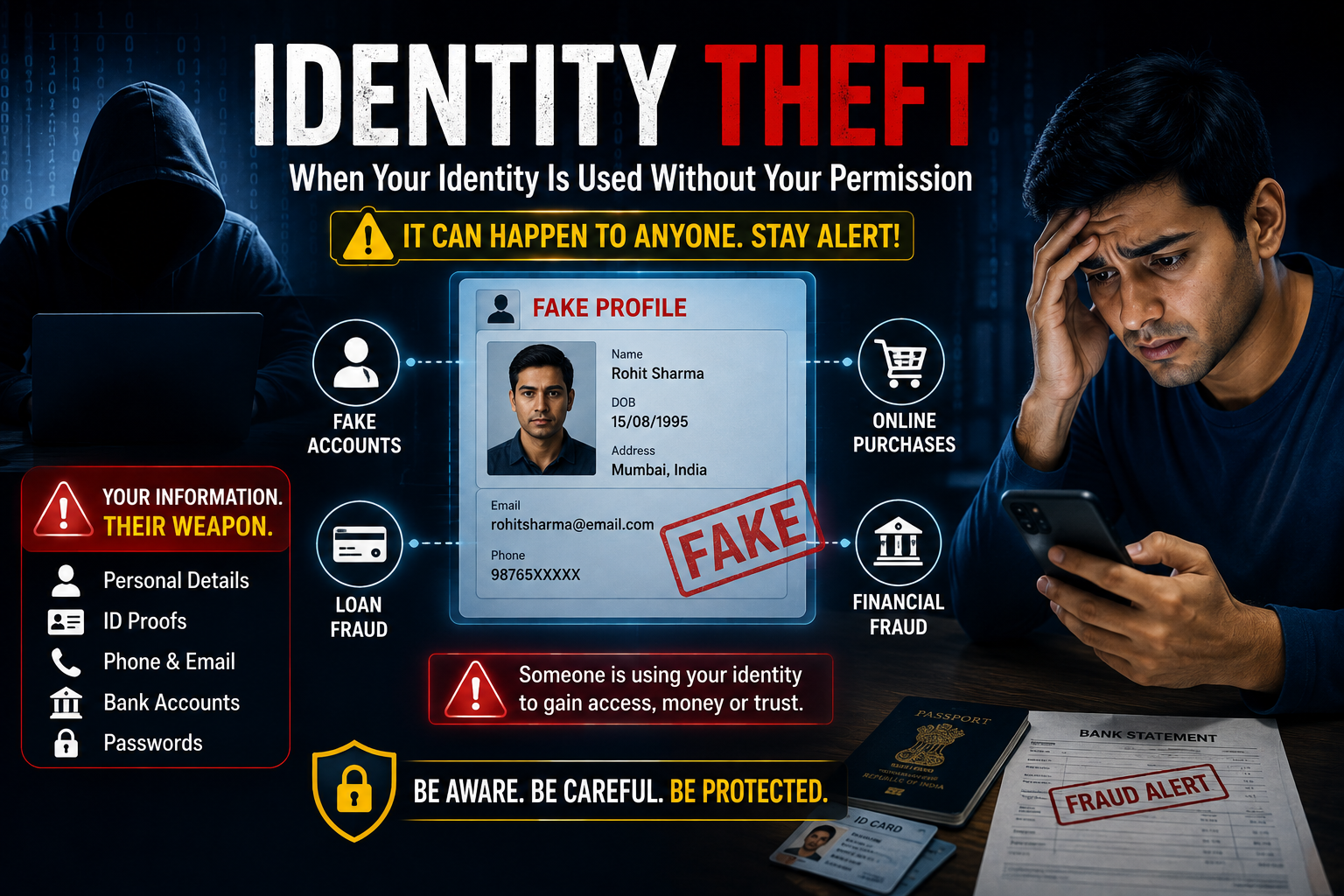
Identity theft can take different forms, but the central concern is the misuse of information associated with another person. Names, identification details, account information, photographs, contact details, or other personal information may be used to create a false identity, access an account, make representations to others, or carry out activities without the person's knowledge.
Not every loss of personal information automatically amounts to identity theft. Information may be exposed without being misused, while in another situation someone may deliberately use that information for a deceptive purpose. Understanding this distinction matters because the appropriate response depends on what actually happened rather than on the possibility that information may have been seen by someone else.
Imagine a person discovering that an unfamiliar social-media account has been created using their name and photograph. At first, they assume it is simply another person with a similar name. A few days later, a friend says that the account has requested money while pretending to be them. The situation has now moved beyond a confusing profile into a matter that may affect the person's reputation, relationships, and possibly finances.
The first practical step is to document what has been discovered. Screenshots, profile information, URLs, dates, messages, and communications from people who received the impersonating messages may help establish what occurred. The person should avoid providing additional personal information to the unknown account and should consider appropriate platform or official reporting channels where relevant.
Legal Awareness in an identity-misuse situation means understanding that the issue can have consequences beyond embarrassment or inconvenience while also recognising that the legal position depends on the facts and applicable law. A careful record of what happened can be more useful than an immediate public accusation.
Online Fraud: When a Digital Transaction Is Not What It Seems
Online fraud is broader than a suspicious message. It can involve a fake seller, fraudulent service provider, deceptive customer-support account, false offer, misleading payment request, or another situation in which a person is persuaded to transfer money, provide information, or accept a transaction based on a false representation.
The difficulty is that fraudulent operations can look remarkably ordinary. A website may use professional design, a seller may provide apparently genuine product information, or a person claiming to be customer support may know enough about a service to sound convincing. These details can create confidence even when the person or transaction is not genuine.
Imagine someone searching online for customer support after facing a problem with a digital service. They find a phone number that appears to belong to the company and contact it. The person answering claims to be a support representative and asks for account information to resolve the problem. Because the original search was genuine, the customer assumes that the person on the other side must also be genuine.
The safer approach is to verify important contact information through an independently trusted source before making a payment or sharing sensitive information. When money is involved, an additional verification step may take only a few minutes but can prevent a much more serious problem.
If a suspicious transaction has already occurred, preserve the relevant information rather than relying on memory. Payment confirmations, transaction references, messages, emails, phone numbers, website addresses, screenshots, and dates can help create a clearer record of the transaction. Legal Awareness in this context means recognising the difference between an ordinary online purchase problem and conduct that may require formal reporting or professional guidance.
Phishing: The Message Designed to Make You Act Quickly
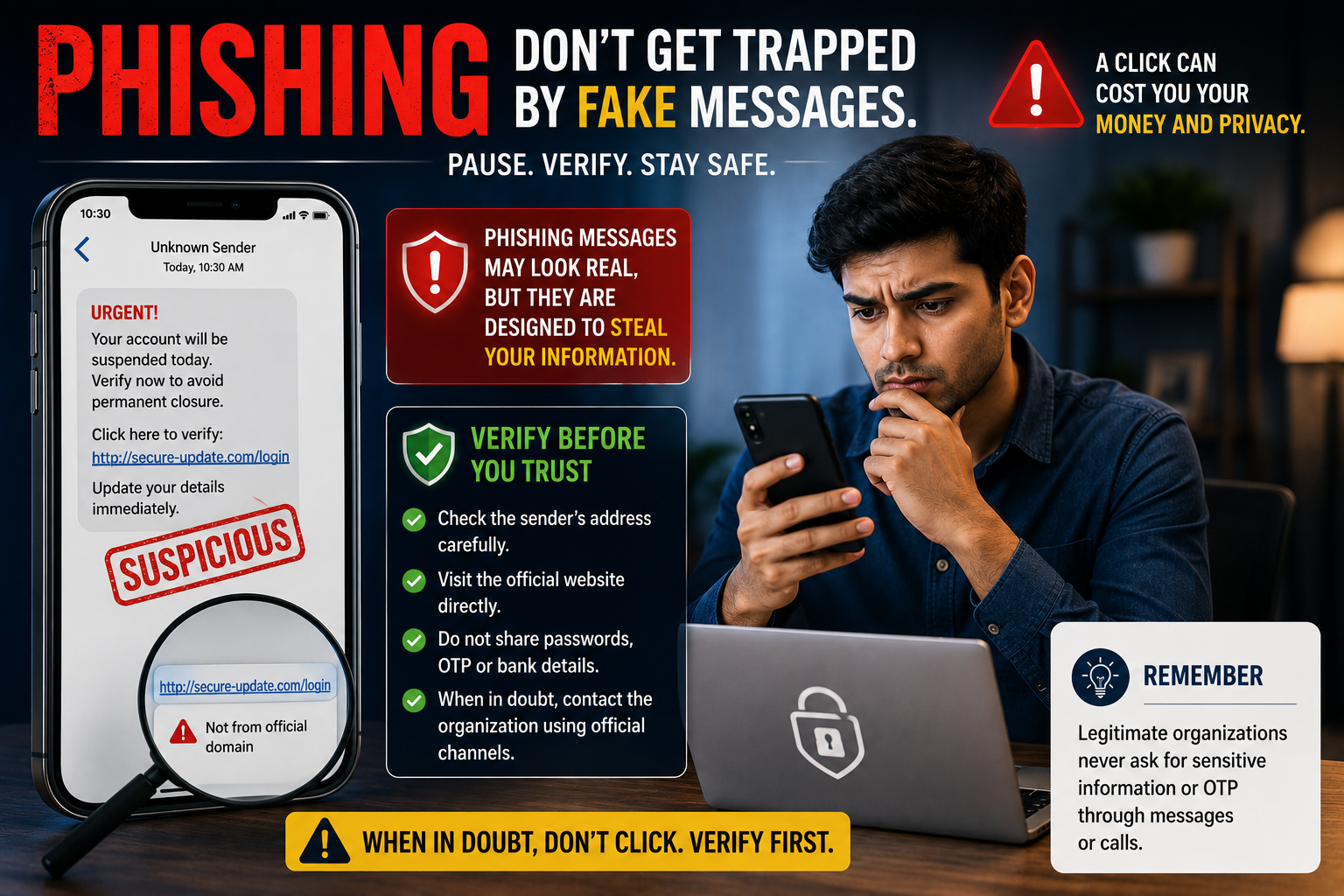
Phishing is more specific than online fraud generally. It typically involves a deceptive communication designed to persuade a person to take a particular action, such as clicking a link, opening an attachment, revealing credentials, sharing an OTP, making a payment, or providing personal information. The communication may appear to come from a bank, delivery service, employer, government-related source, technology company, or another familiar organisation.
Urgency is often central to the approach. A message may claim that an account will be blocked, a payment has failed, a parcel cannot be delivered, a reward is expiring, or an important document requires immediate confirmation. The pressure is useful to the sender because a person who has less time to think may be more likely to act before checking whether the communication is genuine.
A phishing attempt does not always look obviously suspicious. It may contain familiar branding, professional language, copied information, or details that appear connected to a real service. A message may also arrive when the subject feels believable, such as receiving a delivery notification around the time a person is actually expecting a parcel.
One useful habit is to separate the message from the action it is asking you to take. Instead of immediately clicking the supplied link, opening an attachment, calling the number provided, or replying with personal information, consider how the request can be verified independently. If the communication claims to come from a bank or service provider, use a trusted official channel to confirm it rather than relying on the contact details contained in the suspicious message.
Requests for passwords, OTPs, account credentials, card information, or identity documents deserve particular caution. A convincing explanation does not automatically make the request legitimate. Legal Awareness also means knowing what to preserve if you have already acted on a suspicious message, including the original communication, sender details, links, screenshots, and relevant transaction information.
The key distinction is simple: Online Fraud describes the broader deceptive transaction or activity; Phishing describes a deceptive communication designed to trigger a particular action. They can overlap, but they should not be treated as identical concepts.
Digital Impersonation: When Someone Pretends to Be You
Digital impersonation occurs when someone represents themselves as another person online in a way that can cause confusion, deception, or harm. A fake social-media profile using another person's name and photograph is one familiar example, but impersonation can also involve email accounts, messaging platforms, professional profiles, or other digital identities.
Imagine that someone discovers a messaging account using their name and photograph. Initially, they ignore it because they assume it is simply another person with a similar name. A few days later, a friend contacts them and says that the account has requested money while pretending to be them. The situation has now become more serious because another person may be relying on the false identity.
The first priority should be establishing what is actually happening. Save screenshots of the profile, username, account URL, messages, dates, and communications from people who received the impersonating messages. If colleagues, customers, friends, or family members have been contacted, their communications may help establish the sequence of events.
Avoid responding impulsively to the impersonating account. Public arguments, threats, or attempts to expose the person may create additional complications and do not necessarily resolve the underlying problem. Where appropriate, use the platform's official reporting mechanism and consider the relevant official reporting or legal channel if the conduct is serious, persistent, financially harmful, threatening, or otherwise unlawful.
It is also important to distinguish identity misuse from ordinary disagreement or criticism. Someone using a similar name is not automatically impersonating another person, and an account using a person's photograph does not by itself establish every element of a legal offence. Legal Awareness therefore involves documenting the conduct accurately and allowing the appropriate authority or qualified professional to assess what legal issue, if any, has actually arisen.
Fake Documents: Why Digital Records Need Verification
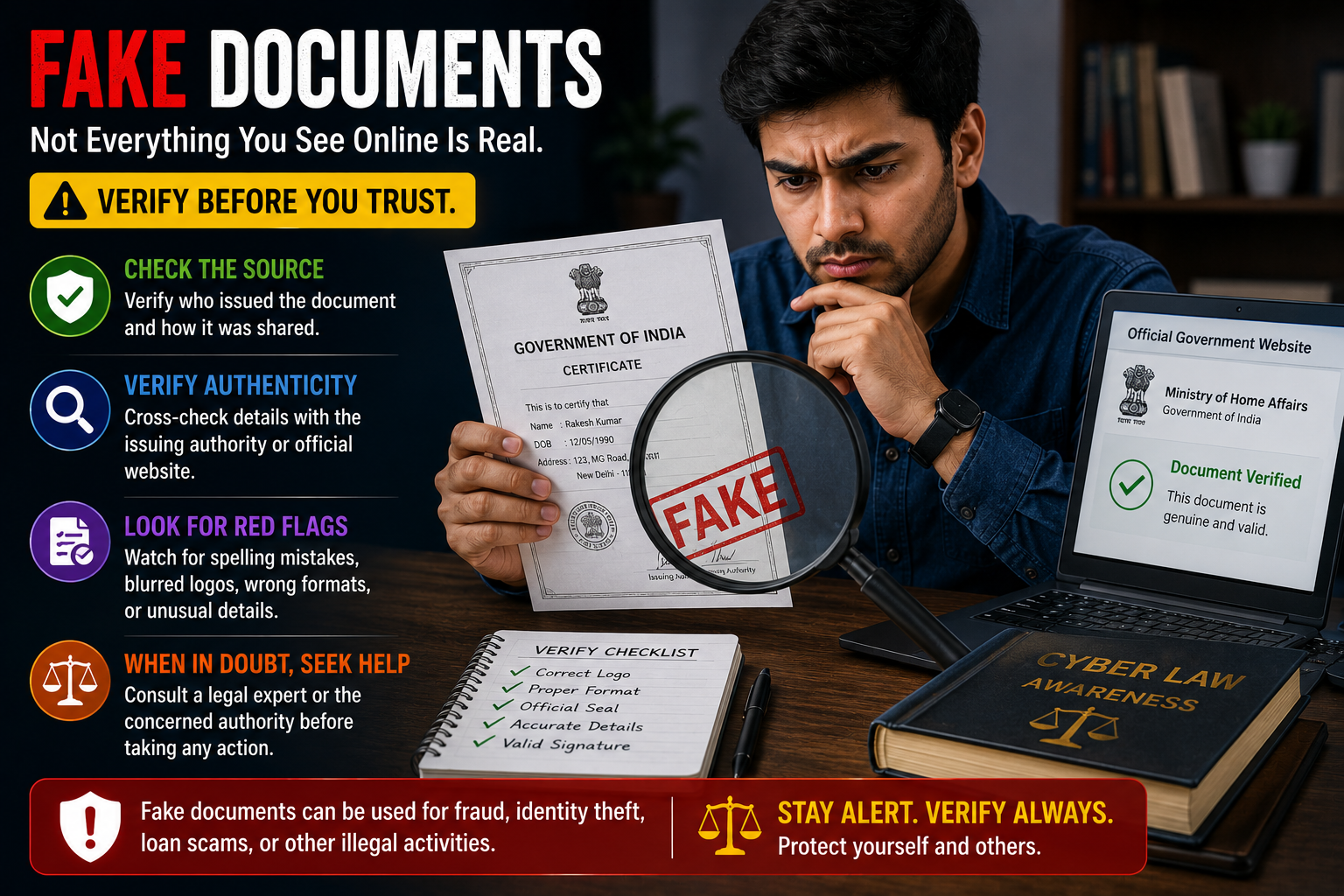
Digital documents have become part of ordinary life. People receive invoices, employment letters, identity records, payment confirmations, certificates, agreements, and other documents electronically, often without questioning their authenticity. Convenience is useful, but a document appearing on a screen should not automatically be treated as genuine simply because it looks official.
A fake document may involve altered information, a fabricated document, a modified image, or a record presented as though it came from an authority when it did not. The legal significance depends on the nature of the document, how it was created or used, the intention involved, and applicable law. It is therefore important not to label every inaccurate digital document as a legally established forgery without examining the facts.
Consider a person who receives a document claiming to confirm an important payment or transaction. It contains a familiar-looking logo, reference number, signature, and official-style formatting. The recipient assumes that the payment has been completed and proceeds with the next step. Later, the recipient discovers that the document was not issued by the organisation named on it.
The better approach is to verify the document through the organisation or authority that is supposed to have issued it. If a document contains a reference number, QR code, website address, or other verification method, use independently trusted information to confirm it rather than relying solely on the details printed on the document.
When authenticity matters, preserve the document in its original form where possible. Keep the email or message through which it was received, sender information, the file itself, and relevant communications concerning the document. Legal Awareness means verifying important records before relying on them and preserving accurate information when their authenticity becomes questionable.
A Real-Life Lesson: When a Loan Demand Comes With Your Identity Details
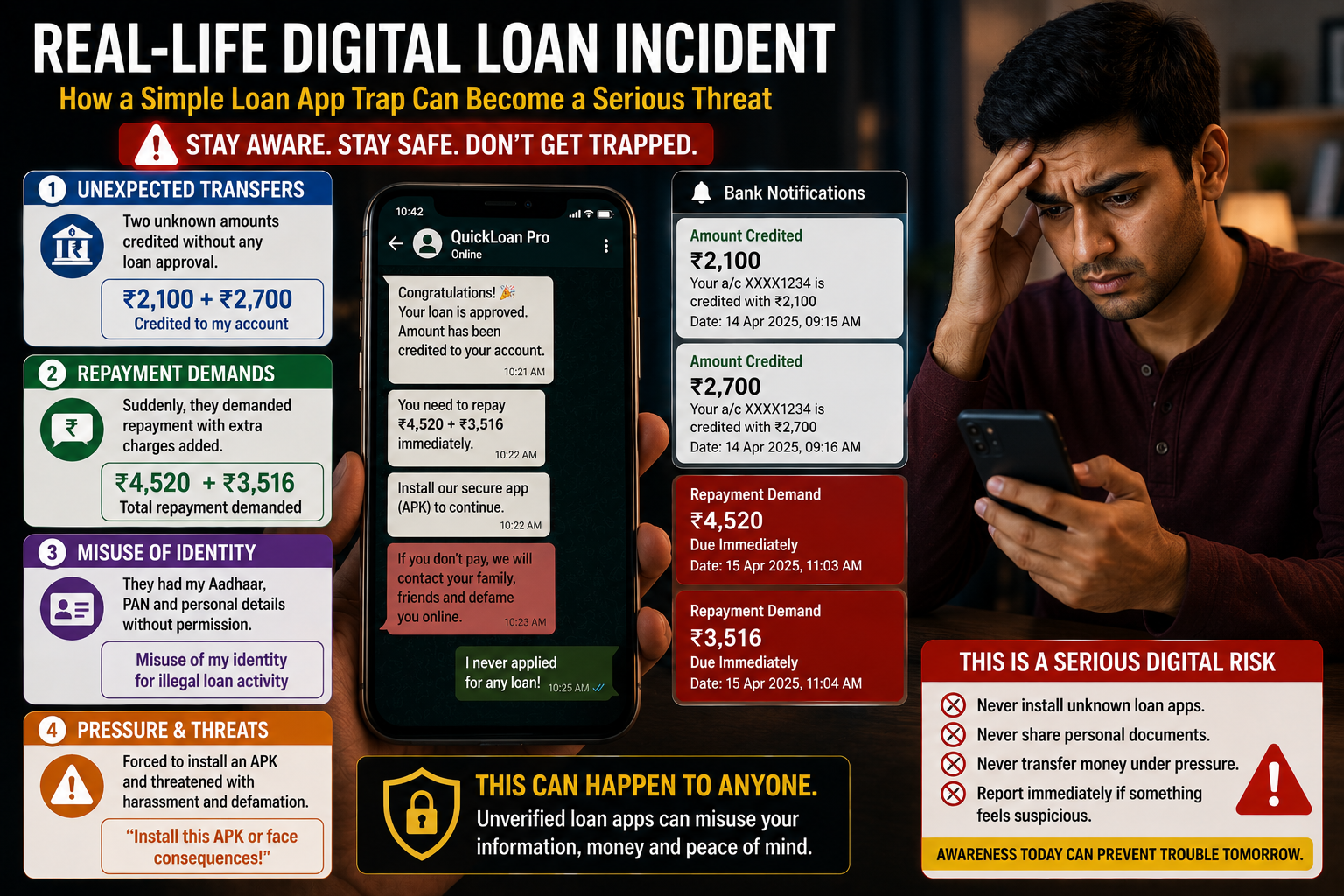
Sometimes, a digital financial problem begins with a transaction that the recipient does not recognise as a loan at all. A real-life experience illustrates why careful verification becomes especially important when unexplained money transfers, personal identity details, repayment demands, and unfamiliar digital applications appear together. In this situation, ₹2,100 was received from one individual account and ₹2,700 from another individual account, even though the recipient had not knowingly taken such a loan.
The transactions were not noticed immediately. Around seven days later, WhatsApp messages were received demanding repayment of two amounts described as EMIs: ₹4,520 and ₹3,516. The messages also contained the recipient's selfie and Aadhaar-related details. Several callers, including both men and women, subsequently contacted the person and claimed that the amounts had to be paid immediately in connection with a finance company.
Rather than immediately refusing to return the money, the person was prepared to return the amounts that had actually been received. The concern was with the much higher amounts being demanded as repayment and the absence of clear documentation showing how those amounts had been calculated. Because the money had come from individual accounts rather than through a clearly established lending transaction known to the recipient, the person wanted the underlying loan records to be verified before making any additional payment.
The person therefore asked for basic documents that would ordinarily be important for understanding such a claim, including the loan sanction letter, disbursement details, and information identifying the relevant RBI-registered lending entity or NBFC, where applicable. These documents were not provided. Instead, the communication continued with demands for payment, without giving the requested documentation that could explain the alleged loan and the amount being claimed.
The person also searched online for the finance company mentioned during the calls. That search raised further concerns because information was found suggesting that people could receive unexpected amounts and later face demands for larger repayments. This online information was not treated as conclusive proof of what had happened in this particular case, but it reinforced the need for independent verification before making a payment.
The situation became more concerning when the callers repeatedly insisted that an APK file should be installed on the person's mobile phone. They claimed that the application contained the relevant documents and information and pressured the person to install it. The person did not install the APK file. Instead, they continued asking for the actual loan documents and clarification through the communication already available.
Over a period of about three days, approximately 30 to 40 calls were received from different callers. The repeated calls created pressure to make an immediate decision, but the person continued to ask for documentary support rather than accepting the repayment demand merely because the callers claimed to represent a finance company. At one point, a message stated, in substance, that if the demanded money was paid, the person's data would be deleted. The person still did not install the APK or accept the unexplained demand without supporting documents.
When the person again asked for the loan documents and proper clarification, no meaningful response was provided. Instead, the communication remained focused on obtaining payment. The person then clearly stated that unless proper documents were supplied, the matter would be reported to the cyber authorities. After this response, the repeated calls stopped.
This experience does not by itself establish who sent the money, whether a genuine lending transaction existed, or whether a particular offence had been committed. Those questions would require examination of the banking records, communications, documents, identity information, and other evidence by the appropriate financial institution or competent authority. The important lesson is that an unexpected payment does not automatically prove that the recipient accepted a loan, just as a repayment demand does not automatically establish that the amount being demanded is legally or contractually payable.
The experience also shows why Legal Awareness matters when a digital financial claim involves unexplained transfers, personal identity information, unusually high repayment demands, missing loan documentation, repeated calls, and pressure to install an unfamiliar APK file. A person may reasonably ask for the underlying documents, independently verify the claimed lender, preserve the communications and transaction records, and avoid installing an unknown application simply because callers insist that it contains important information. When the facts remain unclear, establishing and preserving the evidence can be more useful than making an immediate legal conclusion.
The Legal Importance of Preserving Evidence
When a digital incident occurs, people often focus immediately on stopping the problem. That is understandable, particularly when money or personal information may be involved. But another important question is what information should be preserved while the situation is still fresh.
Digital evidence can include screenshots, emails, messages, transaction confirmations, account notifications, phone numbers, website addresses, profile links, documents, photographs, dates, and records of communication. No single record automatically proves what happened, and the value of particular evidence depends on the circumstances. Nevertheless, preserving relevant material can make it easier to reconstruct events accurately.
Suppose a person receives a suspicious message, clicks a link, and later discovers an unfamiliar transaction. If the original message is deleted immediately, details about the sender, link, wording, timing, or instructions may be lost. If the person instead preserves the message and transaction information while taking appropriate steps to secure the affected account, there may be a clearer record of the sequence of events.
Preservation does not mean collecting every digital file indefinitely. It means keeping material that may reasonably help explain what happened. The original message, relevant screenshots, transaction reference, date and time, account notification, and communication with the service provider may all be useful.
People should also avoid altering or fabricating records to make their case appear stronger. Editing screenshots, changing documents, deleting relevant messages, or presenting reconstructed material as an original can undermine credibility and create additional problems. Legal Awareness includes understanding that accurate records are more valuable than dramatic claims.
What to Do When You Suspect Digital Fraud
The first response should be proportionate to the situation. If sensitive information may have been exposed, focus on protecting the affected account or information. If money has moved, preserve transaction details and use the appropriate financial or official reporting channel. If an identity has been misused, document the impersonation and use the relevant platform or official reporting mechanism.
A suspicious message that was ignored is different from a situation where credentials were disclosed, money was transferred, or identity information was misused. The seriousness of the circumstances should guide the next step rather than a fixed response being applied to every incident.
It is useful to write down the sequence of events while the details are fresh. Note when the communication arrived, what it claimed, what action was taken, what information was shared, and what happened afterward. A clear timeline can help when explaining the incident to a bank, service provider, platform, authority, or professional adviser.
If an account may have been compromised, use trusted methods to secure it rather than following instructions from the suspicious communication. Where appropriate, review account activity, change relevant credentials, and contact the organisation through independently verified channels.
If the matter involves significant financial loss, identity misuse, forged documents, threats, or another potentially serious concern, consider using the appropriate official reporting mechanism and obtaining qualified legal guidance. Legal Awareness does not mean trying to investigate everything personally; sometimes the responsible action is to preserve the information and place the matter with the appropriate authority.
What Not to Do After a Digital Fraud Incident
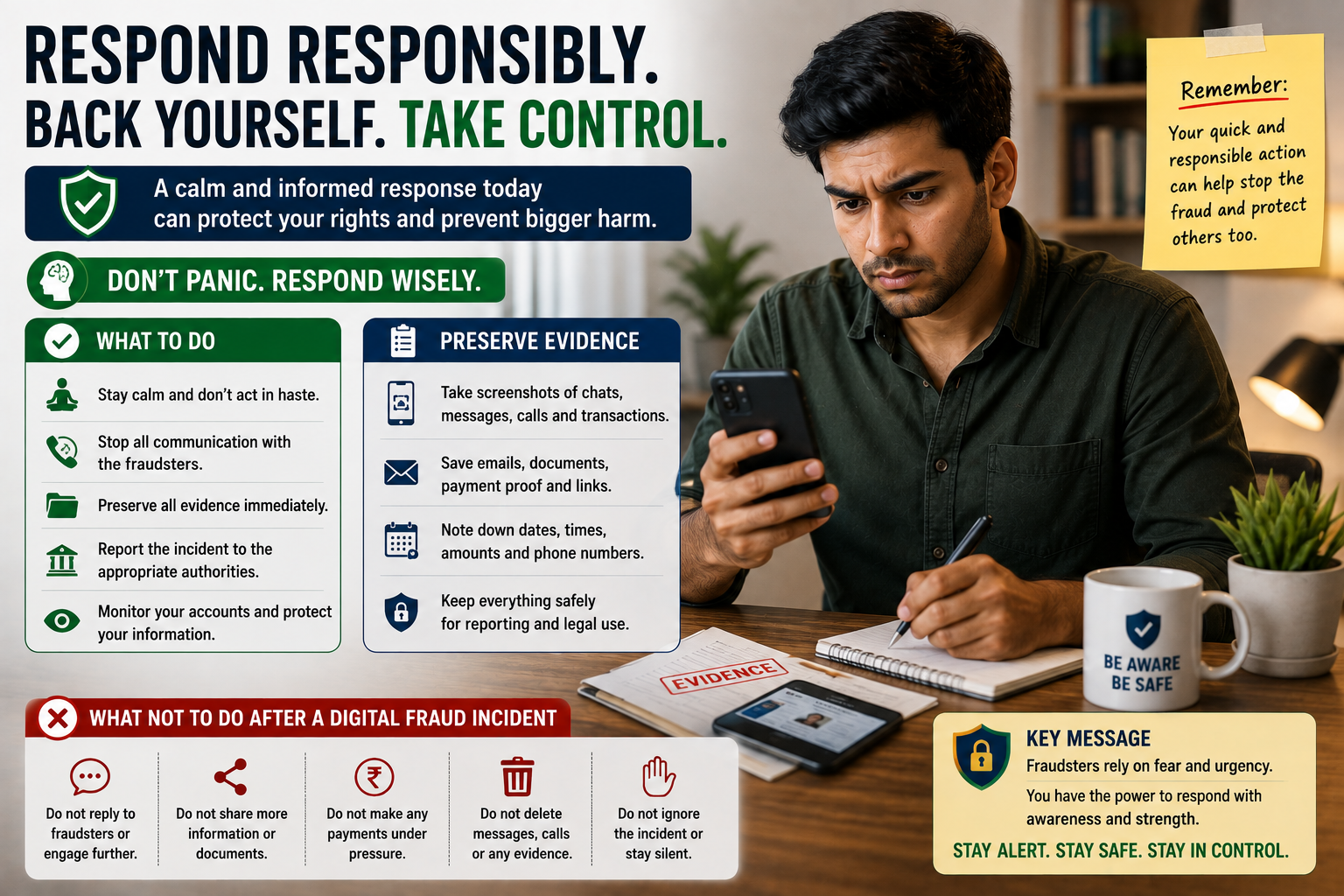
A suspected digital fraud incident can create fear, embarrassment, and anger. Those emotions are understandable, but they can also lead to decisions that make the situation harder to manage. A person may immediately confront the suspected sender, delete messages, publish accusations online, or continue communicating with the person who initiated the contact. A calmer response creates more room to protect yourself, preserve relevant information, and choose an appropriate reporting channel.
One common mistake is continuing the conversation with the suspected fraudster. After realising that a message or call may be fraudulent, a person may try to demand an explanation or threaten the sender. This can reveal additional information, confirm that the target is responding, or give the other person an opportunity to create another deceptive story.
Another mistake is deleting everything immediately. Suspicious messages, documents, transaction details, or account activity may later help establish what happened. Preserve relevant information first and then take appropriate security measures rather than destroying potentially useful evidence.
People should also avoid publicly accusing an individual before the facts are established. A suspicious account or message may justify concern, but suspicion is not the same as a verified conclusion about who is responsible or what offence has occurred. A responsible response focuses on documenting facts and using appropriate reporting channels.
Finally, embarrassment should not prevent someone from seeking help. Legal Awareness includes recognising when an incident has moved beyond a simple online inconvenience and may require assistance from a financial institution, platform, official authority, or qualified professional.
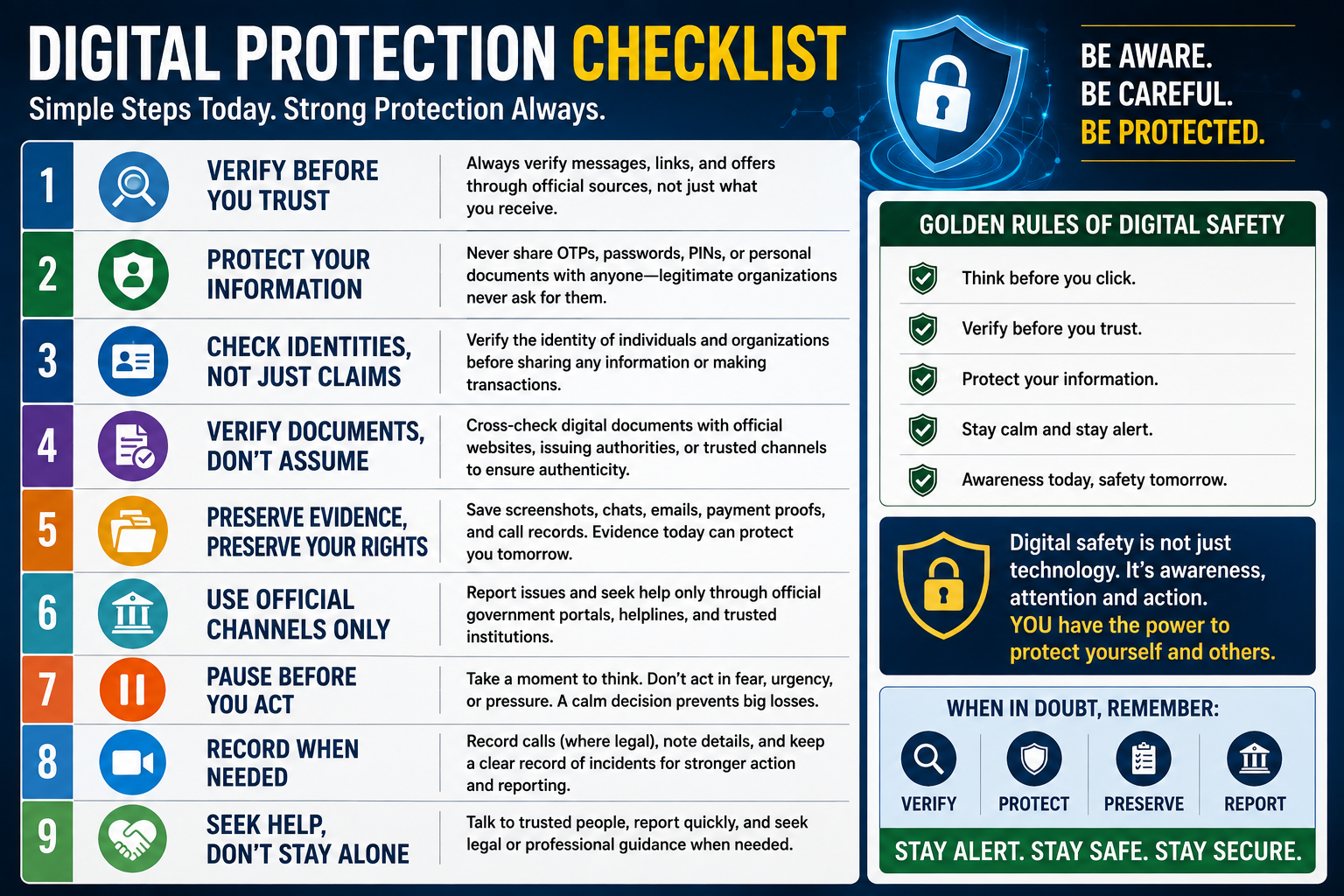
Digital protection becomes easier when a few sensible habits are used regularly. The objective is not to treat every message as dangerous or to avoid digital services altogether. It is to build simple checks into the way you handle unexpected requests, personal information, documents, and financial activity.
A Practical Digital Protection Checklist
| Step | What to Consider |
|---|---|
| 1. Verify Unexpected Requests | When a message asks for money, credentials, an OTP, identity information, or urgent action, verify the request independently. Do not rely only on the links or contact details supplied in the message. |
| 2. Protect Sensitive Information | Avoid sharing passwords, authentication codes, financial details, identity documents, or other sensitive information simply because someone claims to need them. First establish who is asking and why. |
| 3. Check Digital Identities | Before trusting an unfamiliar account or profile, consider whether the identity can be independently confirmed. Similar names, photographs, logos, and professional descriptions do not by themselves prove authenticity. |
| 4. Verify Important Documents | When a digital document has significant financial or legal consequences, confirm its source through an independently trusted channel. |
| 5. Keep Useful Records | For significant transactions or suspicious incidents, retain relevant emails, messages, payment confirmations, documents, URLs, screenshots, and dates. |
| 6. Review Important Account Activity | Regularly checking important accounts can help you notice unfamiliar transactions, changes, login activity, or other unexpected events. |
| 7. Use Official Contact Channels | If you need to contact a bank, service provider, government office, platform, or other organisation, obtain the contact information from a trusted official source rather than relying on an unexpected message. |
| 8. Pause When Someone Creates Urgency | A demand that says you must act immediately should not automatically control your decision. Take a moment to verify the request before clicking, paying, downloading, or sharing information. |
| 9. Record What Happened | If an incident occurs, write down the sequence of events while it is still fresh. Include relevant dates, times, communications, transactions, and actions taken. |
| 10. Know When to Seek Help | If the situation involves significant financial loss, identity misuse, forged documents, threats, repeated harassment, or another serious concern, consider appropriate official reporting and qualified professional guidance. |
Why Legal Awareness Matters Before Something Goes Wrong
People often think about legal rights only after a dispute has already developed. In the digital environment, that approach can be particularly difficult because information can be shared quickly, transactions can happen within seconds, and digital content can be changed or removed. Understanding basic legal responsibilities and practical safeguards before an incident occurs can improve the quality of decisions made when something unexpected happens.
Legal Awareness does not require ordinary users to memorise criminal offences, procedural rules, or technical legal terminology. It means developing enough understanding to recognise when an issue may have consequences beyond a simple technical inconvenience. If someone misuses your identity, creates a deceptive document, attempts to obtain money through false representations, or repeatedly impersonates you, the situation may require more than simply blocking an account.
At the same time, legal awareness should not encourage people to treat every suspicious activity as proof of criminal conduct. Facts need to be established, evidence needs to be considered, and an appropriate authority or professional may need to determine what legal issue exists. A responsible person can therefore take a situation seriously without making conclusions that the available evidence does not support.
The most useful digital habit is often a simple pause. Before trusting an unexpected request, verify the source; before sending sensitive information, consider why it is being requested; before relying on an important document, confirm its origin; and when something goes wrong, preserve the relevant information before taking further action.
In this sense, Legal Awareness in the digital age is not about living cautiously at every moment. It is about understanding that digital decisions can have real-world consequences and developing the judgement to recognise when ordinary caution should become deliberate action.
Key Takeaways
- Legal Awareness can help people recognise when a digital incident may involve more than an ordinary technical problem.
- Identity theft and digital impersonation should be documented carefully rather than treated as matters of reputation alone.
- Online fraud is broader than phishing and can involve deceptive transactions, fake sellers, or fraudulent service providers.
- Phishing specifically uses deceptive communication to persuade a person to take an action.
- Digital documents with important consequences should be verified through trusted sources.
- Screenshots, messages, transaction records, URLs, documents, and dates may help establish what happened.
- After a suspected incident, avoid deleting useful evidence or continuing unnecessary communication with the suspected fraudster.
- Serious incidents involving financial loss, identity misuse, forged documents, threats, or repeated harm may require official reporting and qualified professional guidance.
Identity theft generally refers to the misuse of information associated with another person for an unauthorised or deceptive purpose. The exact legal meaning and consequences depend on the circumstances and applicable law.
No. A suspicious message may be an ordinary mistake, unwanted communication, or a potentially deceptive attempt. Phishing generally involves communication designed to persuade a person to reveal information or take a particular action.
Avoid clicking unfamiliar links or sharing sensitive information immediately. Verify the claimed sender through an independently trusted channel and preserve the message if it may be relevant to a potential incident.
Screenshots and related records may help establish what communication occurred, what was requested, and when events happened. Their usefulness depends on the circumstances, but preserving relevant information is generally preferable to relying only on memory.
It can, depending on how another person's identity is being used and the surrounding circumstances. A similar name or photograph alone does not establish every element of unlawful impersonation, so the facts should be documented accurately.
Continue Your Personal Growth Journey
Digital legal awareness is closely connected with informed decision-making, responsible communication, and protecting your interests in everyday situations. These related DivyalVision articles explore practical legal habits from different angles:
- 📖 Legal Risks in Everyday Life: 10 Hidden Dangers Most People Ignore – Explore ordinary situations where overlooked legal risks can create unnecessary complications. Read the article
- 📖 Your Rights Begin with Awareness: Why Legal Knowledge Is Your Greatest Protection – Understand why knowing your rights can support better everyday decisions. Read the article
- 📖 Digital Life, Real Laws: Legal Responsibilities in the Online World Explained – Explore the legal responsibilities that accompany everyday digital communication and online behaviour. Read the article
- 📖 The Truth About Verbal Promises and Written Agreements: What Really Protects You? – Learn why clear documentation and reliable records can matter when expectations differ. Read the article
- 📖 Think Before You Sign: Legal Facts Hidden Inside Everyday Documents – Learn what to examine before accepting contracts, consent forms, financial paperwork, and other important documents. Read the article