Legal Risks in Everyday Life: 10 Hidden Dangers Most People Ignore
Legal risks are often hiding in ordinary moments that most people never question. Renting a home, shopping online, transferring money through UPI, accepting digital agreements, or sharing a photo on social media may seem routine, yet each of these actions can create responsibilities that many people discover only after something goes wrong.
Most people imagine legal problems as dramatic events involving courtrooms, police investigations, or lengthy disputes. In reality, the law quietly influences ordinary moments that rarely attract attention. Renting a new apartment, accepting an app's terms and conditions, transferring money to a friend, posting a review online, or recording a video in a public place may seem like routine activities. Yet each of these everyday actions can carry legal consequences that many people never consider until a problem appears.
The challenge is that legal risks are often invisible. They rarely announce themselves with warning signs or immediate consequences. Instead, they remain hidden beneath decisions that feel perfectly normal at the time. A rental agreement signed in a hurry, an online purchase completed without checking the seller's policy, or a casual social media post can quietly create responsibilities that become apparent only weeks or months later. By then, correcting the situation may require far more time, money, and effort than preventing it in the first place.
Legal awareness is not about becoming suspicious of every decision or fearing every agreement you encounter. It is about recognizing that informed choices provide better protection than assumptions. Understanding the legal side of everyday life allows you to ask the right questions, preserve important records, and identify potential risks before they develop into avoidable disputes.
As daily life becomes increasingly digital and interconnected, hidden legal risks are becoming part of ordinary routines rather than exceptional situations. Learning to recognize them is one of the simplest ways to protect your rights, finances, reputation, and peace of mind without changing the way you live.

Understanding Hidden Legal Risks in Everyday Life
Imagine an ordinary weekday. You leave home for work, pay your rent through an online banking app, order groceries from an e-commerce platform, transfer money to a friend through UPI, sign into a new mobile application by clicking "I Agree," and later share a photo from a café on social media. None of these actions feel unusual because millions of people perform similar tasks every day. However, each of them creates legal relationships, responsibilities, or digital records that continue to exist long after the moment has passed.
The modern world runs on agreements, permissions, and digital interactions. Every purchase creates consumer rights and obligations. Every rental agreement establishes responsibilities for both the tenant and the property owner. Every online account involves terms that govern how your information may be collected, stored, and used. Even something as simple as publishing a public review or recording a video can affect the rights and privacy of other individuals. The law is present in these situations not because something has gone wrong, but because everyday activities are increasingly connected to legal frameworks that most people rarely think about.
The encouraging news is that you do not need to understand every law to reduce everyday legal risks. Developing simple habits reading important agreements, preserving records, verifying information, respecting privacy, and asking questions when something seems unclear can prevent many common problems before they begin. Legal awareness is less about memorizing legal provisions and more about making thoughtful decisions in situations that appear ordinary but carry lasting consequences.
Why Ordinary Actions Can Create Extraordinary Problems
One of the biggest misconceptions about legal risks is that they always arise from intentional wrongdoing. In reality, many disputes begin because people simply assume everything is straightforward. A tenant assumes that the landlord's verbal promise is enough. A customer believes every online seller follows the same return policy. A person clicks "Accept" on an application's terms because everyone else does the same. None of these decisions seem dangerous at the time, yet each one creates obligations that may only become visible when something goes wrong.
Legal risks often remain hidden because everyday routines encourage speed rather than careful thinking. Businesses want transactions completed quickly, mobile applications are designed for convenience, and online services reward instant decisions. While convenience saves time, it can also reduce the attention people give to agreements, documentation, and verification. Many avoidable disputes begin not because someone intended to ignore the law, but because they never realized a legal responsibility existed in the first place.
Recognizing hidden legal risks does not require fear or constant caution. Instead, it requires awareness. Before making an important decision, pause for a moment and ask yourself a few simple questions. Do I understand what I am agreeing to? Have I preserved proof of this transaction? Is the information I am relying on trustworthy? These habits take only a few minutes but can prevent months of unnecessary stress later.
Understanding hidden legal risks becomes much easier when you develop stronger awareness in everyday life. If you enjoyed this discussion, explore Why Awareness Creates Stronger Communities to discover how informed individuals contribute to safer, more responsible, and better-connected communities.
Hidden Legal Risk #1 – Renting a Home Without Understanding the Agreement
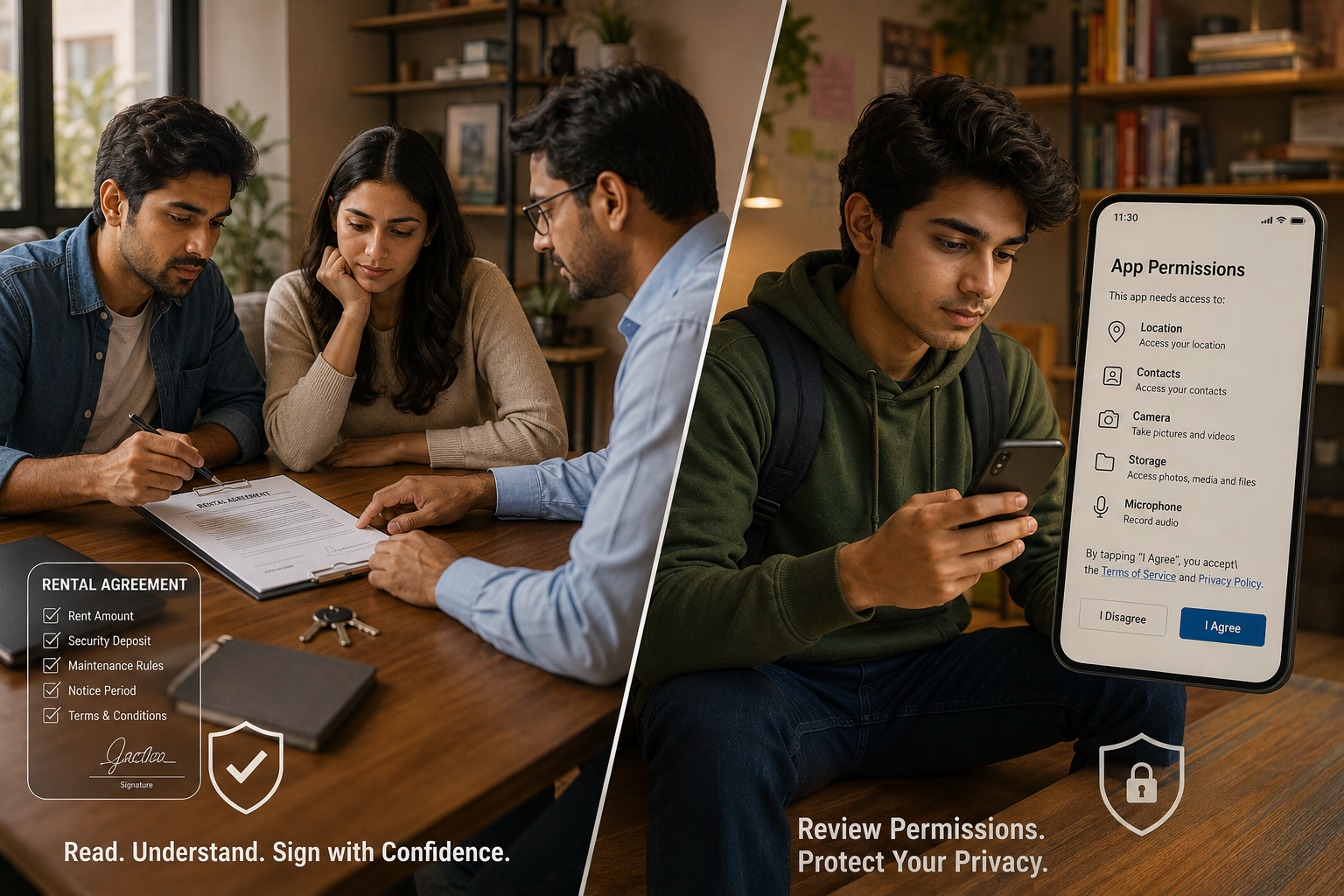
After weeks of searching, a young couple finally finds an apartment that fits both their budget and workplace commute. The landlord seems friendly, the neighborhood feels welcoming, and another family is reportedly waiting to rent the same property. Eager not to lose the opportunity, they quickly pay the security deposit and sign the rental agreement without reading every clause. Moving into their new home feels like the end of a stressful search and the beginning of an exciting chapter.
Nearly a year later, circumstances change. One partner receives a job transfer to another city, and the couple informs the landlord that they plan to vacate the apartment. Only then do they discover that the agreement requires a longer notice period than they expected and allows deductions from the security deposit under specific conditions. Both parties believe they are acting fairly, yet the disagreement grows because the terms were never clearly understood before signing. A pleasant landlord-tenant relationship slowly becomes an avoidable dispute.
Rental agreements are far more than simple formalities. They define important responsibilities such as the security deposit, maintenance obligations, rent revisions, notice periods, utility payments, repair responsibilities, and conditions for ending the tenancy. Verbal assurances made during initial conversations may not always match the written agreement. Reading the document carefully before signing helps ensure that both the tenant and the property owner share the same expectations from the very beginning.
Taking a little extra time before signing can prevent significant misunderstandings later. Ask questions whenever a clause appears unclear, preserve a signed copy of the agreement, and document important conversations whenever possible. Renting a home should provide stability and peace of mind, not unexpected legal uncertainty. This is one of the most common legal risks faced by tenants.
Before signing any rental agreement, confirm that you clearly understand the notice period, security deposit conditions, maintenance responsibilities, and any additional charges mentioned in the document.
Hidden Legal Risk #2 – Accepting Digital Agreements Without Reading Them
A university student downloads a new productivity application recommended by friends. The installation takes less than two minutes. Like millions of users every day, he scrolls directly to the bottom of the screen and taps "I Agree" without reading the terms and conditions or checking the permissions requested by the application. Everything appears perfectly normal, and the app begins working immediately.
Several months later, the student notices unexpected promotional emails, personalized advertisements, and requests for information that seem unusually specific. Curious about how the application knows so much about his preferences, he revisits the settings and discovers that he had granted extensive permissions during installation. Although the permissions were disclosed in the agreement, he never realized what he had accepted because he skipped the details in the interest of convenience.
Digital agreements have quietly become part of everyday life. Every mobile application, online marketplace, streaming platform, cloud storage service, and software subscription operates under terms that define how services are provided, how user information may be processed, what happens when accounts are suspended, and how disputes may be handled. While not every agreement contains problematic clauses, accepting them without understanding the important provisions means accepting responsibilities and permissions that may affect privacy, data usage, subscription renewals, or account access.
You do not need to read every legal sentence word for word before installing an application. However, it is worth reviewing the sections related to privacy, subscription charges, automatic renewals, permissions, and account deletion. Spending just a few minutes understanding these key areas provides far greater control over your digital life than blindly accepting every request that appears on your screen. Digital agreements are among today's fastest-growing legal risks.
Whenever an application requests access to your contacts, location, camera, microphone, or personal files, pause for a moment and ask whether those permissions are genuinely necessary for the service you intend to use.
Digital agreements are only one part of the modern online world. Understanding why trust matters before you click, share, or sign digitally can help you make safer decisions every day. If you want to dive deeper into this subject, read our recommended article on Digital Trust: The Invisible Foundation of the Connected World.
Many people believe legal awareness requires learning complex laws. In reality, one simple habit prevents a surprising number of everyday legal problems: never agree to something important until you understand what you are agreeing to. Whether you are renting a home, installing a mobile application, purchasing a product online, or accepting a financial arrangement, taking a few extra minutes to read, verify, and preserve important information often provides better protection than trying to solve a dispute later. Legal awareness is not about slowing down your life it is about making smarter decisions before convenience turns into an unexpected problem.
Hidden Legal Risk #3 – Shopping Online Without Checking Seller Policies
Late one evening, a college student notices an incredible discount on a branded pair of wireless headphones while scrolling through an online marketplace. The price is much lower than what he has seen elsewhere, and the product listing displays attractive images and positive-looking ratings. Excited by the limited-time offer, he places the order immediately without checking who the seller is, whether the product is returnable, or what the warranty conditions actually say. The package arrives a few days later, but the headphones stop working within a week.
When he tries to request a replacement, he discovers that the product was sold by a third-party seller with a "No Return" policy. The manufacturer's warranty does not apply because the item was not purchased through an authorized seller. Although the shopping platform has clear policies explaining these conditions, he never reviewed them before completing the purchase. What looked like a great bargain has now become an expensive lesson in consumer awareness.
Online shopping has made purchasing products remarkably convenient, but convenience should never replace careful decision-making. Different sellers on the same platform may have different return policies, warranty conditions, shipping responsibilities, and customer support standards. Assuming that every product comes with identical protections can lead to disappointment when something goes wrong. Reading the seller information, checking verified customer reviews, understanding return policies, and confirming warranty coverage require only a few minutes but can save considerable time and money later.
Another overlooked habit is failing to preserve purchase records. Order confirmations, invoices, payment receipts, warranty details, and communication with the seller often become valuable if a dispute arises. Keeping these records organized makes it much easier to resolve issues through customer support or other appropriate channels. Many consumer legal risks begin with assumptions rather than verification.
Before placing an online order, always verify the seller's credibility, return policy, warranty coverage, and customer ratings. A few extra minutes of research are often more valuable than a large discount.
Hidden Legal Risk #4 – Sending Money Through UPI Without Proper Records
One evening, a close friend calls with an urgent request. His motorcycle has broken down during an out-of-town trip, and he needs ₹40,000 immediately to cover emergency repairs and travel expenses. Wanting to help without hesitation, you transfer the money through UPI within seconds. Since the transaction appears in your banking app, you assume that no further documentation is necessary. After all, he is a trusted friend, and repayment should not be a problem.
Several months pass without any mention of the money. When you gently remind your friend, the conversation becomes uncomfortable. He remembers the payment differently and believes it was financial help rather than a loan that needed to be repaid within a fixed period. Both of you genuinely believe your own version of the original conversation, yet nothing was written down to clarify the purpose of the transfer. A friendship that survived for years now begins to suffer because expectations were never documented.
Digital payment systems have made transferring money faster than ever, but they have not eliminated the importance of maintaining clear records. A UPI confirmation proves that money moved from one account to another, but it does not necessarily explain why the payment was made. Was it a loan, repayment, gift, advance payment, or shared expense? Without supporting communication or written confirmation, misunderstandings can arise even between people who trust each other.
Whenever significant amounts of money are involved, it is wise to create a simple written record. A text message, email, signed acknowledgement, or written agreement describing the amount, purpose, and expected repayment terms can provide valuable clarity. Documentation protects both parties because everyone understands the arrangement from the beginning, reducing the likelihood of future disagreements. Financial legal risks often arise when transactions lack proper documentation.
A payment confirmation shows that money was transferred it does not always explain why it was transferred. Keep a written record whenever money is lent, borrowed, or paid for an important purpose.

Making safe financial decisions is not only about managing money it is also about developing responsible daily habits. If you enjoyed this section, you'll find practical ideas in Small Positive Habits That Can Transform Your Life. Small habits such as maintaining records, verifying information, and planning before acting often prevent much bigger problems in the future.
Quick Consumer Safety Checklist
Before making an important online purchase or sending a significant digital payment, ask yourself:
- Have I verified the seller or recipient?
- Do I understand the return, refund, or repayment terms?
- Have I preserved invoices, receipts, and payment confirmations?
- Is there written communication explaining the purpose of the transaction?
- Would I still understand this transaction clearly six months from now if I looked only at my records?
Taking a minute to answer these questions can help you avoid misunderstandings, strengthen your financial records, and reduce hidden legal risks in everyday life.
Hidden Legal Risk #5 – Recording or Sharing Photos Without Permission
A group of friends gathers at a popular café to celebrate a birthday. The evening is full of laughter, photographs, and short videos shared instantly on social media. While editing a video, one friend notices a heated argument taking place at a nearby table. Thinking it might attract attention online, he uploads the clip without giving it much thought. Within hours, the video receives thousands of views and is widely shared across multiple platforms.
The following day, one of the individuals featured in the video contacts him and requests that it be removed. The argument involved a private family matter, and the unexpected online exposure has caused embarrassment and emotional distress. What began as an attempt to share an interesting moment has unintentionally affected another person's privacy and reputation. The uploader never intended to cause harm, but the decision to publish someone else's personal moment without careful consideration has created an avoidable problem.
Modern smartphones allow anyone to become a photographer, videographer, or content creator within seconds. However, the ease of recording and sharing content does not remove the responsibility to respect other people's privacy and dignity. Public places do not automatically eliminate every expectation of privacy, especially when content focuses on identifiable individuals or sensitive situations. Recording events for personal memories is very different from publishing those recordings to a large audience.
Before uploading photos or videos that prominently feature other people, pause for a moment and consider the possible consequences. Could the content embarrass someone, reveal personal information, or create misunderstandings if viewed without context? Responsible sharing protects not only other people's interests but also your own digital reputation. A moment of reflection before posting is often the simplest way to avoid unnecessary legal or personal complications. Privacy-related legal risks continue to increase as more people share content online.
If a photo or video clearly identifies another person or captures a sensitive situation, think carefully before sharing it publicly. Respect for privacy is not only courteous-it is an important part of responsible digital behavior.
Hidden Legal Risk #6 - Ignoring Apartment or Community Rules
A family moves into a modern residential apartment after purchasing their first home. Excited to settle into the community, they begin making small changes to their balcony, install additional outdoor lighting, and occasionally organize weekend gatherings for relatives and friends. Since the apartment belongs to them, they naturally assume they are free to use it however they wish, provided they are not intentionally disturbing anyone.
A few weeks later, they receive written communication from the apartment association regarding repeated complaints from neighboring residents. Some of the modifications require prior approval under the community's rules, while late-night gatherings have violated established quiet hours. The family is surprised because they believed these matters were simply personal choices within their own property. Instead, they discover that community living also involves shared responsibilities designed to protect the interests of every resident.
Apartment complexes, gated communities, and residential societies often operate under rules that govern the use of common areas, parking spaces, renovations, waste disposal, noise levels, visitor access, pet policies, and other aspects of community life. These guidelines are intended to balance individual freedom with the comfort, safety, and rights of everyone living within the community. Ignoring them-whether intentionally or unintentionally can create avoidable conflicts with neighbors or management bodies.
Living harmoniously in a shared community begins with understanding the rules that apply to everyone. Reviewing community guidelines after moving in, asking questions whenever requirements seem unclear, and communicating openly before making significant changes help prevent misunderstandings. Respecting shared spaces and established procedures contributes to a more cooperative environment while reducing unnecessary disputes. Community living also brings shared legal risks and responsibilities.
Whether you rent or own your home, take time to understand the rules that govern your residential community. Knowing the expectations early is far easier than resolving disagreements after they arise.

Many everyday problems become serious only because people fail to notice them early. If this section made you think differently about daily responsibilities, you may also enjoy reading Invisible Problems We See Every Day but Rarely Talk About: 9 Alarming Realities. It explores how seemingly ordinary situations often have deeper personal and social consequences and why awareness is the first step toward preventing them.
Owning a smartphone or a home gives us convenience and freedom, but every freedom comes with responsibilities. The strongest legal protection often begins with a simple habit: considering how your actions might affect someone else before making a decision.
Hidden Legal Risk #7 – Posting Public Reviews Without Verifying Facts
After a disappointing experience at a newly opened restaurant, a customer returns home feeling frustrated. The food arrived late, one item in the order was incorrect, and the overall experience fell far below expectations. Without contacting the restaurant or giving it an opportunity to respond, the customer immediately posts a one-star review online accusing the business of deliberately cheating customers and using poor-quality ingredients. The review is emotional, strongly worded, and quickly attracts attention from other users.
A few days later, the restaurant owner reaches out with an explanation. A temporary technical issue in the kitchen had caused unusual delays that evening, and the incorrect order resulted from a system error rather than intentional negligence. While the customer was fully entitled to share an honest opinion about the experience, some of the factual allegations made in the review could not be supported with evidence. What started as genuine frustration has now created an unnecessary dispute that might have been avoided with a little more care.
Online reviews play an important role in helping consumers make informed decisions and encouraging businesses to improve their services. Honest feedback benefits everyone. However, there is an important difference between expressing a personal experience and making factual accusations that cannot be verified. Statements such as "The service was slow" describe personal experience, whereas claims like "This business is running a scam" suggest facts that require evidence. Understanding this distinction helps people communicate responsibly while protecting both consumer rights and the rights of others.
Before publishing a review, take a few moments to separate facts from assumptions. Describe what actually happened, avoid exaggerated language, preserve invoices or order confirmations if relevant, and consider contacting the business first if the issue appears capable of being resolved. Responsible reviews are not weaker they are more credible because they are based on facts rather than emotion. Online reviews can create unexpected legal risks when facts are not verified.
Share your genuine experience, but avoid making serious allegations unless you have reliable evidence to support them. Honest, factual reviews are far more valuable than emotional accusations.
Hidden Legal Risk #8 – Using Someone Else's Creative Content Online
A freelance designer is preparing a presentation for a new client. While searching online, she finds an attractive infographic that perfectly explains the topic she wants to discuss. Assuming that everything published on the internet is free to use, she downloads the image, removes the original logo, and includes it in her presentation. The client is impressed, and the project moves forward successfully. Weeks later, she receives a message from the original creator requesting that the content be removed because it was being used without permission.
Many people unknowingly assume that content available online belongs to everyone. In reality, photographs, illustrations, articles, videos, music, logos, and original designs are often protected by intellectual property rights. Simply because something is easy to download does not automatically mean it is free to copy, modify, or republish. The internet provides convenient access to creative work, but it does not remove the rights of the individuals who created it.
Fortunately, respecting creative work has become easier than ever. Numerous platforms provide royalty-free images, open-licensed resources, and content specifically intended for public use under certain conditions. Whenever you wish to use someone else's work, check the licence terms carefully, provide attribution where required, or obtain permission if necessary. Creating your own original content is always the safest and most rewarding approach.
Respecting intellectual property is not only about following legal principles it also supports the creative community that produces valuable educational, artistic, and professional work. By acknowledging the efforts of creators, we encourage innovation while protecting ourselves from unnecessary disputes. Copyright-related legal risks affect individuals as well as businesses.
If you did not create the content yourself, never assume you have permission to use it. Always verify the licence, attribution requirements, or permission before publishing or modifying someone else's work.

Responsible online behaviour is built on more than technology-it begins with thoughtful decision-making. If you found these examples useful, explore Confidence vs. Arrogance: Understanding the Difference. The article explains why confident people verify facts, accept responsibility, and make balanced decisions instead of acting on assumptions or emotions. Those same qualities are essential when sharing opinions or using someone else's creative work online.
| Situation | Responsible Habit | Risky Habit |
|---|---|---|
| Posting online reviews | Share factual experiences supported by evidence | Publish emotional accusations without verification |
| Using online content | Check the licence, attribution requirements, or obtain permission | Copy, edit, or republish content without checking ownership |
| Sharing information | Verify facts before publishing | Assume every online claim is accurate |
| Digital communication | Think before posting | React immediately in anger or frustration |
Small decisions made online can have lasting consequences. Taking a little extra time to verify facts, respect creative work, and communicate responsibly protects your credibility while reducing hidden legal risks in everyday life.
Hidden Legal Risk #9 – Throwing Away Important Documents Too Soon
After shifting to a new apartment, a family decides it's the perfect opportunity to clear years of accumulated paperwork. Old utility bills, warranty cards, bank statements, insurance papers, tax documents, and purchase invoices are sorted into piles. Believing that most of them are no longer useful because everything is "available online," they throw away a large collection of documents without checking whether they might be needed in the future.
Several months later, an unexpected problem arises. A recently purchased home appliance develops a manufacturing defect, but the warranty claim requires the original invoice. Around the same time, the family notices an error in a previous financial transaction and needs supporting records that were discarded during the move. Documents they once considered unnecessary have suddenly become important evidence, making a simple issue far more difficult to resolve.
Many people underestimate the long-term value of everyday documents. Purchase invoices, warranty certificates, insurance policies, rental agreements, bank records, tax-related papers, medical bills, educational certificates, and important government communications often serve as proof when questions arise later. While many records are now available digitally, not every document remains permanently accessible, and retrieving older records may not always be quick or straightforward.
A practical solution is to develop a simple document management habit. Keep original documents that relate to significant purchases, property, employment, taxation, banking, insurance, healthcare, and education in a secure location. Where appropriate, create clear digital copies and organize them using meaningful file names so they can be located easily when needed. Good record-keeping is not about collecting unnecessary paperwork-it is about preserving evidence that may protect your rights in the future. Proper record-keeping reduces future legal risks.
Before discarding any important document, ask yourself one question: "Could I need this to prove something in the future?" If the answer is even possibly, preserve the original or keep a secure digital copy where appropriate.
Hidden Legal Risk #10 - Ignoring Small Legal Notices and Official Communications
One afternoon, an office employee receives an email from his bank requesting that certain account details be updated. Around the same time, a letter from the local municipal authority arrives regarding property-related information that requires verification. Both communications appear routine, and because nothing seems urgent, he decides to deal with them "next weekend." Days turn into weeks, and the letters remain unopened in a drawer.
When he finally reviews them, one deadline has already passed. Although the issue can still be resolved, the process now requires additional documentation and unnecessary follow-up. The original request was not a serious legal dispute it was simply an important communication that deserved timely attention. The inconvenience resulted not from the notice itself but from delaying action until the available options became more limited.
Not every official communication signals a major legal problem. Banks, insurance companies, employers, educational institutions, government departments, housing societies, and public authorities regularly issue notices requesting information, clarification, verification, or action within a specified period. Reading these communications promptly allows you to understand what is required and respond appropriately before minor matters become larger administrative or legal complications.
Developing the habit of reviewing official emails, letters, and notifications as soon as they arrive is one of the simplest forms of legal awareness. Even if you are uncertain about the contents, acknowledging the communication, preserving a copy, and seeking clarification where necessary is almost always better than ignoring it. Responding quickly minimizes unnecessary legal risks.
Treat official communications with the same importance as financial transactions. Reading them today may save considerable time, effort, and unnecessary stress tomorrow.

Everyday Legal Safety Checklist
Hidden legal risks often arise from everyday habits rather than extraordinary events. The following checklist can help you reduce unnecessary risks without making life more complicated. Before making an important decision, ask yourself:
- Have I read and understood the agreement?
- Have I verified the information through a reliable source?
- Have I preserved invoices, receipts, agreements, or payment records?
- Am I respecting another person's privacy and rights?
- Have I checked the seller, service provider, or platform carefully?
- Am I relying on facts rather than assumptions?
- Have I organized important documents for future reference?
- If something goes wrong later, will I have enough evidence to explain what happened?
| Everyday Situation | Safer Habit | Risky Habit |
|---|---|---|
| Renting a home | Read and understand rental agreement before signing | Rely only on verbal assurances |
| Installing apps | Review key permissions and privacy settings | Accept every permission without checking |
| Shopping online | Verify the seller, return policy, and warranty | Buy based only on discounts |
| Sending money | Keep written confirmation for significant payments | Depend only on memory |
| Sharing photos or videos | Respect privacy before publishing | Upload sensitive content without thinking |
| Posting online reviews | Share factual experiences | Make allegations without evidence |
| Using online content | Check licences and permissions | Copy content assuming it is free |
| Managing documents | Preserve important records systematically | Discard documents without checking future value |
| Official communications | Read and respond promptly | Ignore notices until deadlines pass |
Final Thought
Hidden legal risks rarely appear as dramatic warnings. More often, they are woven into ordinary moments that seem too small to matter a document signed in a hurry, an online purchase made without reading the details, a payment sent without written confirmation, or a photo shared without considering its impact. These everyday decisions may appear insignificant individually, yet together they shape how well we protect our rights, finances, relationships, and reputation.
The encouraging reality is that reducing legal risks does not require expert legal knowledge. It begins with simple habits: reading before agreeing, verifying before believing, documenting before forgetting, and thinking before sharing. These small actions take only a few extra minutes, but they often prevent problems that could otherwise consume months of unnecessary time and energy.
Legal awareness should not make life feel more complicated. Instead, it should make everyday decisions feel more confident. When people understand the hidden legal side of ordinary situations, they are better prepared to recognise risks early, ask better questions, and make choices that protect both themselves and those around them.
The biggest legal risks are often the ones that never look like legal risks at all. Every thoughtful decision you make today becomes another quiet layer of protection for your future.
Key Takeaways
- Hidden legal risks often arise from routine activities rather than extraordinary situations.
- Reading agreements carefully helps prevent avoidable misunderstandings later.
- Digital convenience should never replace careful verification.
- Maintaining written records protects both financial transactions and personal relationships.
- Respecting privacy and intellectual property supports responsible digital behaviour.
- Organised documents and timely responses to official communications reduce unnecessary complications.
- Small daily habits often provide the strongest long-term legal protection.
Hidden legal risks are everyday situations that may create legal responsibilities or disputes without appearing obvious at the time, such as digital agreements, rental contracts, online purchases, or sharing content online.
No. Most everyday legal risks can be reduced by developing practical habits such as reading agreements carefully, keeping records, verifying information, and responding promptly to official communications.
Yes. Digital agreements often define important terms relating to privacy, subscriptions, permissions, and account responsibilities. Reviewing key sections before accepting them is a good practice.
Invoices, agreements, warranty documents, and payment records may become valuable evidence if questions or disputes arise in the future.
No. This article is intended for general legal awareness and educational purposes. If you face a specific legal issue, consult a qualified legal professional or the appropriate authority for advice relevant to your circumstances.
Divyal Vision Reflection – Continue Your Personal Growth Journey
Hidden legal risks are closely connected with awareness, responsible decision-making, and digital behaviour. Continue exploring these practical insights from Divyal Vision to strengthen your everyday knowledge and make more informed choices: