Beyond Smart Devices: The Next Evolution of Human-Centered Technology
For decades, technological progress has been measured by numbers. Faster processors, larger storage capacities, sharper displays, and more connected devices have often been considered the ultimate indicators of innovation. Every new generation of smartphones, smartwatches, laptops, and smart home gadgets promised greater intelligence, more features, and improved performance. While these advancements have undoubtedly transformed modern life, they have also introduced an unexpected challenge. Instead of simplifying daily routines, technology has gradually become something that constantly competes for our attention. Notifications interrupt conversations, multiple applications demand continuous management, and digital distractions consume valuable time that could otherwise be spent on meaningful work or personal relationships.
As society becomes increasingly connected, people are beginning to ask a different question. Rather than wondering how many smart devices they own, they want to know whether technology truly understands their needs and supports their lives in meaningful ways. Owning another intelligent gadget is no longer enough if every device requires separate management, constant updates, and endless user interaction. Modern users are looking for experiences that feel natural, intuitive, and almost invisible where technology quietly performs its role without becoming the center of attention.
This shift represents one of the most important turning points in the history of digital innovation. Instead of designing products around machines, developers are increasingly designing them around people. This philosophy is known as Human-Centered Technology, and it is changing the way the world thinks about artificial intelligence, smart environments, digital services, and connected ecosystems. Rather than asking humans to adapt to technology, Human-Centered Technology encourages technology to adapt to human behavior, preferences, abilities, and everyday routines.
The impact of this transformation extends far beyond consumer electronics. It is influencing healthcare, education, transportation, finance, agriculture, public services, and even disaster management. Artificial intelligence is becoming more capable of understanding context, connected environments are learning to respond automatically to changing situations, and intelligent assistants are evolving from simple voice interfaces into proactive digital companions. The ultimate goal is not to create more technology but to create technology that quietly improves everyday life while preserving human choice, privacy, and control.
This article explores how Human-Centered Technology is redefining the future beyond traditional smart devices. We will examine why current digital experiences are no longer sufficient, how ambient computing is changing human-computer interaction, where this technology will create the greatest impact, the challenges society must address, and why the next era of innovation may be remembered not for creating smarter machines but for creating a more human digital world.
Technology Has Always Evolved Around Human Needs
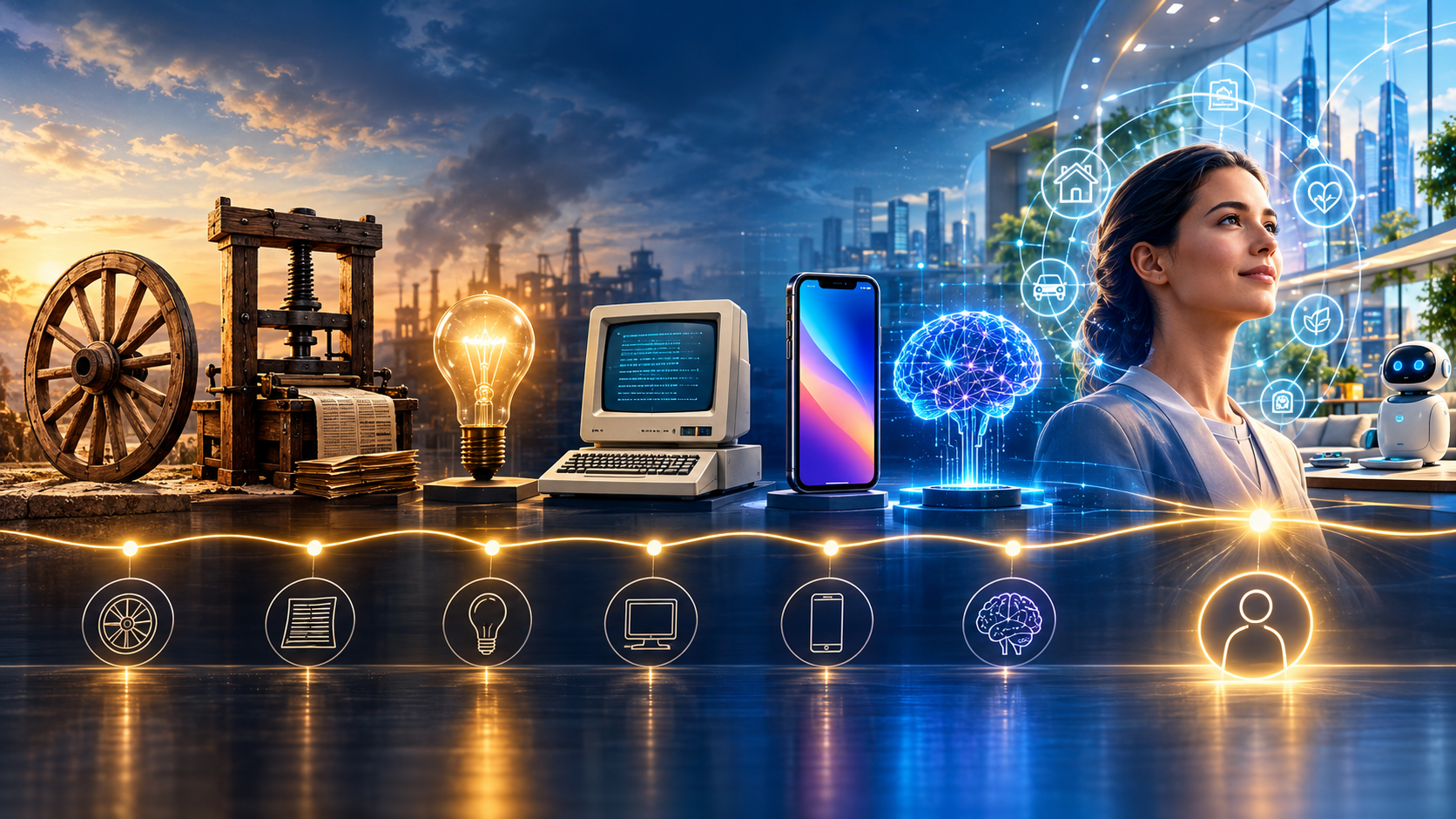
Every major technological revolution in history has been driven by a simple objective: solving human problems. The invention of the wheel made transportation easier, the printing press made knowledge accessible, electricity transformed industries, and the internet connected billions of people across the globe. Each breakthrough succeeded not because it was technologically impressive, but because it improved the way people lived, worked, and communicated.
The digital revolution followed the same path. Personal computers changed workplaces by making information processing faster and more efficient. Smartphones placed communication, navigation, banking, entertainment, and photography into a single handheld device. Cloud computing allowed businesses to collaborate globally, while artificial intelligence introduced entirely new possibilities for automation and decision support. These innovations dramatically increased productivity and convenience, reshaping everyday life in ways that were once considered impossible.
Yet, as technology continued to evolve, a new challenge quietly emerged. Every innovation brought additional applications, settings, notifications, passwords, and connected devices that demanded continuous attention. Instead of reducing mental effort, many digital experiences began creating information overload and decision fatigue. People found themselves managing technology almost as much as technology was helping them. The very tools designed to simplify life were, in some situations, becoming another source of complexity.
This realization has encouraged technology leaders, researchers, and designers to rethink the direction of innovation. The next stage of technological progress is no longer focused solely on creating devices with more advanced specifications. Instead, it aims to build systems that understand people first. Human-Centered Technology represents this evolution by shifting attention away from hardware and toward meaningful human experiences. It recognizes that the greatest innovations are not always those with the most impressive technical features but those that quietly fit into everyday life and make it better without demanding constant attention.
What Is Human-Centered Technology?
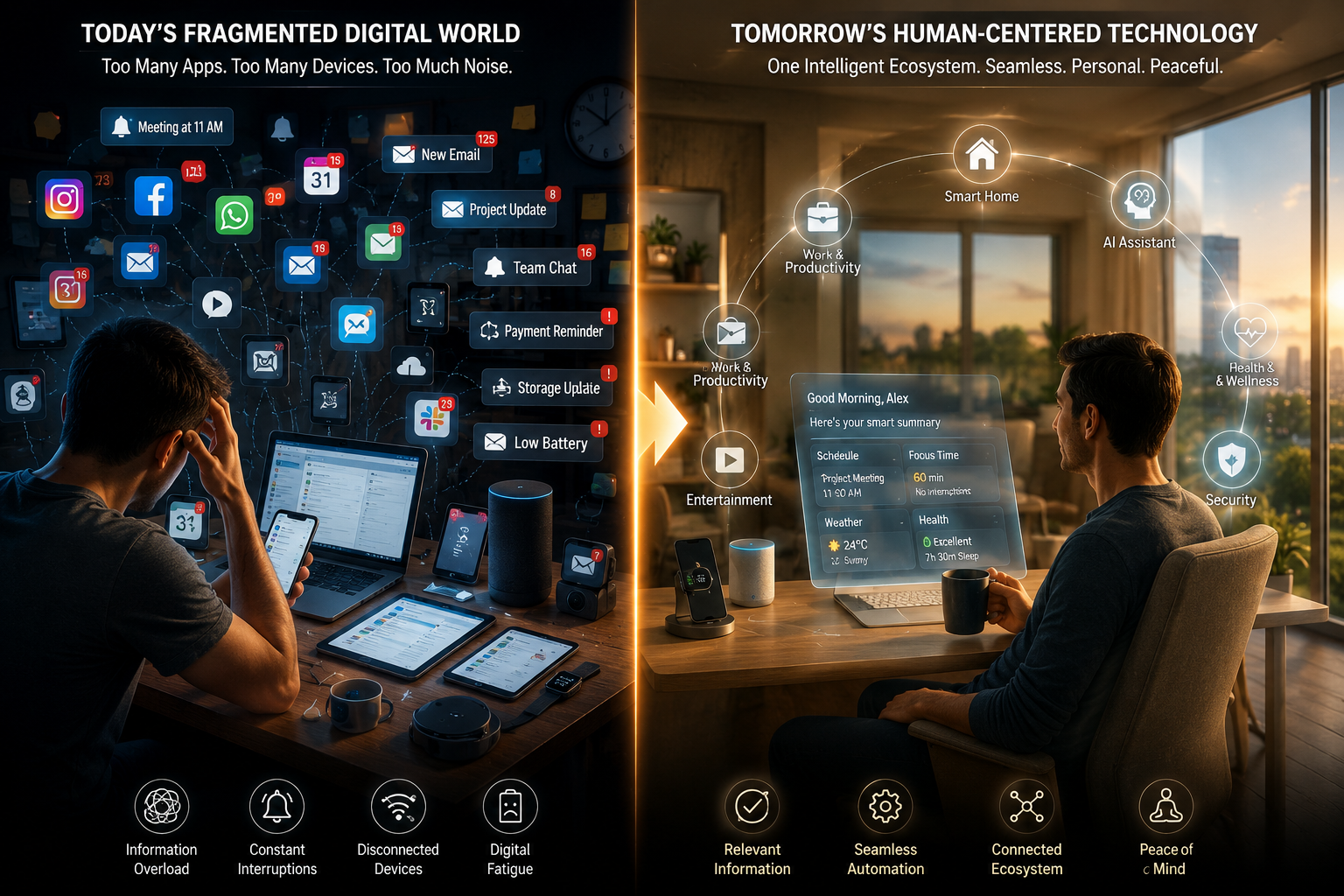
For many years, technological innovation followed a predictable pattern. Companies introduced new devices with faster processors, larger displays, more storage, and increasingly sophisticated features. Consumers eagerly upgraded because every generation promised something better than the last. While this rapid progress transformed modern life, it also created an important realization. More technology does not automatically create a better experience. In many cases, people now spend as much time managing their digital devices as they do benefiting from them. This growing imbalance has inspired a new philosophy of innovation known as Human-Centered Technology.
At its core, Human-Centered Technology is a people-first approach to designing digital products, services, and intelligent systems. Instead of asking, "What else can technology do?", designers begin with a more meaningful question: "What do people actually need?" Every feature, interaction, and digital experience is created to solve real human problems while remaining simple, accessible, and intuitive. Rather than expecting users to learn increasingly complex systems, Human-Centered Technology encourages technology to understand human behavior and adapt accordingly.
This philosophy extends far beyond attractive user interfaces or modern product design. It considers how people think, communicate, make decisions, solve problems, and experience emotions during their daily interactions with technology. A truly human-centered system respects attention instead of competing for it. It protects privacy instead of treating personal information as an unlimited resource. Most importantly, it assists people without reducing their independence or replacing their judgment. The objective is not to build machines that control human lives but to create intelligent tools that quietly empower individuals to live and work more effectively.
As artificial intelligence continues advancing, this approach is becoming increasingly important. Modern AI systems can analyze enormous amounts of information, recognize complex patterns, and automate repetitive tasks with remarkable speed. However, intelligence alone is not enough. Technology must also be transparent, trustworthy, ethical, and inclusive. Human-Centered Technology combines these qualities by ensuring that innovation always serves human interests before technological ambition. In many ways, it represents a shift from building smarter machines to creating smarter experiences.
Why Smart Devices Are No Longer Enough
The first generation of smart technology focused on connecting individual devices to the internet. Smartphones placed powerful computers in people's pockets, smart speakers responded to voice commands, wearable devices monitored health, and connected home appliances automated routine household activities. These innovations were revolutionary, making daily life faster, more convenient, and more efficient than ever before.
Despite these achievements, today's digital ecosystem often feels fragmented. A typical person may use dozens of different applications throughout the day, each requiring separate accounts, passwords, settings, and notifications. One device tracks fitness, another manages work, another controls home automation, while several others handle communication, entertainment, banking, shopping, and transportation. Although every product is considered "smart," the overall experience frequently feels disconnected and unnecessarily complicated.
This complexity creates a phenomenon commonly known as digital fatigue. Constant notifications interrupt concentration, frequent software updates require attention, and information overload makes it increasingly difficult to distinguish what is important from what is merely urgent. Ironically, technology designed to save time sometimes ends up consuming it. As digital experiences become more crowded, users begin searching for something different not another smart device, but a smarter relationship with technology itself.
This is precisely where Human-Centered Technology begins to reshape the future. Instead of developing isolated products that compete for attention, innovators are creating intelligent ecosystems that work together seamlessly. Information flows naturally between devices, artificial intelligence understands context, and digital systems provide assistance only when it genuinely adds value. The emphasis shifts from managing technology to simply living with it. In the future, people may not remember which device performed a task because the entire environment will function as one connected, intelligent experience.
Think About This
Owning more smart devices does not necessarily create a smarter life. The next generation of innovation will be defined by how effortlessly technology works together, allowing people to focus less on managing devices and more on living meaningful lives.
Divyal Vision Reflection
Beyond Smart Devices: The Rise of Ambient Computing
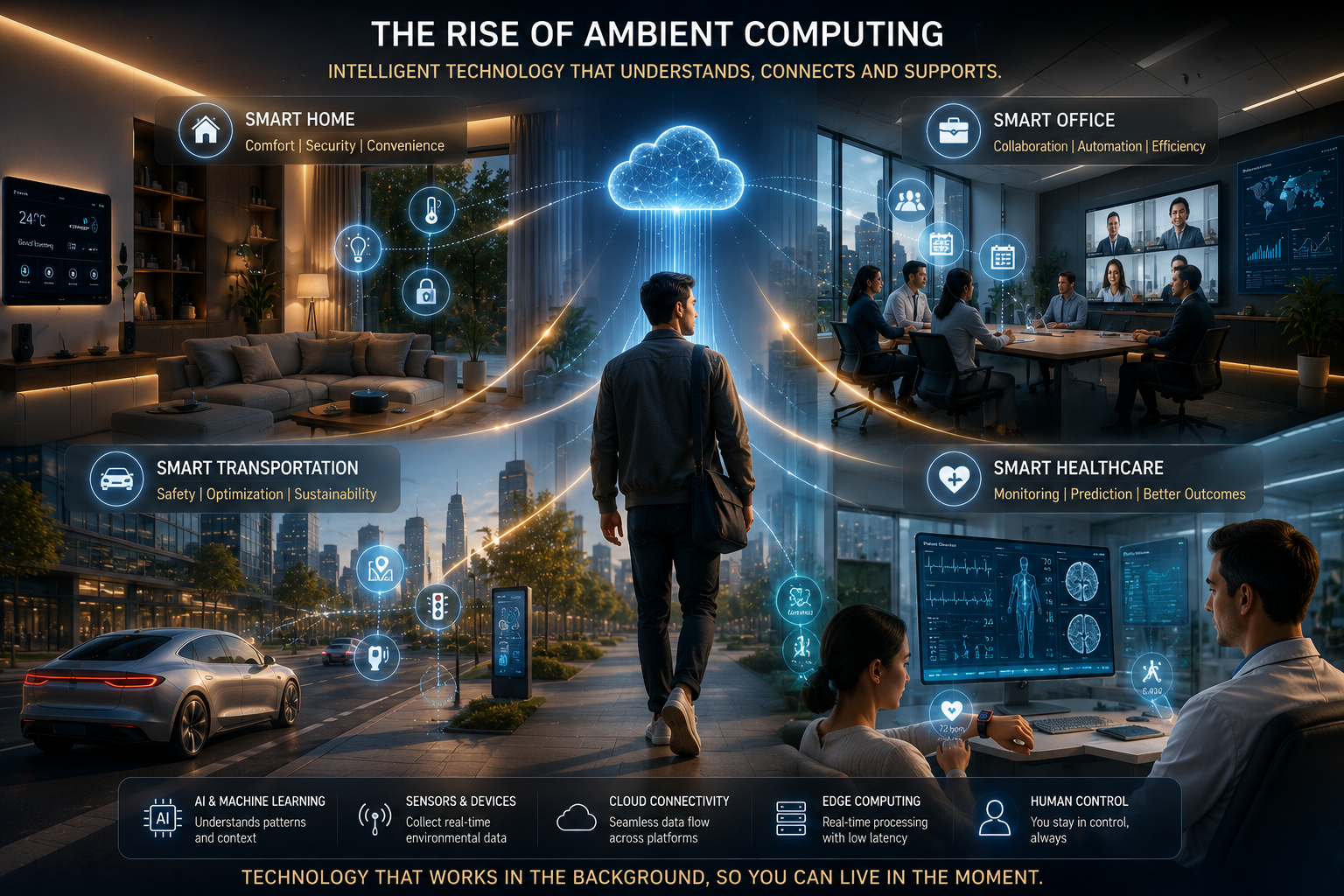
The evolution from isolated smart devices to Human-Centered Technology becomes possible through a concept known as ambient computing. While smartphones, smartwatches, and voice assistants introduced the idea of connected technology, ambient computing takes this vision several steps further. Instead of requiring people to actively interact with individual devices, it creates intelligent environments where technology understands context, communicates across multiple systems, and quietly provides assistance whenever it is genuinely useful.
Unlike traditional digital experiences, ambient computing is designed to remain almost invisible. People do not need to think about which application to open, which device to control, or which command to give first. Multiple technologies including artificial intelligence, cloud computing, sensors, edge computing, and connected devices work together as a unified ecosystem. The result is an experience where technology becomes less noticeable while becoming significantly more helpful. The goal is not to eliminate human involvement but to remove unnecessary friction from everyday life.
This shift represents one of the biggest differences between today's smart devices and tomorrow's intelligent environments. Current technology often waits for instructions before taking action. Ambient computing, however, continuously understands changing circumstances while respecting user preferences and privacy. It recognizes patterns instead of simply responding to commands, creating digital experiences that feel more like natural assistance than traditional software interaction.
Imagine entering your home after a long day at work. Instead of unlocking multiple applications to adjust lighting, temperature, entertainment, and security settings, your environment quietly recognizes your arrival. The lights gradually brighten to your preferred level, indoor temperature adjusts automatically, calming music begins playing softly, and unnecessary notifications are temporarily silenced because your system recognizes that you usually spend your first thirty minutes at home relaxing with your family. Nothing feels automated for the sake of automation. Every action serves a meaningful purpose while allowing you to override the system whenever you choose.
The same experience extends far beyond the home. In an office, ambient computing may reserve meeting rooms automatically, prepare presentation materials before participants arrive, summarize previous discussions, and translate conversations instantly for international teams. In hospitals, intelligent monitoring systems may continuously observe patient health indicators, notifying medical professionals only when meaningful intervention is required. Schools may adapt digital learning environments according to each student's progress without forcing teachers to manually configure every lesson. In every case, the technology remains in the background while people remain firmly in control.
Why Ambient Computing Matters
At first glance, ambient computing may appear to be another technological trend. In reality, it represents a fundamental change in how humans and machines interact. For decades, people have adjusted their routines to accommodate technology. They have learned software interfaces, remembered passwords, installed updates, synchronized devices, and constantly switched between applications. Ambient computing reverses this relationship by allowing technology to adapt to human behavior instead of asking humans to adapt to technology.
This people-first approach offers significant practical advantages. It reduces unnecessary interruptions by presenting only relevant information at the appropriate moment. It minimizes repetitive tasks through intelligent automation while ensuring that users retain complete control over important decisions. It also creates a more natural relationship between humans and digital systems, where technology quietly supports daily activities without becoming a constant source of distraction.
Another important benefit is continuity. Instead of treating every device as an isolated product, ambient computing creates a connected experience where information flows securely across multiple platforms. A task started on one device can continue naturally on another without manual synchronization or repeated configuration. The experience feels less like using separate gadgets and more like interacting with a single intelligent environment designed around human needs.
As Human-Centered Technology continues to evolve, ambient computing is expected to become one of its defining characteristics. The future will not belong to the companies that manufacture the largest number of devices. It will belong to those capable of creating digital ecosystems that understand context, respect privacy, and quietly improve everyday experiences without demanding continuous attention.
Future Snapshot: A Day in 2035
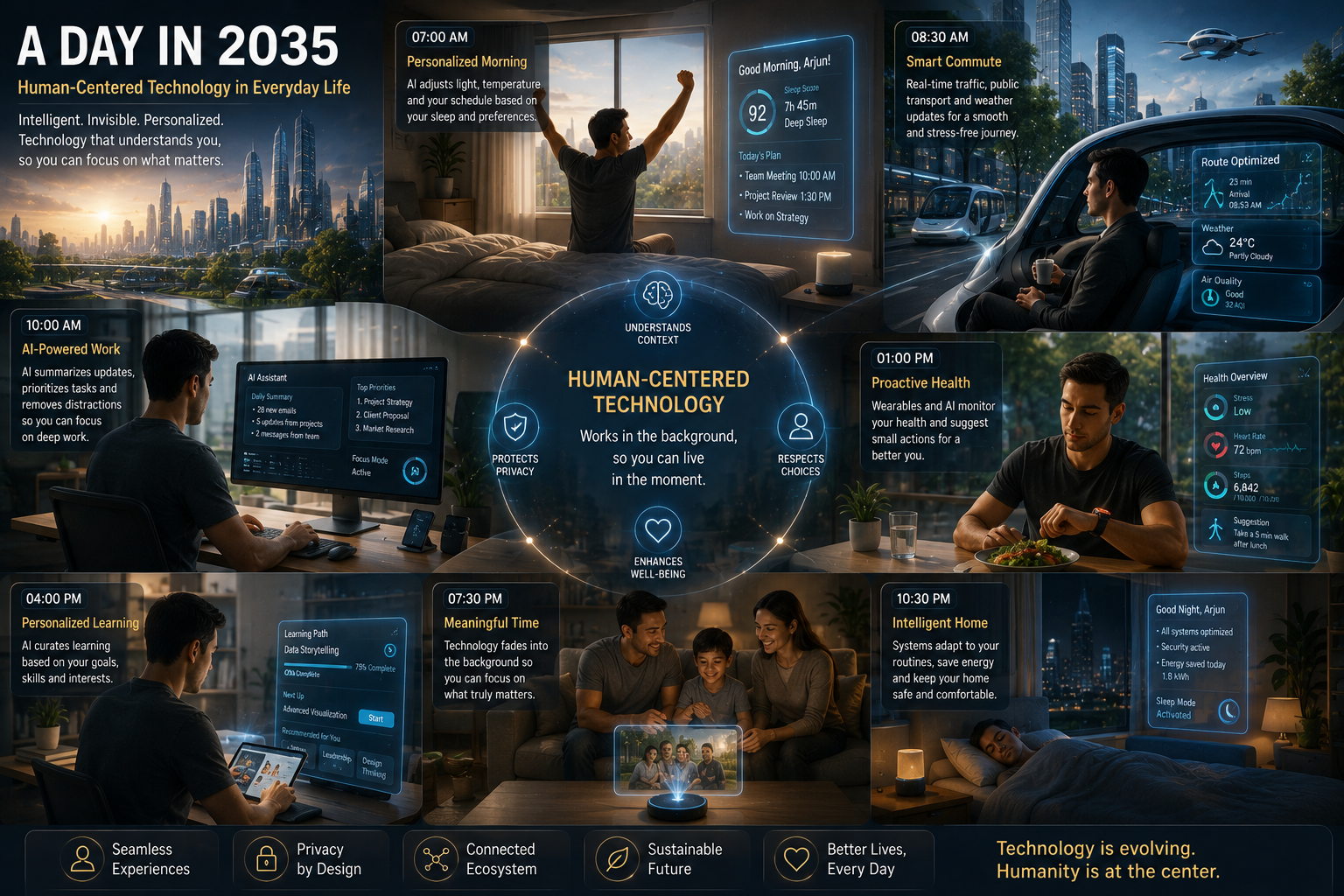
Close your eyes and imagine waking up on an ordinary Tuesday morning in the year 2035. Your bedroom has already adjusted its lighting because it detected that you are naturally waking rather than forcing you awake with a loud alarm. The curtains open gradually, indoor temperature matches your preferred comfort level, and your smartwatch quietly confirms that you slept well enough to begin the day. Nothing demands your attention immediately because your digital environment understands that the first few minutes of the morning are best spent without unnecessary interruptions.
As you prepare for work, your intelligent assistant informs you that your first meeting has been moved by twenty minutes due to severe weather affecting several participants. Instead of simply displaying the change, your calendar has already reorganized the morning schedule, suggested the best departure time, and synchronized the update across your home display, vehicle, and office workstation. During breakfast, your kitchen recommends a meal based on your nutritional goals and recent activity levels, not because it is trying to control your choices, but because it understands your preferences and offers helpful suggestions when they are most relevant.
Throughout the day, technology continues working quietly in the background. Meetings begin with automatically generated summaries, repetitive administrative work is completed before you even notice it, and your wearable device gently reminds you to take a short walk after several hours of focused work. None of these interactions interrupt your concentration because they occur naturally within the rhythm of your day. You remain in complete control, yet technology consistently removes small obstacles that would otherwise consume time and mental energy.
This vision of 2035 is not about living in a world dominated by machines. It is about living in a world where Human-Centered Technology becomes so intuitive that people stop thinking about the technology itself and begin appreciating the freedom it creates. That is the true promise of innovation beyond smart devices.
Divyal Vision Reflection
Every technological revolution changes the tools we use. The next one will change the relationship we have with those tools. When technology quietly understands people instead of constantly demanding their attention, innovation becomes almost invisible and that is precisely when it becomes most valuable.
Unexpected Places Where Human-Centered Technology Will Make the Biggest Difference
When most people think about Human-Centered Technology, they picture smart homes, intelligent assistants, or futuristic offices. While these examples certainly represent an important part of the future, they tell only half the story. The real transformation is likely to happen in places where technology is not merely making life more convenient but making it safer, fairer, and more inclusive. Some of the most meaningful innovations are emerging far beyond consumer electronics, quietly solving problems that directly affect communities, economies, and even the environment.
The true success of Human-Centered Technology will not be measured by the number of connected devices sold each year. Instead, it will be measured by how effectively technology helps people overcome challenges that once seemed impossible to solve. Whether supporting farmers during unpredictable weather, helping emergency responders save lives, empowering people with disabilities, or improving public services, the next generation of innovation is expanding into areas where human expertise and intelligent systems can work together to create lasting positive change.
When Technology Helps Save Lives
Natural disasters such as earthquakes, floods, wildfires, and hurricanes often create situations where every second becomes critical. Rescue teams must quickly locate survivors, assess damaged infrastructure, and coordinate emergency operations despite limited information and dangerous conditions. Traditional response methods rely heavily on human observation, which can be both time-consuming and risky.
Human-Centered Technology offers new possibilities without replacing human expertise. AI-powered drones equipped with thermal imaging cameras can rapidly scan affected areas, identify heat signatures beneath collapsed structures, and provide emergency teams with real-time aerial intelligence. Predictive models can estimate flood paths, identify high-risk zones, and recommend safer evacuation routes before conditions worsen. These technologies do not replace emergency professionals; they simply provide better information, allowing responders to make faster and more informed decisions when every moment matters.
The same principles extend to wildfire monitoring, coastal disaster preparedness, and humanitarian relief operations. Intelligent systems can process enormous amounts of environmental data far more quickly than humans alone, but the final decisions always remain with experienced emergency personnel who understand the human realities behind every crisis.
Helping Farmers Feed a Growing World
Agriculture is experiencing one of the most significant technological transformations in history. Farmers today face increasingly unpredictable weather, changing climate conditions, water shortages, rising production costs, and growing pressure to produce more food using fewer natural resources. These challenges require smarter decision-making rather than simply larger machines or more automation.
Through Human-Centered Technology, intelligent farming systems combine satellite imagery, soil sensors, weather forecasting, and artificial intelligence to help farmers make better daily decisions. Instead of watering an entire field equally, precision irrigation systems can identify exactly where moisture is needed. AI-powered crop analysis can detect early signs of disease before visible damage appears, while predictive weather models help farmers choose the best planting and harvesting schedules.
Importantly, these systems do not replace agricultural knowledge developed through generations of experience. They complement it. Farmers remain responsible for every important decision, while technology provides clearer insights that reduce waste, improve sustainability, and increase long-term productivity.
Building a More Accessible Society
One of the most inspiring applications of Human-Centered Technology is its ability to remove barriers for people living with disabilities. Technology reaches its highest purpose when it creates opportunities for inclusion rather than simply adding convenience for those who already have access.
Artificial intelligence is already helping visually impaired individuals navigate unfamiliar environments using smart glasses capable of identifying objects, reading signs aloud, and recognizing faces. Real-time speech recognition provides live captions for people with hearing loss, while intelligent communication tools translate spoken language into multiple formats almost instantly. Navigation systems are becoming more accessible by identifying wheelchair-friendly routes, elevators, ramps, and safer pedestrian crossings.
These innovations demonstrate that accessibility should never be considered an optional feature added after development. It should be a fundamental design principle. Human-Centered Technology succeeds when every individual regardless of age, ability, or technical knowledge can participate fully in education, employment, healthcare, travel, and community life.
Smarter Public Services for Better Communities
Cities around the world are becoming increasingly connected, yet connectivity alone does not automatically improve people's lives. The real opportunity lies in using technology to make public services more responsive, efficient, and centered around the needs of citizens.
Future transportation systems may automatically adjust traffic signals to prioritize ambulances and fire engines during emergencies. Public transport networks could adapt schedules in real time based on passenger demand, reducing waiting times and improving efficiency. Intelligent environmental sensors may continuously monitor air quality, noise levels, and water conditions, allowing local authorities to respond to potential problems before they become serious public health concerns.
Government services may also become more accessible through digital platforms that simplify administrative processes, reduce paperwork, and provide personalized guidance without requiring citizens to navigate complicated bureaucratic systems. In every case, technology serves as an enabler of better public services rather than a replacement for human responsibility and governance.
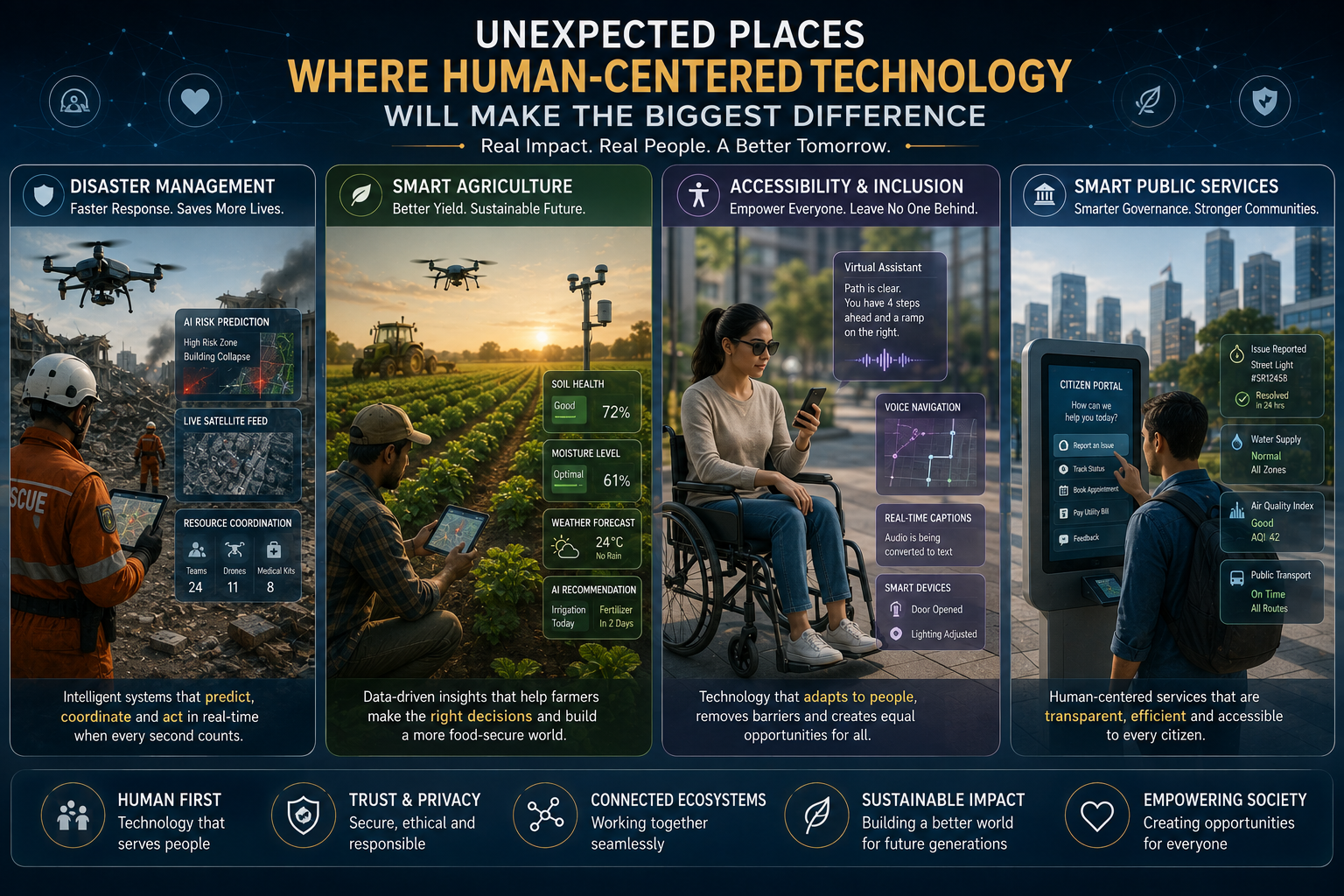
According to technology analysts, the greatest economic and social impact of artificial intelligence over the next decade is expected to come not only from consumer devices but also from improvements in healthcare, agriculture, public infrastructure, accessibility, and emergency response areas where technology directly enhances human well-being rather than simply increasing convenience.
Benefits of Human-Centered Technology
Every technological breakthrough promises to improve people's lives, but not every innovation succeeds in doing so. Some technologies become more complicated as they evolve, requiring users to spend additional time learning new systems, managing updates, and adapting to changing interfaces. Human-Centered Technology takes a fundamentally different approach. Its success is measured not by the number of advanced features it offers but by how naturally it fits into everyday life and how effectively it removes unnecessary complexity without reducing human control.
One of its greatest advantages is the ability to reduce cognitive overload. Modern professionals often switch between emails, messaging platforms, project management software, virtual meetings, calendars, and countless mobile applications throughout the day. Constant interruptions make deep concentration increasingly difficult and contribute to digital fatigue. Human-centered systems intelligently organize information, prioritize meaningful tasks, and reduce unnecessary distractions so that people can devote more attention to creative thinking, strategic decision-making, and personal well-being instead of constantly managing digital tools.
Another significant benefit is greater accessibility. Technology should empower everyone, regardless of age, physical ability, language, or technical expertise. Human-Centered Technology encourages designers to create products that adapt to individual needs rather than expecting every user to interact in exactly the same way. Voice-based interfaces, adaptive text sizes, multilingual communication, gesture recognition, AI-powered translation, and personalized accessibility settings help ensure that digital services become more inclusive. When innovation is designed for everyone from the beginning, society benefits as a whole rather than leaving certain groups behind.
Equally important is the improvement in decision-making. Artificial intelligence can process enormous volumes of information within seconds, identify hidden patterns, and generate valuable insights that would be impossible for humans to analyze manually within the same timeframe. However, Human-Centered Technology does not aim to replace human judgment. Instead, it strengthens it. Doctors receive better diagnostic support, teachers gain deeper insights into student progress, financial advisors analyze complex market trends more efficiently, and business leaders make decisions with greater confidence because technology provides meaningful assistance while humans retain final responsibility.
Perhaps the most valuable benefit is the improvement of quality of life itself. Technology quietly takes care of repetitive and time-consuming tasks, allowing people to invest more time in activities that machines cannot replace building relationships, caring for families, developing creativity, solving complex problems, and contributing to their communities. Instead of making humans work harder to manage technology, Human-Centered Technology ensures that technology works harder to support humanity.
Challenges We Cannot Ignore
Every technological revolution brings extraordinary opportunities, but it also introduces responsibilities that cannot be overlooked. Throughout history, innovations such as electricity, the internet, and social media have improved millions of lives while simultaneously creating new ethical, legal, and security challenges. Human-Centered Technology is no different. Its long-term success depends not only on technological advancement but also on society's ability to develop responsible policies, transparent systems, and ethical standards that place people before algorithms.
The first and perhaps most significant challenge is privacy. Human-centered systems often rely on personal information including health records, behavioral patterns, location history, daily routines, and communication preferences to deliver personalized experiences. While this information enables more intelligent assistance, it also creates important responsibilities for organizations that collect and process it. People deserve to know what information is being collected, why it is needed, how it is protected, and who has access to it. Without transparency and meaningful user control, even the most advanced technologies risk losing public trust.
Another challenge is algorithmic bias. Artificial intelligence learns by analyzing existing data, but if that data contains historical inequalities or incomplete information, AI systems may unintentionally produce unfair recommendations or decisions. Whether supporting recruitment, financial services, education, healthcare, or public administration, developers must continuously test and improve AI models to ensure fairness, accuracy, and inclusivity. Responsible innovation requires acknowledging that artificial intelligence is a powerful tool-not an infallible decision-maker.
Cybersecurity represents another growing concern as billions of connected devices communicate continuously across homes, hospitals, workplaces, transportation systems, and public infrastructure. Every connected sensor, wearable device, or intelligent assistant creates another potential entry point for cyber threats if security is neglected. Protecting these digital ecosystems requires strong encryption, secure software development, continuous monitoring, timely updates, and responsible data governance. A technology ecosystem cannot truly be considered human-centered if users constantly worry about the safety of their personal information.
Finally, society must carefully balance automation with human responsibility. Artificial intelligence excels at analyzing data, identifying patterns, and automating repetitive work, but it cannot replace empathy, moral reasoning, creativity, or cultural understanding. Decisions involving healthcare, justice, education, or public safety should always include meaningful human oversight. The future should be built on collaboration between intelligent systems and human expertise not on replacing one with the other.
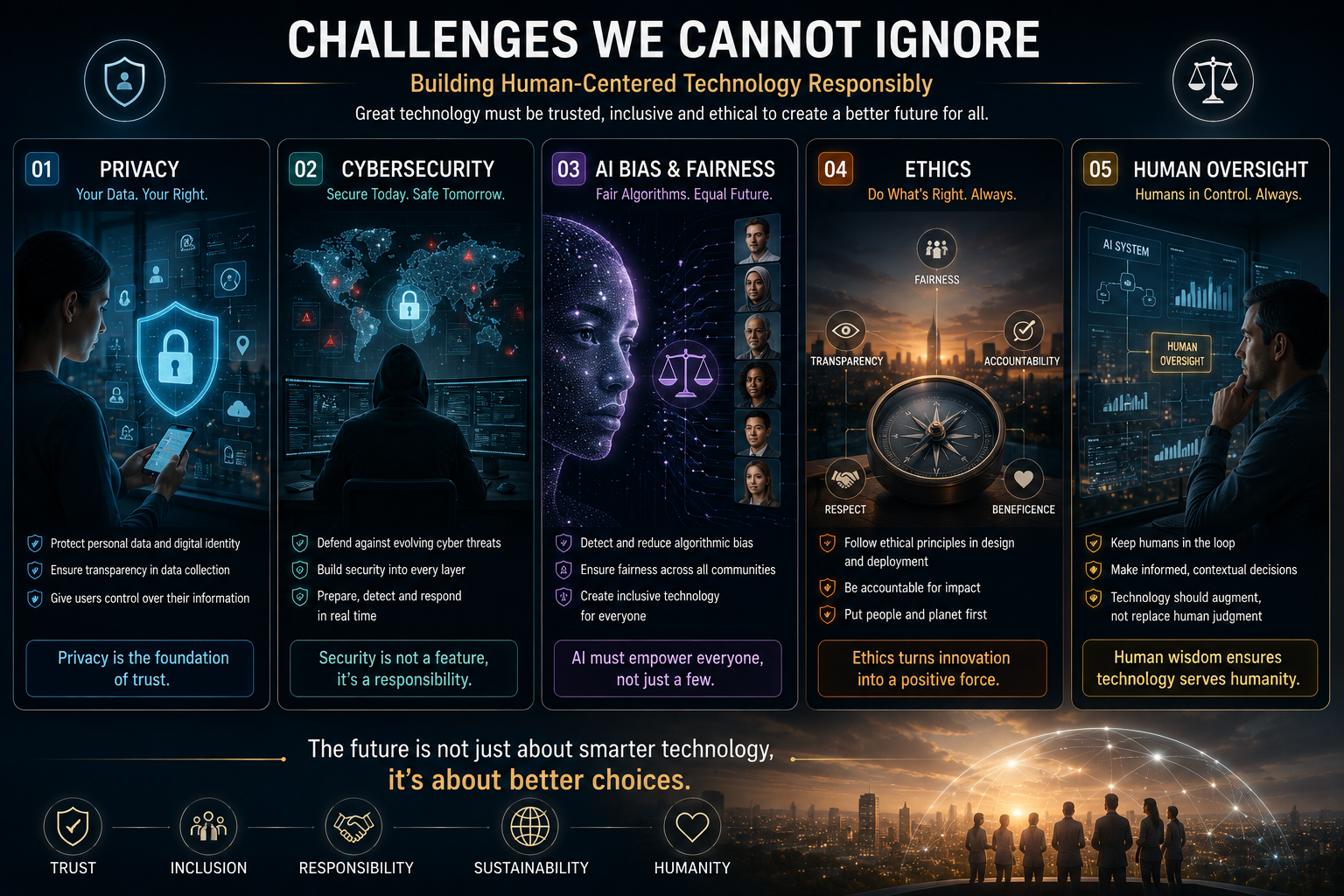
Technology becomes truly intelligent not when it thinks faster than people, but when it helps people think more clearly, live more safely, and make better decisions without taking away their freedom of choice.
Preparing for a Human-Centered Future
The transition toward Human-Centered Technology is no longer a distant possibility-it has already begun. Artificial intelligence is becoming more capable, connected ecosystems are expanding rapidly, and digital services are becoming increasingly integrated into everyday life. Yet technology alone cannot create a better future. The success of this transformation will depend on how responsibly people, businesses, educators, and governments choose to design, adopt, and regulate these innovations. Preparing for a human-centered future is therefore not only a technological challenge but also a social responsibility.
For individuals, the most valuable skill will be continuous learning. The future workforce will need more than technical knowledge. Understanding how artificial intelligence works, protecting personal data, recognizing misinformation, and developing digital literacy will become essential life skills. At the same time, qualities such as creativity, empathy, communication, ethical judgment, and critical thinking will become even more valuable because they represent uniquely human abilities that intelligent systems cannot fully replicate. Rather than competing against technology, people will achieve greater success by learning how to collaborate with it effectively.
Businesses must also rethink the way they build digital products and services. In the past, success was often measured by adding more features, increasing user engagement, or collecting larger amounts of data. The next generation of successful organizations will be those that earn trust by designing technology that is transparent, secure, accessible, and respectful of user privacy. Instead of asking how long people can remain connected to a product, companies will increasingly ask how technology can genuinely improve people's lives. Trust, rather than attention, is likely to become the most valuable competitive advantage.
Educational institutions have an equally important role in shaping this future. Schools and universities should prepare students not only to use intelligent technologies but also to understand their opportunities, limitations, and ethical implications. Learning environments that combine science, technology, creativity, collaboration, and responsible digital citizenship will help future generations become confident innovators rather than passive technology consumers. When education develops both technical expertise and human values, society becomes better prepared for an increasingly intelligent world.
Governments and policymakers must create an environment where innovation can flourish without compromising public safety or individual rights. Clear frameworks for data privacy, cybersecurity, accessibility, artificial intelligence, and digital governance will encourage responsible innovation while protecting citizens from potential misuse. Collaboration between governments, technology companies, academic researchers, and civil society will be essential to ensure that Human-Centered Technology benefits everyone rather than widening existing social or economic inequalities.
Every generation is remembered for the technology it created. The steam engine powered the Industrial Revolution, electricity illuminated the modern world, and the internet connected billions of people across continents. The coming generation, however, may be remembered for something far more meaningful-not for building smarter machines, but for redefining the relationship between humans and technology.
The greatest innovations rarely announce themselves with noise. Electricity quietly became part of everyday life. GPS transformed navigation without changing the way people thought about travel. The internet became so deeply integrated into society that most people now use it without consciously thinking about the extraordinary infrastructure behind it. Human-Centered Technology is likely to follow the same path. As digital systems become more intuitive, they will gradually disappear into the background, allowing people to focus on living rather than managing technology.
The best technology is not the one people admire the most-it is the one they rarely notice because it quietly removes obstacles, respects their choices, and helps them live better every single day.
That simple idea may become the defining philosophy of the next technological era.
For decades, technological progress has been driven by a race to create faster processors, smarter devices, and increasingly powerful digital systems. While these innovations transformed communication, healthcare, education, transportation, and business, they also introduced new layers of complexity that often competed for people's attention rather than simplifying their lives. Today, innovation is entering a new phase one where success is measured not by how intelligent machines become, but by how effectively they improve human experiences.
Human-Centered Technology represents this new direction. Instead of expecting people to adapt to technology, it encourages technology to adapt to people. Through ambient computing, intelligent assistants, connected ecosystems, and ethical artificial intelligence, future digital experiences will become more seamless, accessible, and supportive while preserving human choice and control. From disaster response and sustainable agriculture to inclusive education, personalized healthcare, and smarter public services, its influence will extend far beyond consumer electronics into nearly every aspect of society.
The future will not belong to organizations that simply create more connected devices. It will belong to those that build trust, respect privacy, embrace accessibility, and design innovations that genuinely improve people's lives. Likewise, individuals who continue learning, think critically, and use technology responsibly will be best prepared for an increasingly intelligent world.
Ultimately, the next evolution of technology is not about replacing humanity with machines. It is about creating a future where technology quietly amplifies human potential, allowing people to spend less time managing digital systems and more time focusing on creativity, relationships, health, learning, and meaningful progress. Beyond smart devices lies something far more important a future where innovation finally becomes as human as the people it is designed to serve.
Key Takeaways
- Human-Centered Technology prioritizes human needs, attention, privacy, and control over complex hardware specifications and endless device management.
- Ambient computing creates intelligent environments where technology works quietly in the background without demanding constant manual interaction.
- Real-world applications extend beyond consumer electronics into disaster response, precision agriculture, accessibility, and smarter public services.
- Major challenges include protecting personal privacy, preventing algorithmic bias, securing connected ecosystems, and maintaining human oversight.
- Preparing for a human-centered future requires continuous learning, ethical business design, progressive education, and responsible governance.
Human-Centered Technology is a people-first approach to designing digital products and services that prioritize usability, accessibility, privacy, trust, and meaningful human experiences while keeping people in control.
Traditional smart technology focuses on connected devices and automation. Human-Centered Technology goes further by creating seamless digital ecosystems that understand human needs, reduce complexity, and provide meaningful assistance rather than simply adding more features.
Ambient computing is an intelligent environment where artificial intelligence, connected devices, sensors, and cloud services work together quietly in the background, providing support with minimal user interaction while respecting human preferences.
Healthcare, education, agriculture, transportation, disaster management, finance, manufacturing, accessibility services, and smart cities are expected to experience some of the greatest benefits as Human-Centered Technology continues to evolve.
Key challenges include protecting user privacy, reducing AI bias, strengthening cybersecurity, ensuring ethical AI development, maintaining transparency, and preserving meaningful human oversight in important decisions.