The Future of Human Memory in a World That Remembers Everything
There was a time when remembering was not a choice it was a necessity. People memorized important phone numbers, birthdays, directions, recipes, poems, historical events, and countless pieces of everyday knowledge because there was no reliable place to store them outside their own minds. Memory was not simply a mental ability. It was one of the foundations of learning, decision-making, and daily life.
Today, that relationship with memory is quietly changing. Most people no longer try to remember information that can be retrieved within seconds. A smartphone remembers contacts. Navigation apps remember every destination. Cloud storage preserves thousands of photographs. Search engines answer questions instantly. Artificial intelligence can summarize an entire topic before a person finishes reading the first article. For the first time in history, human beings are surrounded by machines that rarely forget.
At first glance, this appears to be remarkable progress. Life has become faster, more convenient, and more organized than ever before. Information that once required years of study can now be accessed almost instantly. Digital technology has expanded human knowledge in extraordinary ways.
Yet beneath this convenience lies a quieter transformation. The more technology remembers on our behalf, the less often we ask our own minds to remember. Instead of recalling information, many people simply recall where to find it. Instead of developing deeper understanding through repeated reflection, they rely on immediate access to answers. Gradually, memory shifts from an internal skill to an external service.
This change is subtle enough that most people never notice it happening. Few people realize how often they reach for a phone before trying to remember something themselves. A forgotten appointment, an unfamiliar word, a simple calculation, or even a childhood fact often sends the hand toward a screen almost automatically. Digital assistance has become so deeply woven into everyday life that dependence frequently feels indistinguishable from convenience.
The question is not whether technology is making people less intelligent. Modern digital tools have undoubtedly expanded what individuals can accomplish. The more important question is whether constant dependence on external memory is changing the way the human brain learns, thinks, and solves problems over time.
Understanding the future of Human Memory is no longer just an academic discussion for neuroscientists or psychologists. It has become an important conversation for students, educators, parents, professionals, and anyone living in a world where information is always available-but meaningful understanding still depends on the human mind.
Why Human Memory Is Changing
Human memory has never remained completely unchanged throughout history. Every major technological breakthrough has influenced the way people preserve knowledge. Writing reduced the need to memorize long stories. Printed books made information easier to preserve. Libraries organized centuries of learning into accessible collections. Computers accelerated information storage, while the internet connected billions of pages of knowledge across the world.
Each innovation made information easier to access than the one before it. Artificial intelligence represents the next stage of this evolution. Unlike previous technologies that simply stored information, modern AI systems can organize it, compare it, summarize it, explain it, and even generate entirely new content within seconds. They do far more than preserve knowledge they actively participate in the process of finding and presenting it.
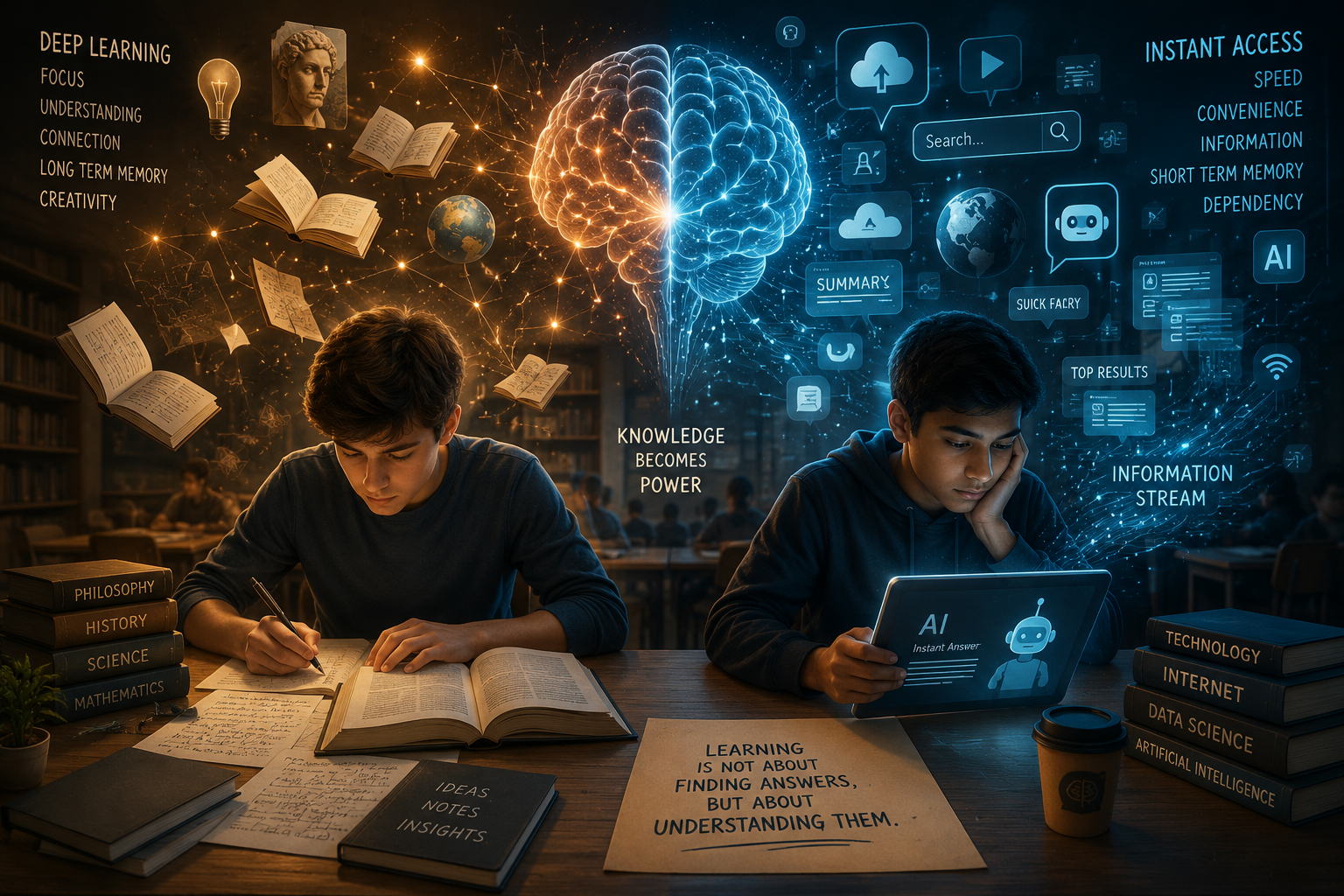
As a result, the purpose of memory is beginning to shift. For generations, people focused on remembering information because access to knowledge was limited. Today, information is rarely scarce. The challenge is no longer remembering facts but deciding which information deserves attention, whether it is trustworthy, and how different ideas connect together.
This subtle change influences the way people learn. Instead of strengthening long-term memory through repetition and reflection, many individuals become accustomed to instant retrieval. The brain gradually adapts to an environment where remembering becomes optional because searching is always possible.
This does not necessarily mean human memory is becoming weaker. It means it is being used differently. Just as calculators changed mental arithmetic without eliminating mathematics, digital technology is changing memory without eliminating the need for thinking. The real challenge is ensuring that convenience does not slowly replace understanding, curiosity, and independent reasoning.
The Shift from Remembering to Searching
Imagine asking someone for directions twenty years ago. There was a good chance they could guide you street by street without looking at a map. Today, even people who have lived in the same city for years often open a navigation app before starting a familiar journey. The destination has not changed. What has changed is the habit of remembering.
This pattern extends far beyond navigation. Birthdays are stored in calendars. Shopping lists live inside mobile apps. Phone numbers disappear into contact lists. Recipes are bookmarked instead of memorized. Even simple facts that could be recalled with a little effort are frequently searched online within seconds.
Searching has become easier than remembering. At first glance, this seems like an intelligent adaptation. Why spend mental energy memorizing information that can be retrieved instantly? Digital technology frees the brain from countless routine tasks, allowing people to focus on more complex problems. In many situations, this is a genuine advantage.
However, convenience often changes behavior in ways that are difficult to notice. Psychologists have observed that when people know information will always be available later, they become less likely to commit it to long-term memory. The brain naturally avoids storing what it believes can be accessed whenever needed. Instead of remembering the information itself, it remembers where that information exists.
This quiet shift changes the way learning takes place. Learning has traditionally been more than collecting facts. It involves connecting ideas, recognizing patterns, comparing experiences, and building understanding over time. Those connections become stronger when information is recalled repeatedly without assistance. Every act of remembering reinforces the pathways that make future thinking faster and more intuitive. Constant searching interrupts that process.
When every question is answered immediately, the brain receives the result without experiencing the effort of retrieval. That effort may feel inconvenient, but it is one of the most powerful ways memory becomes stronger. Without it, information often remains temporary, disappearing almost as quickly as it appeared.
The result is an unusual contradiction. People now have access to nearly unlimited knowledge, yet many struggle to remember information they read only hours earlier. Articles are skimmed instead of studied. Videos are watched without reflection. Facts are consumed rapidly but rarely become lasting understanding. Technology has not reduced the amount of information available. It has changed the relationship people have with information itself.
The real risk is not forgetting individual facts. It is gradually losing the habit of engaging deeply enough with knowledge for it to become part of the mind. When searching replaces remembering in every situation, learning begins to feel less like building a library and more like borrowing a book that is returned moments after reading. Knowledge that lives only on a screen can certainly solve today's question. Knowledge that lives inside the mind continues to shape tomorrow's decisions.
Smartphones as the New External Brain
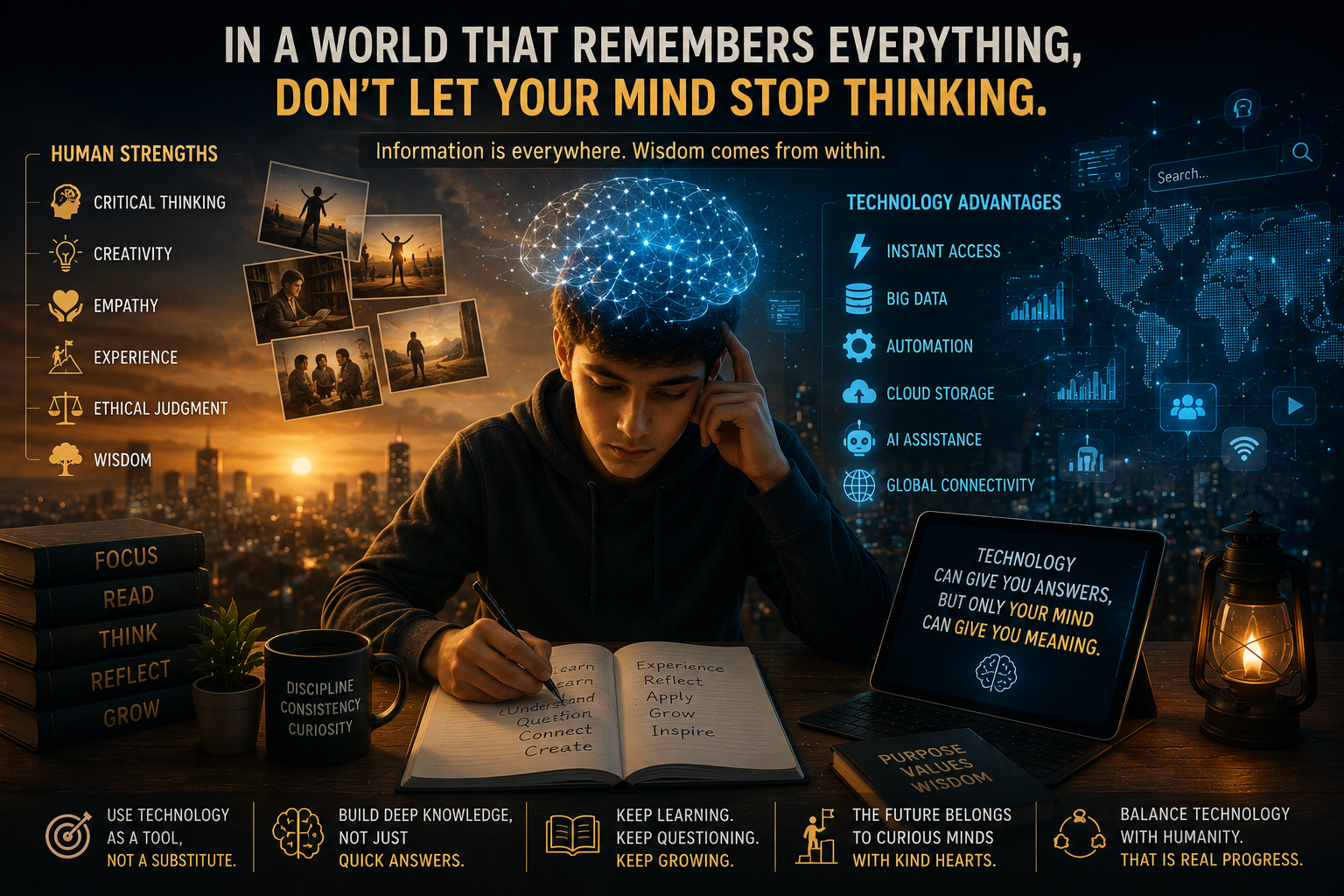
Few inventions have changed human memory as quietly as the smartphone. Unlike books, computers, or even the internet, a smartphone is almost always within reach. It wakes us in the morning, guides us through traffic, reminds us of meetings, stores our photographs, remembers passwords, keeps track of appointments, and answers questions within seconds. It has become far more than a communication device. For many people, it now functions as an extension of the mind itself.
Consider how often a normal day depends on it. A calendar remembers important dates. A navigation app remembers unfamiliar roads. A note-taking app stores ideas before they disappear. Banking applications remember financial records. Cloud storage preserves years of photographs that might otherwise fade from memory. Even grocery lists, fitness goals, and daily routines increasingly exist inside a screen rather than inside the mind.
In many ways, this represents one of humanity's greatest technological achievements. The problem is not that smartphones remember information. The problem begins when people gradually stop exercising the ability to remember for themselves.
Imagine a muscle that performs less work each year because a machine quietly takes over every physical task. The muscle may not disappear overnight, but over time it becomes weaker through lack of use. Human memory follows a surprisingly similar principle. The brain strengthens many of its abilities through regular use. When those abilities are consistently outsourced, they receive fewer opportunities to develop.
This does not mean smartphones damage memory directly. Instead, they change the habits that memory depends upon. When every answer is immediately available, patience becomes less necessary. When every appointment triggers a reminder, remembering dates becomes less important. When every destination is displayed on a digital map, the brain spends less effort building mental maps of familiar places. Slowly, convenience begins replacing mental practice.
Researchers often describe this behavior as cognitive offloading the tendency to shift mental tasks onto external tools. Writing a reminder instead of memorizing it, saving a phone number instead of learning it, or asking an AI assistant instead of recalling previous knowledge are all examples of this process.
Cognitive offloading is not inherently harmful. In fact, it often improves productivity by reducing mental overload. A surgeon, engineer, scientist, or pilot should not rely solely on memory when accurate records and digital systems can improve safety and efficiency. The challenge arises when offloading becomes the default response for every situation, including those where independent thinking and memory remain valuable.
There is another subtle consequence. Memories are not simply collections of facts. They are connected through emotions, experiences, repetition, and reflection. Remembering something without assistance requires the brain to search through those connections, strengthening them each time they are used. When a device provides the answer immediately, that internal search often never begins.
Over months and years, this may influence not only what people remember but also how confidently they trust their own memory. Many individuals now check their phones even when they already know the answer. Not because they have forgotten but because they trust the device more than themselves. That may be the most remarkable transformation of all. For thousands of years, human memory was considered one of the mind's greatest strengths. Today, an increasing number of people carry a second memory in their pockets and often consult it before consulting their own.
What Constant Digital Access Does to Learning
Learning has never been about collecting information alone. True learning happens when information is understood, connected with previous knowledge, questioned, and eventually remembered well enough to be used without assistance. This process requires time, attention, and repeated engagement. Every time the brain struggles to recall an idea, it strengthens the mental pathways that make future recall easier.
The digital world has transformed this process in remarkable ways. Students can now access entire libraries from a single device. Professionals can solve technical problems within minutes by searching online. Artificial intelligence can explain difficult concepts almost instantly. Access to knowledge has become faster and more democratic than ever before.
Yet unlimited access to information does not automatically create deeper understanding. Many people today consume information continuously but rarely spend enough time reflecting on it. Articles are skimmed instead of carefully read. Videos are watched at double speed. Long explanations are replaced with short summaries. Questions are answered before curiosity has a chance to grow. The result is a habit of collecting information without allowing it to become lasting knowledge.
Learning is not measured by how quickly an answer is found. It is measured by how well that answer can be understood, connected to other ideas, and applied in a completely different situation. Searching for information may solve today's problem, but genuine learning prepares people to solve tomorrow's problems without depending on a search engine every single time.
There is another important difference between knowing and finding. A person who understands a concept can explain it, adapt it, challenge it, and use it creatively. Someone who only knows where to search for it often struggles when technology is unavailable or when a problem requires original thinking instead of a familiar answer. Information stored on the internet remains external until it becomes part of the way a person thinks.
This is becoming increasingly visible in classrooms and workplaces alike. Many students can locate facts within seconds but find it difficult to explain those facts in their own words. Employees often rely on documentation for routine tasks yet struggle when unexpected situations demand reasoning instead of repetition. The issue is rarely a lack of intelligence. More often, it reflects a learning process that prioritizes access over understanding.
None of this suggests that digital technology is harmful to education. In fact, it has opened extraordinary opportunities for learning that previous generations could only imagine. Online courses, educational videos, digital libraries, and AI tutors have made high-quality knowledge accessible to millions of people across the world. The challenge is not using technology-it is allowing technology to replace the mental effort that learning requires. Reading carefully, asking questions, solving problems independently, and recalling information without immediate assistance remain essential parts of developing a strong and adaptable mind. Technology can support these habits, but it should never become a substitute for them.
Ultimately, the future of learning will not be determined by how much information humanity can store in machines. It will be determined by whether people continue developing the curiosity, patience, and critical thinking needed to transform information into wisdom.
Information Overload and the Decline of Deep Thinking
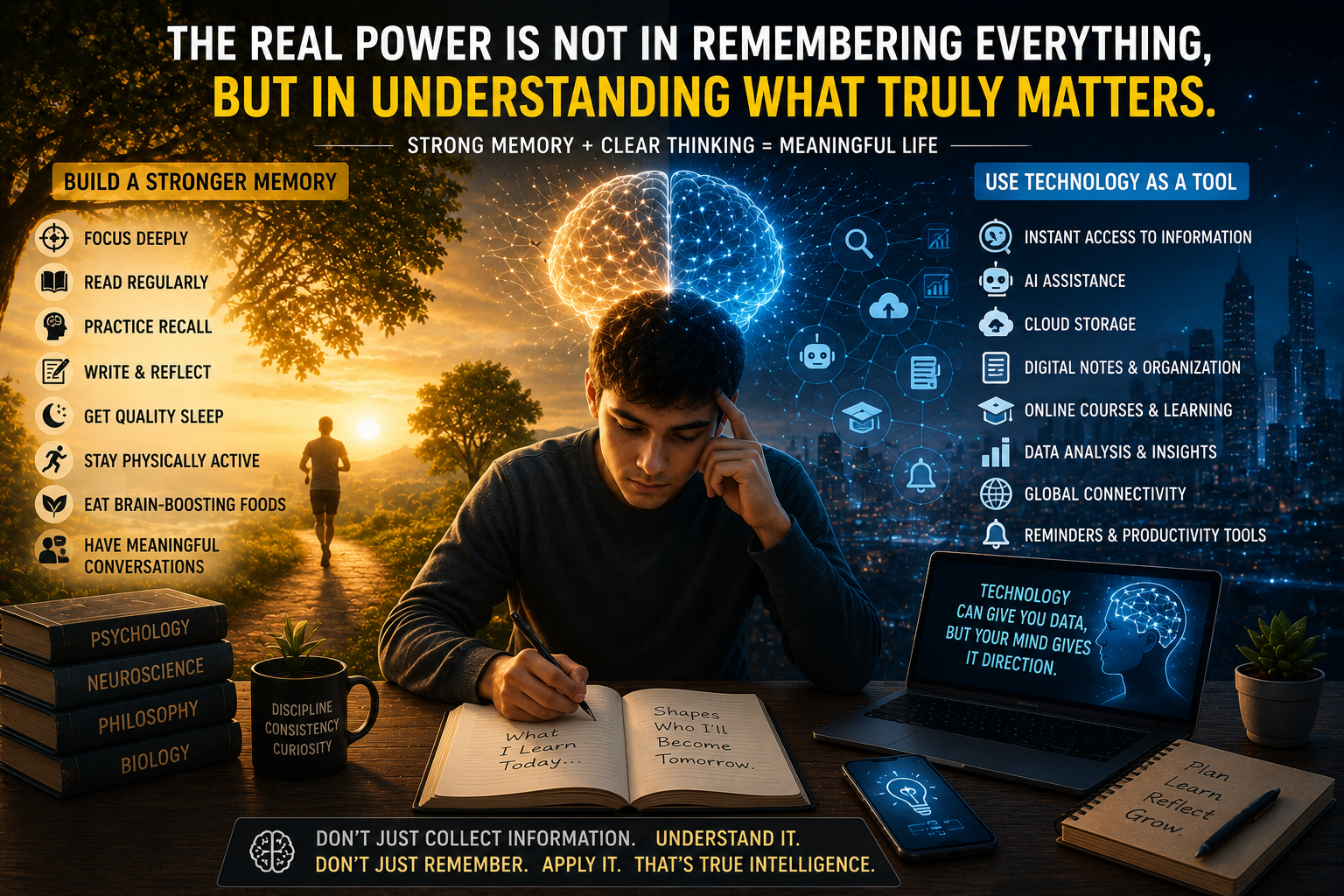
Never before in human history has so much information been available to so many people at the same time. Every minute, millions of articles are published, videos are uploaded, messages are exchanged, and opinions are shared across digital platforms. A single smartphone now provides access to more knowledge than entire libraries once contained. What was once difficult to find has become impossible to escape.
At first, this seems like one of the greatest achievements of the digital age. More information should lead to better decisions, greater understanding, and faster learning. Yet reality often tells a different story. Many people feel mentally exhausted despite consuming more information than ever before. The challenge is no longer finding knowledge-it is filtering it.
The human brain was never designed to process an endless stream of updates without pause. Every notification competes for attention. Every headline demands curiosity. Every social media feed introduces another opinion, another statistic, another crisis, or another trend. Individually, these interruptions appear insignificant. Together, they create a constant state of mental distraction.
Deep thinking requires something that modern technology rarely encourages uninterrupted attention. When people focus on a single idea for an extended period, the brain begins connecting concepts, recognizing patterns, and generating original insights. Creativity often emerges during these quiet moments of sustained concentration. Unfortunately, constant digital interruptions break this natural process before it has time to develop.
Imagine reading an important book while someone interrupts you every two minutes with a different conversation. Even if each interruption lasts only a few seconds, returning to the same level of concentration becomes increasingly difficult. Digital notifications produce a remarkably similar effect. Every alert forces the brain to switch context, consuming mental energy that could otherwise be used for deeper understanding.
This constant switching gradually changes the way people think. Instead of following one idea from beginning to end, attention becomes fragmented across dozens of unrelated topics. News headlines replace detailed analysis. Short videos replace long-form reading. Quick summaries replace careful reflection. Information is consumed rapidly but rarely explored deeply enough to produce lasting understanding.
The consequences extend beyond memory. Critical thinking depends on the ability to compare different perspectives, question assumptions, evaluate evidence, and reach independent conclusions. These skills require patience. They cannot develop through endless scrolling or continuous exposure to disconnected pieces of information. When every answer is delivered instantly, people may become less inclined to ask whether that answer is complete, accurate, or even true.
Another hidden consequence is the growing illusion of knowledge. Reading dozens of headlines or watching several short videos can create the feeling of being well informed. However, familiarity is not the same as understanding. Recognizing a topic is very different from explaining it clearly, discussing its complexities, or applying it to real-world situations. The digital world often rewards speed, while genuine understanding continues to reward depth.
This is why many experts encourage the practice of digital mindfulness rather than digital avoidance. The goal is not to reject technology or disconnect from the online world. Instead, it is to become intentional about how information is consumed. Choosing fewer but higher-quality sources, reading without interruptions, reflecting before moving to the next topic, and allowing time for independent thought can significantly improve both learning and decision-making. In the years ahead, intelligence may be defined less by how much information a person can access and more by how well they can filter, evaluate, and transform that information into meaningful understanding. In a world overflowing with knowledge, the rarest skill may no longer be finding information-it may be thinking deeply about it.
Can Artificial Intelligence Replace Human Memory?
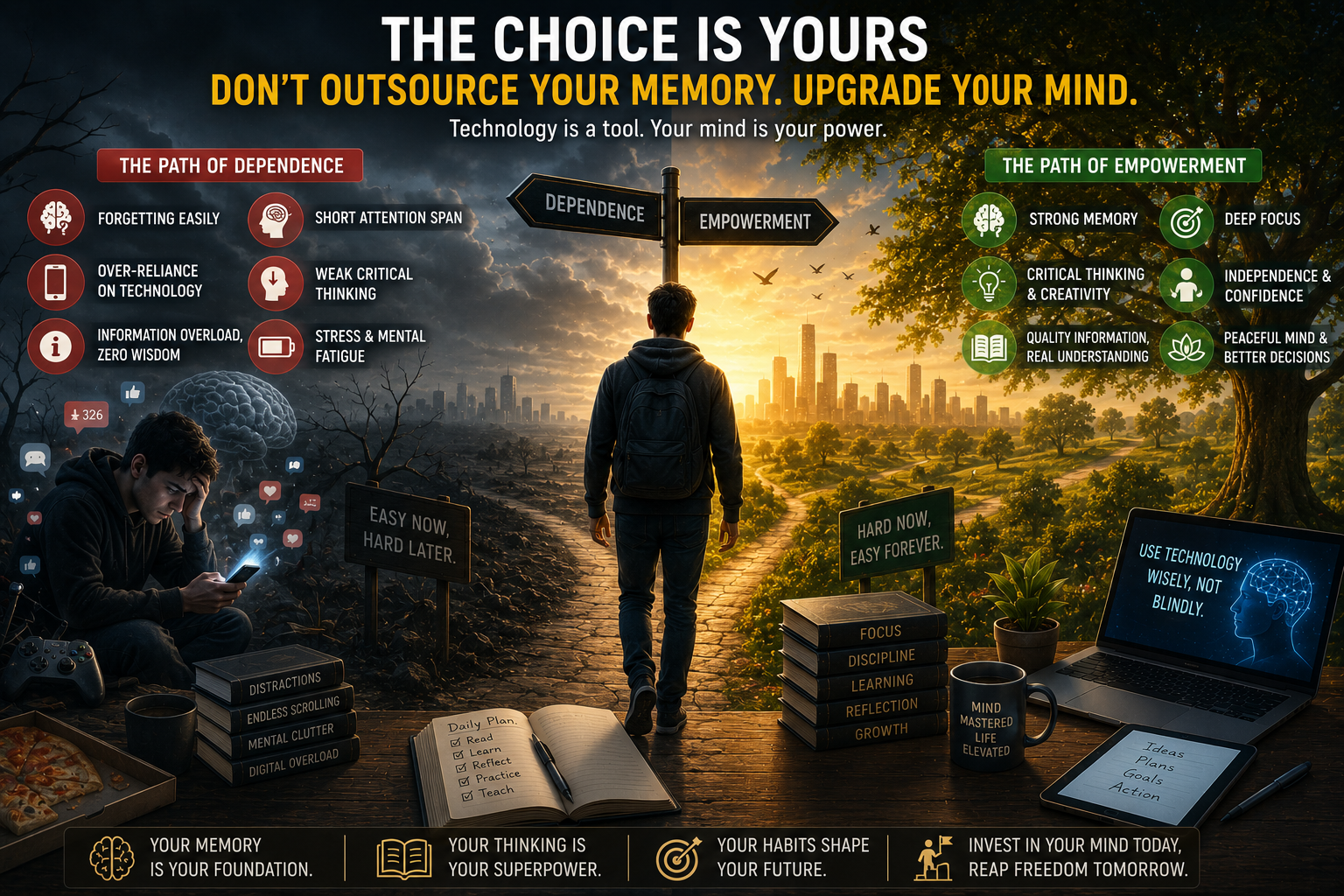
Artificial intelligence has rapidly become one of the most powerful tools humanity has ever created. It can answer complex questions, summarize lengthy documents, translate languages, generate ideas, write code, and analyze enormous amounts of information within seconds. Tasks that once demanded hours of research can now be completed in minutes. Naturally, this has led many people to wonder whether AI could eventually replace one of our oldest cognitive abilities-human memory.
The answer is more complex than it first appears. Artificial intelligence can certainly store and retrieve information far more efficiently than any human being. It never becomes tired, does not forget because of age, and can search through vast collections of data almost instantly. From a purely informational perspective, machines already outperform human memory in speed, capacity, and consistency.
However, remembering is only one part of what human memory actually does. Human memory is deeply connected to personal experience, emotions, imagination, and identity. It is not a digital database that simply stores facts. Every memory is shaped by context, relationships, feelings, and individual interpretation. Two people can witness the same event and remember it differently because memory is influenced by personal perspective rather than perfect accuracy.
Artificial intelligence does not experience life in this way. An AI system can describe what happiness means, but it has never celebrated a personal achievement. It can explain grief, but it has never lost someone it loves. It can analyze thousands of stories about courage, yet it has never faced fear itself. Human memories are meaningful not simply because they contain information, but because they are connected to lived experiences that shape personality and decision-making.
This distinction becomes even more important when creativity enters the picture. Many groundbreaking ideas are born from unexpected connections between memories, emotions, and experiences. A scientist discovers a new theory by linking observations made years apart. An artist transforms childhood memories into a painting. A writer develops a powerful story by combining personal experiences with imagination. These creative leaps emerge from the uniquely human ability to connect memories in ways that extend beyond logical storage.
Artificial intelligence can assist this creative process by organizing information, suggesting possibilities, and generating drafts. It can become an extraordinary thinking partner. Yet the inspiration behind truly original ideas often begins with human curiosity, intuition, and experience qualities that cannot simply be downloaded into a machine.
There is another important consideration. The more people depend on AI to recall information, solve problems, or make decisions, the greater the risk of weakening their own confidence in independent thinking. If every difficult question is immediately handed to an intelligent system, the habit of wrestling with uncertainty gradually begins to disappear. Over time, people may become highly skilled at obtaining answers while becoming less comfortable discovering answers for themselves.
This does not mean AI should be feared or avoided. On the contrary, it represents one of the greatest educational and professional tools ever developed. Students can receive personalized explanations, researchers can analyze enormous datasets, doctors can identify medical patterns more quickly, and businesses can automate repetitive work. Used wisely, artificial intelligence has the potential to expand human capability rather than replace it.
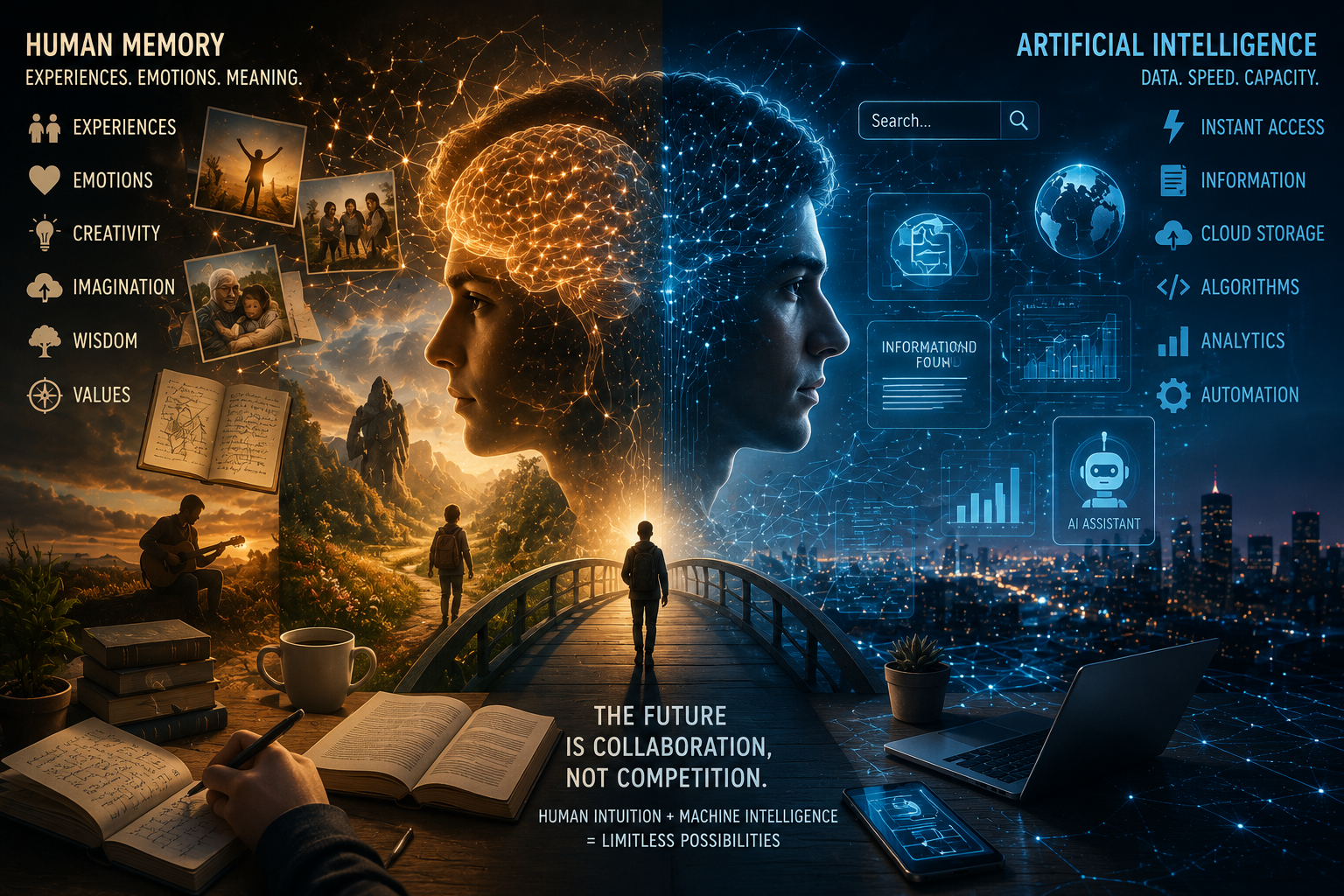
The future is therefore unlikely to be a competition between human memory and artificial intelligence. Instead, it will depend on collaboration. Artificial intelligence will remember vast amounts of information with extraordinary speed, while humans continue providing judgment, empathy, creativity, ethics, and the ability to assign meaning to knowledge. One excels at storing and processing information. The other excels at transforming information into wisdom.
Perhaps the most important question is not whether artificial intelligence can remember more than humans. It almost certainly can. The more meaningful question is whether people will continue strengthening the uniquely human abilities that no machine can fully replicate. In a future where technology remembers almost everything, our greatest advantage may not be remembering more-it may be understanding more deeply.
Protecting Human Memory in the Digital Age
Technology is not the enemy of human memory. In many ways, it has become one of its greatest allies. Digital calendars prevent important appointments from being forgotten. Cloud storage protects family photographs for future generations. Educational platforms make knowledge accessible to anyone with an internet connection. Artificial intelligence helps explain complex ideas that once required years of study.
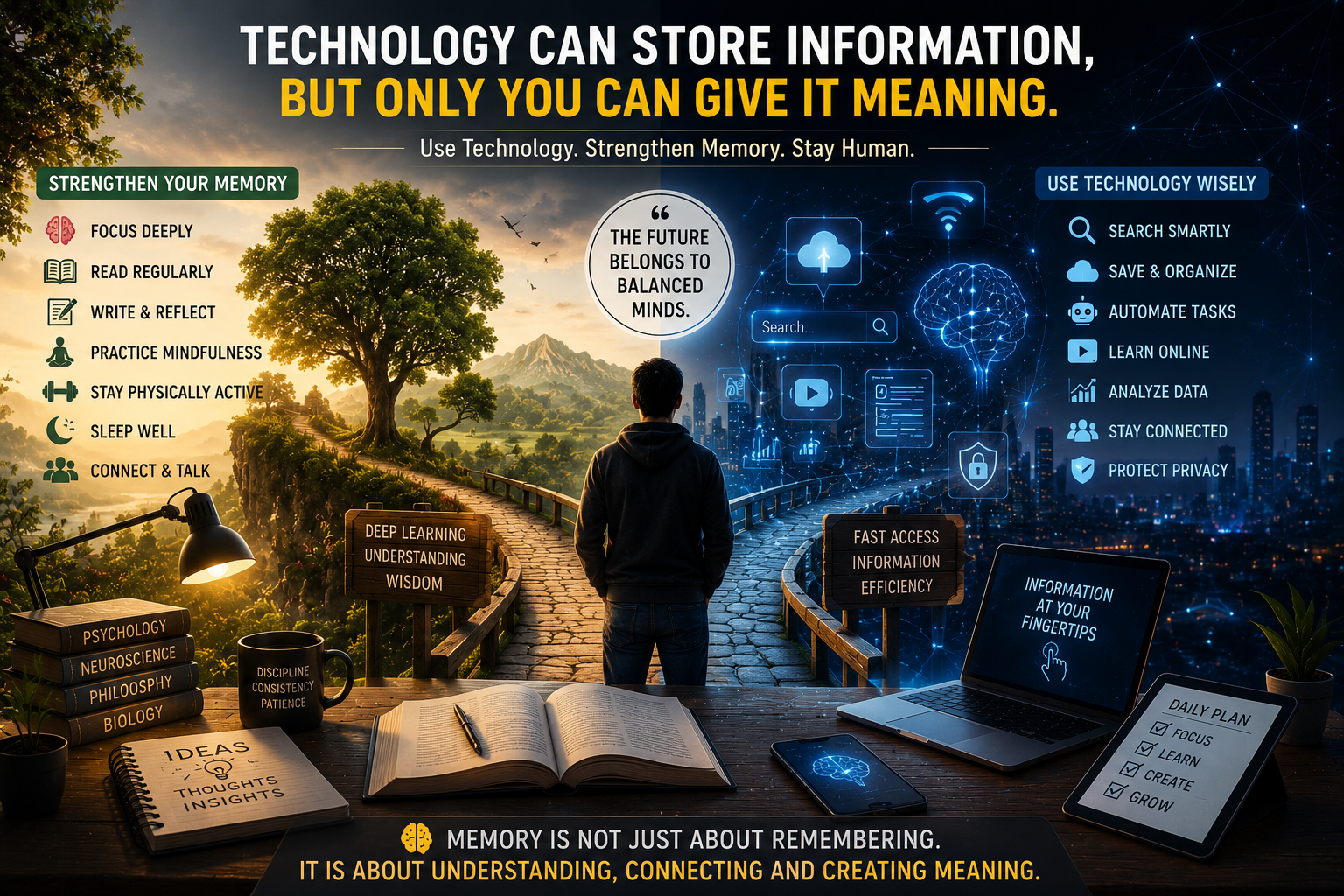
The challenge, therefore, is not whether people should use technology. The challenge is ensuring that technology supports the mind instead of quietly replacing the habits that keep it strong. Human memory improves through use, much like physical fitness. A person who exercises regularly maintains strength over time because the body is continually challenged. The brain follows a similar principle. Every time people recall a fact without searching for it, solve a problem independently, or explain an idea in their own words, they reinforce the neural connections responsible for learning and memory.
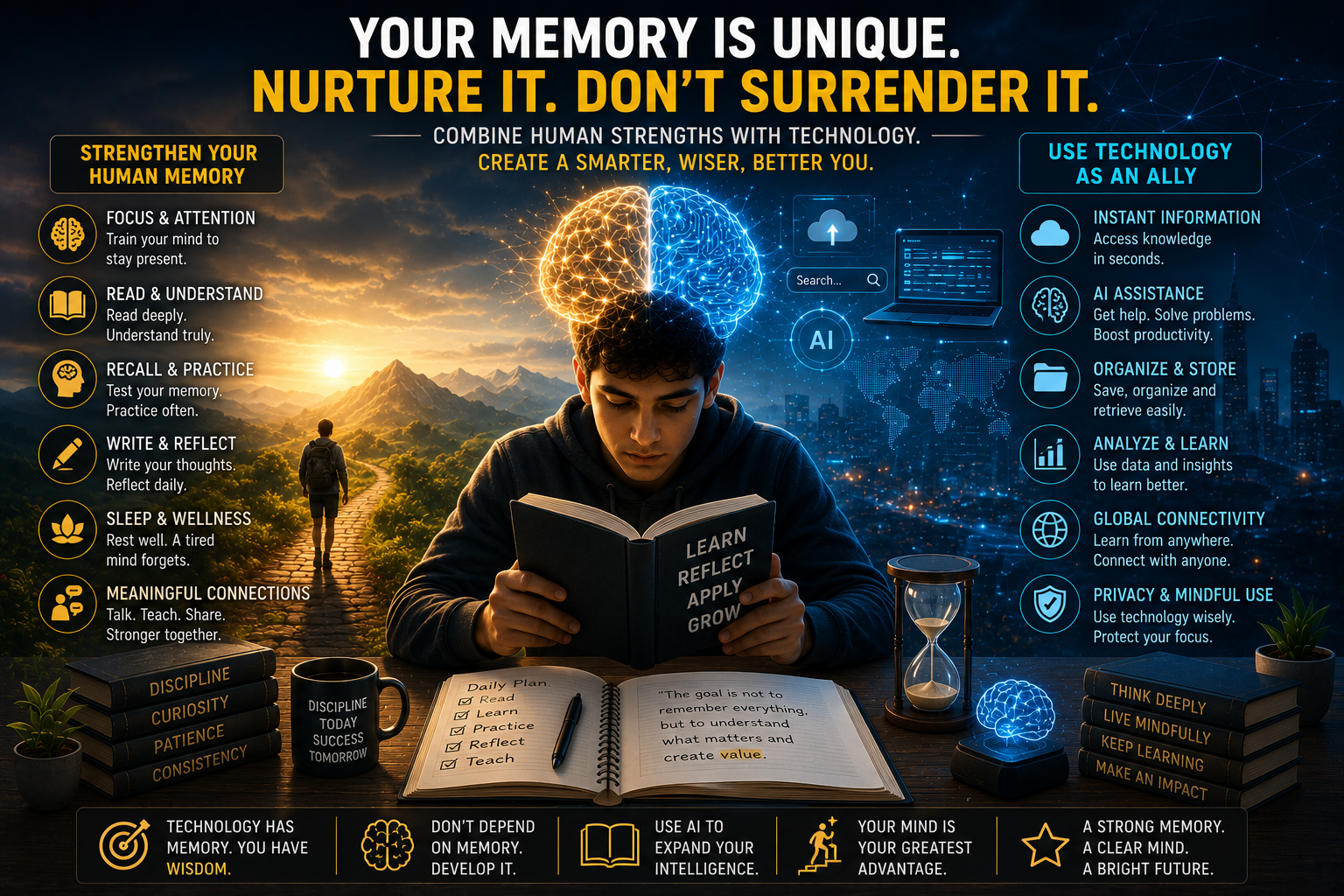
Small daily habits can make a remarkable difference. Reading a book without checking notifications allows the mind to remain focused long enough to build deeper understanding. Memorizing a few important phone numbers, important dates, or useful information may seem unnecessary today, but these simple exercises continue training the brain's ability to retain knowledge. Even taking a few minutes to reflect on what has been learned before moving to the next topic strengthens long-term memory far more than endless scrolling.
Writing by hand also remains surprisingly valuable. When people write notes with a pen instead of copying text digitally, the brain becomes more actively involved in processing information. Handwriting is slower than typing, forcing the mind to summarize ideas rather than record every word. This additional mental effort improves comprehension and makes important concepts easier to remember later.
Meaningful conversations contribute to memory as well. Discussing ideas with friends, teaching someone a new concept, or explaining a difficult topic without relying on notes requires active recall. The brain must organize information, connect different ideas, and express them clearly. These activities transform passive information into lasting knowledge far more effectively than simply reading or watching another video.
Equally important is learning to create moments without constant digital assistance. Many people immediately photograph beautiful experiences instead of fully experiencing them. A sunset is captured before it is admired. A family celebration is viewed through a camera lens before it is enjoyed. While photographs preserve moments, memories are often strengthened by attention, emotion, and presence. Sometimes the most meaningful memories are created when technology quietly steps into the background.
Developing healthy digital habits does not require rejecting modern technology. It simply requires balance. There are moments when searching for information is the smartest choice, and there are moments when challenging the mind to remember is equally valuable. Choosing between the two consciously allows technology to remain a powerful tool without becoming an unconscious dependency.
Perhaps the greatest protection for human memory is curiosity itself. Curious people naturally ask questions, seek deeper understanding, revisit ideas, and connect knowledge across different subjects. Their goal is not merely to find answers but to understand why those answers matter. Curiosity encourages the kind of deep engagement that transforms information into wisdom and experiences into lasting memories.
As artificial intelligence becomes increasingly capable of remembering almost everything, the value of human memory may shift rather than disappear. Instead of competing with machines in storing information, people may find their greatest strength in understanding, interpreting, creating, and giving meaning to knowledge. Those abilities begin with a mind that continues to learn actively rather than simply retrieve answers.
Protecting human memory in the digital age is therefore not about remembering every fact. It is about preserving the habits of attention, reflection, curiosity, and independent thinking that have shaped human intelligence for thousands of years. Technology will continue evolving at extraordinary speed, but the future of the human mind will ultimately depend on whether people continue exercising the remarkable abilities that no device can develop on their behalf.
The Future of Human Memory
Every generation believes it is witnessing the most significant technological transformation in history. The invention of writing changed how knowledge was preserved. The printing press changed how ideas spread. Computers changed how information was processed. The internet changed how the world connected. Today, artificial intelligence is changing how people think about memory itself.
The future of human memory will not be defined by how many facts individuals can remember. Machines have already surpassed humans in storing and retrieving vast amounts of information. Instead, the defining question will be what people choose to do with the information that remains inside their minds.
In the coming decades, digital memory will become even more powerful. Artificial intelligence assistants may organize personal schedules before people ask. Wearable devices could remember conversations, translate languages instantly, and retrieve information based on voice, images, or even location. Smart glasses may display contextual information while someone walks through a city. Instead of searching for knowledge, people may simply expect it to appear whenever it is needed.
These innovations will undoubtedly make everyday life more convenient. However, convenience alone has never been the ultimate measure of human progress. Throughout history, the greatest discoveries have come from imagination, curiosity, deep reflection, and the ability to connect ideas that initially seemed unrelated. Those qualities cannot be automated simply by increasing access to information.
The future may therefore create an interesting divide. Some individuals will use technology merely to consume endless streams of information. Others will use the very same technology to think more deeply, learn more effectively, and create ideas that would have been impossible without digital tools. The difference will not lie in the technology itself but in the habits people develop while using it.
Education will also continue evolving. Instead of rewarding students for memorizing isolated facts, future education may place greater emphasis on critical thinking, creativity, ethical reasoning, communication, and problem-solving. When factual information is always available, the ability to evaluate that information becomes far more valuable than simply recalling it.
Workplaces are likely to experience a similar transformation. Professionals will increasingly collaborate with intelligent systems capable of processing enormous amounts of data within seconds. Yet the final decisions in fields such as medicine, law, engineering, education, leadership, and scientific research will continue requiring human judgment. Facts alone rarely solve complex problems. Wisdom emerges from experience, empathy, ethics, and understanding qualities that cannot simply be downloaded into a machine.
Perhaps the most valuable skill of the future will be knowing when to rely on technology and when to rely on oneself. There will be moments when artificial intelligence provides extraordinary assistance, helping people analyze information that would otherwise take weeks to process. There will also be moments when independent reasoning, careful reflection, and personal experience become far more important than the fastest available answer. Recognizing this balance may become one of the defining characteristics of digital intelligence.
Ultimately, the future of human memory is not a story about competition between people and machines. It is a story about adaptation. Human beings have always evolved alongside their tools. Fire changed survival. Agriculture changed civilization. Electricity changed industry. Digital technology is now changing the relationship between memory and knowledge. Yet despite every technological revolution, one truth has remained remarkably consistent: The greatest achievements of humanity have never come from information alone. They have come from people who questioned accepted ideas, imagined impossible futures, connected unrelated experiences, learned from failure, and transformed knowledge into wisdom. Those abilities begin not with perfect memory, but with a curious and thoughtful mind.
In a world that remembers almost everything, the true value of human memory may no longer lie in storing more information than machines. Its greatest value may lie in giving meaning to information, creating understanding from experience, and reminding us that intelligence is measured not only by what we know, but by how wisely we choose to use it.
Key Takeaways
- Human memory is evolving as digital technology and artificial intelligence become everyday companions.
- Modern devices make information easier to access, but instant access should not replace deep learning.
- Smartphones and AI function as powerful external memory tools, yet they cannot replace human experiences, emotions, or judgment.
- Information overload makes focused attention and critical thinking more valuable than ever before.
- Protecting memory requires habits such as active learning, reflection, reading without distractions, and independent problem-solving.
- The future belongs to people who use technology to expand their thinking rather than replace it.
- In an age where machines remember almost everything, human wisdom, creativity, and curiosity remain our greatest strengths.
Technology itself does not weaken memory. However, constantly relying on digital devices to remember information can reduce the habit of actively recalling knowledge, which is an important part of strengthening long-term memory.
No. AI can store and retrieve information far more efficiently than humans, but it cannot replace memories shaped by personal experiences, emotions, relationships, and individual understanding.
One reason is that information is always available online. When the brain expects it can search for an answer later, it becomes less likely to store that information in long-term memory.
Practicing active recall, reading without distractions, writing notes by hand, reflecting on new ideas, getting enough sleep, and limiting unnecessary digital interruptions can all help strengthen memory.
As information becomes increasingly accessible through AI and digital technology, critical thinking, creativity, ethical judgment, and the ability to transform information into wisdom are likely to become even more valuable than memorizing facts alone.